November 25, 2026, 8:30 a.m. (JST)
[Japan]
The Japanese Market, Where “Gaming Culture” Is Deeply Rooted, Is the Target
How to See Through the True Nature of Online Casinos
Next, let’s talk about the next hot sector: online gambling. A key characteristic of gambling sites is that, at first glance, they don’t look like gambling sites. In many cases, they appear to be gaming sites.Many gambling sites are based overseas; while they list addresses in places like Malta or Curaçao, their actual operations are often located in Southeast Asia, Eastern Europe, or the Middle East. There are numerous gambling sites worldwide. Operators of these overseas gambling sites view the Japanese market—where gaming culture is deeply rooted—as a prime target.
Now, with the widespread adoption of AI, translating Japanese has become extremely easy. As a result, these fraudulent overseas gambling sites are attempting to deceive Japanese consumers by masquerading as Japanese gaming sites and apps.
Even global online casino sites are now configured to display content in Japanese when accessed from a Japanese IP address, while they may appear in English when accessed from the United States. There is an increasing number of sophisticated sites designed so that ordinary users, believing they are viewing a Japanese gaming site, do not realize they are actually accessing an illegal overseas gambling site.
In Japan, gambling other than state-sanctioned forms is generally prohibited, and online casinos are illegal. Despite the illegality of online casinos in Japan, there are a significant number of victims. Under Japanese law, even if the operator is based overseas or holds a foreign casino operating license, the act of a consumer placing bets via access from within Japan is considered a violation of the gambling offenses stipulated in the Japanese Penal Code.
According to a report released last year by the National Police Agency, a survey in Japan found that 60% of those who had used illegal online casinos stated they “knew it was illegal.” Conversely, this means 40% were unaware that it was illegal. The report also details deposit methods, noting that 55% used credit cards, while 30% made deposits through payment processors such as electronic payment services.
Globally, online gambling tends to attract customers through affiliates, influencers, and social media. There are many cases where users click on a link, see an advertisement for what appears to be an entertaining game, and—without realizing it—are redirected to an overseas gambling site. They then make a deposit thinking it’s for a game, only to later discover that the transaction was classified as a gambling deposit and thus considered illegal gambling.
Because online gambling is addictive, it has become a problem even in the United States, and regulations are trending toward stricter enforcement worldwide. As regulations tighten, unscrupulous operators are increasingly disguising their transactions to avoid detection.Problematic tactics include processing transactions using disguised MCCs (Merchant Category Codes) and engaging in so-called “transaction laundering”—transaction processing for businesses that would not normally pass review under a different Merchant’s contract—which makes it extremely difficult to ascertain the true nature of the transactions.Since stating “This is online gambling” would cause a merchant to fail the screening process, operators are becoming increasingly sophisticated in applying for Merchant accounts under different websites and linking them behind the scenes.
Countermeasures
Against Skin Gambling and Sweepstakes Casinos Detection Through Transaction Monitoring
As examples of these increasingly sophisticated casino schemes, we’ll introduce skin gambling and sweepstakes casinos.Skin gambling is a form of gambling in which in-game items known as “skins” are used as wagers. Players use skins obtained within the game to play games such as roulette or card games. While some activities appear to be gambling at first glance, others look like regular games. Skin gambling is a system where players profit not from money, but from these in-game items.
It is characterized by the fact that users are often unaware they are gambling—they believe they are simply playing a game—which makes it particularly appealing to younger generations. The problem lies in the fact that users find it difficult to recognize this as gambling, and the activity is both highly entertaining and addictive.
Although it appears to be a game and does not seem to involve real money, skins can actually be converted into cash on the secondary market, which can effectively constitute gambling. Since various regulations apply when funds can be transferred, this poses a very high risk for Merchants.
Next, let’s discuss sweepstakes casinos. Also known as prize casinos, they offer casino games such as slots and blackjack and operate under a system where users receive prizes rather than engaging in gambling. Points are often divided into two types—game points and prize points—and the system is ingeniously designed to circumvent gambling regulations.They often claim, “This isn’t gambling; it’s a prize campaign,” but in reality, many of the prizes can be redeemed for cash, meaning they are effectively online casinos.
A similar phenomenon has recently become an issue in Japan with “Ori-Pa” (original packs) of trading cards. Since lotteries and convenience store raffles are so commonplace in Japan, I personally believe that sweepstakes casinos may present a lower cultural barrier, particularly for Japanese people.
In the United States, an increasing number of states are tightening regulations on these sweepstakes casinos, treating them as unlicensed online gambling. In the U.S., the legality of gambling varies by state. Since these platforms operate online, using them is illegal if the user is located in a state where they are prohibited. Recently, there has been a growing trend in the U.S. for states to classify these sweepstakes casinos as illegal as well.
Gambling sites target users worldwide, and Japan is often one of those targets. To detect online casinos, it is effective to conduct global monitoring using multiple methods, including transaction monitoring investigations.
To identify sites related to online gambling, it is important to look beyond whether the site is a casino itself. You must also examine the business model behind the front site, the nature of related sites, the location of affiliates, the regions from which connections originate, the payment routes, and connections to third parties to determine whether the site is indirectly involved in gambling.
Transaction laundering is becoming
more sophisticated Detect it through traffic analysis and backlinks
Recently, in particular, there has been an increase in operators masquerading as gaming or information sites.It’s important to note that just because an overseas online casino is based abroad doesn’t mean it has no connection to Japanese Acquirers or payment service providers (PSPs). In particular, starting in 2025, regulations in Japan will be strengthened under the amended Basic Act on Countermeasures Against Gambling and Other Addictions, which prohibits advertising, promotion, and solicitation activities that lead to online casinos.
Even if the gambling sites themselves are operated overseas, AI can seamlessly create websites that advertise, promote, and direct users in Japanese. Japanese businesses are often involved in these advertising and promotional efforts. Specifically, this includes websites, online communities, and social media. Caution is also needed regarding ads on social media, comparison sites, and sites that mimic informational sites.
So, how can we prevent gambling sites? We believe that investigations from the perspective of transaction laundering are essential for detecting them.Transaction laundering is a topic you’ve likely heard of before; it refers to the practice of using specific Merchant accounts for transaction processing of products or services from other businesses that Acquirers or Payment Service Providers have not identified or vetted.
Transaction laundering has become increasingly sophisticated. G2 Risk Solutions continuously crawls various Merchant websites and has a dedicated investigation team specializing in transaction laundering detection that monitors IP addresses and conducts investigations using a variety of methods.
At G2 Risk Solutions, we have partnerships with Acquirers, payment service providers (PSPs), and other entities worldwide, so we continuously accumulate data on fraudulent Merchants in our database.We have established a system that, when a dummy site identified as engaging in transaction laundering in one country—or a hidden payment gateway—reapplies to another Acquirer under a different store name or domain, provides information confirming it has already been identified, allowing for immediate cross-referencing against blacklists to block the transaction.
Here is an actual example of transaction laundering we’ve confirmed. In one case, a site ostensibly sold shoes but was actually linked to an online casino, performing casino transaction processing under the same MID (Merchant Identification Number) without notifying the Acquirer. There are also cases where a site claims to sell software but is actually engaged in illegal streaming.We often hear merchants say, “We only work with safe merchants, so we’re fine,” but transaction laundering is something that cannot be detected simply by looking at a merchant’s website or their registration details. A site may appear to be selling T-shirts at first glance, but behind the scenes, it may be connected to a casino site.
It’s crucial to establish a system capable of identifying such cases. We’ll introduce some of the methods we use for investigation, such as traffic analysis and backlink analysis.
Traffic analysis examines factors such as which countries generate the most traffic to a site. For example, if a Japanese website receives a high volume of traffic from China, this warrants caution. Backlink analysis provides data showing whether users are flowing to the Merchant’s site from specific URLs. By understanding this, you can determine if there are any related domain names that the Merchant has not disclosed.Even when you click on a backlink, there may be cases where nothing is actually being sold there, or where completely different products are being sold. It is important to investigate with the suspicion that there may be something fraudulent on specific subdomains or subpages.
Our system allows us to examine not only the website itself but also information about the operating company, whether business details are sufficiently disclosed, whether the actual operation can be verified, whether there are any related businesses that haven’t been declared, and online reviews. We quantify this information, and a high score indicates a high level of risk.We’ve designed the system to clearly explain why a high score is assigned—by specifying the specific conditions that led to it—and we’re continuously refining it to improve its accuracy every day.
The Increasingly Borderless Nature of Cybercrime
Collaborating with Global Payment Processors to Share Information
A recent trend is that cybercrime is becoming increasingly borderless. I began my work investigating fraudulent online sales about 15 years ago, and back then, illegal or “gray-area” sites had distinct characteristics.They might have been poorly built, used distinctive design templates, or featured unnatural Japanese, but now they’ve become so polished that it’s become extremely difficult to determine whether a site is fraudulent.
International criminal organizations that previously did not target Japanese citizens have, thanks to technological advancements such as AI, become technically capable of easily targeting them. For example, there is an increasing number of websites using techniques such as geoblocking and geotargeting—where they display fraudulent content to users accessing the site from Japanese IP addresses, while showing legitimate content to users from countries with strict regulations.
Detecting transaction laundering has also become more difficult than before. While it used to be easy to identify who was behind a website, the advancement of privacy protection legislation—which originated in the EU—has made it possible to register domain names anonymously due to domain name privacy protection.
From a criminal’s perspective, it’s now easy to register domain names anonymously, and technologically, it’s simple to create polished Japanese-language websites using AI. To combat these increasingly sophisticated fraudulent sites, the volume of data is crucial.At G2 Risk Solutions, we have partnered with numerous Acquirers and PSPs worldwide, and we report any malicious sites we discover. Based on this information, we terminate Merchant agreements; even if the fraudulent operator moves to another Acquirer or PSP, our system is designed to detect them there as well.
There are many aspects that a single company cannot detect on its own. During the initial merchant screening process, it is crucial to investigate whether the merchant has engaged in fraudulent activity elsewhere in the past. By incorporating G2 Risk Solutions’ initial screening and monitoring services, we cross-reference historical data to identify merchants who have been caught multiple times in the past, even if they apply to a different service provider.
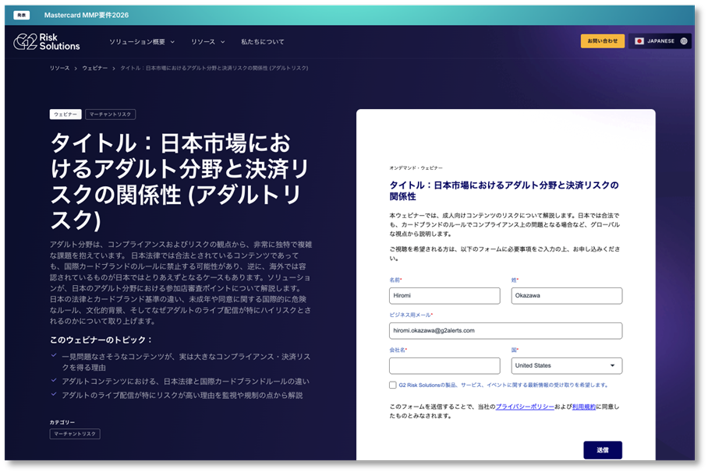
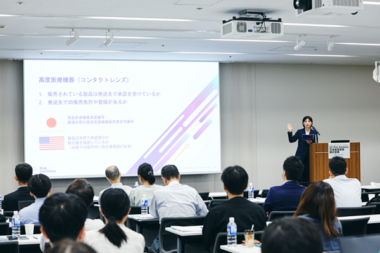
Today, we briefly touched on sectors such as pharmaceuticals, contact lenses, and gambling, but due to time constraints, we were unable to discuss each in depth. We offer free online seminars in Japanese. For the adult entertainment sector—which we were unable to cover today due to time limitations—we have a 30-minute on-demand seminar available to the public. If you are interested, please email us and we will send you the link.

■Contact
Information  G2 Risk Solutions
Address: 111 Anza Blvd, Burlingame, CA 94010, USA
URL: https://g2risksolutions.com
Email: japan@g2risksolutions.com