October 23, 2026, 7:40 a.m. (JST)
[Japan] GlobalPlatform (GP), an international standards organization for smart cards and secure elements, promotes the standardization of secure components—including Secure Elements and TEEs (Trusted Execution Environments), which are widely used in mobile payments—and supports the trust infrastructure for digital wallets and digital IDs.In this presentation, we will explore GP’s role and history before introducing its latest initiatives and technological trends. (Excerpt from a presentation at the “Payment Security Forum 2026 Fall” held on September 25, 2026)
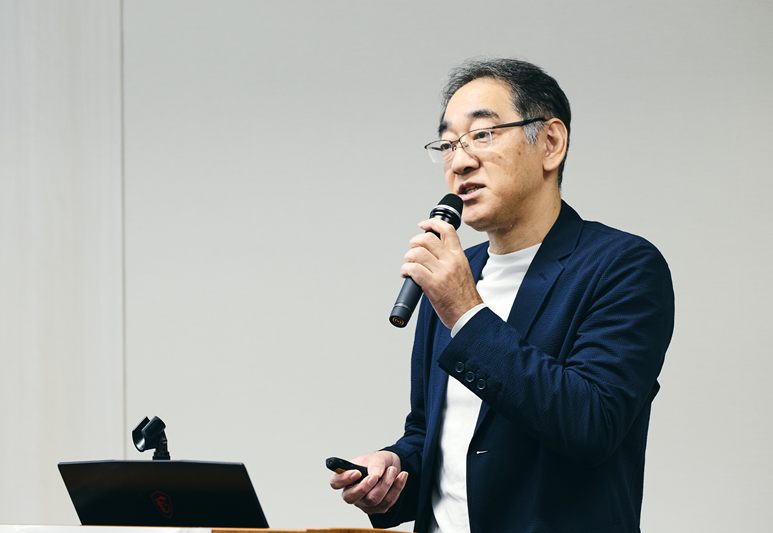
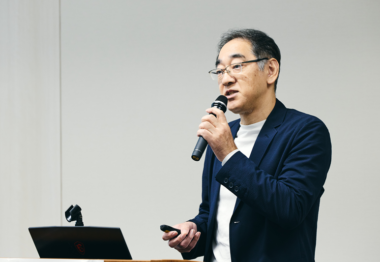
Mr. Takahide Kadoyama, Chair of the GlobalPlatform Japan Task Force
Adoption rate in smartphones in Japan is nearly 100%
Secure elements utilizing GP technology
My name is Takahide Kadoyama, Chair of the GlobalPlatform Japan Task Force’s Japan Branch. Today, I will be speaking on the topic, “GlobalPlatform: Underpinning ‘Trust’ in Payments.”
You may not be familiar with GlobalPlatform (GP), but you use its technology in your daily lives. I would like to focus specifically on the perspective of payments. The PCI SSC, which spoke before me, is a standards organization, and GP is also a standards organization.
To put it simply, GP is an organization that standardizes secure technologies and ecosystems designed to underpin the trust in digital services, including payments. In terms of technology, secure elements—specifically semiconductor chips—are embedded in the smartphones you all use.
In Japan, the adoption rate of these secure elements is nearly 100%. Such a high adoption rate is extremely rare, making Japan a very unique market. In addition to these semiconductor chips and secure elements, there are core technologies such as TEE and HSM (Hardware Security Modules), and we are developing standards for these as well.Furthermore, we collaborate with organizations such as EMVCo—which operates certification programs and establishes and manages international technical standards (EMV standards) for IC cards and payment terminals—the GSMA (Global System for Mobile Communications Association), and FIDO, an organization dedicated to promoting passwordless authentication standards.
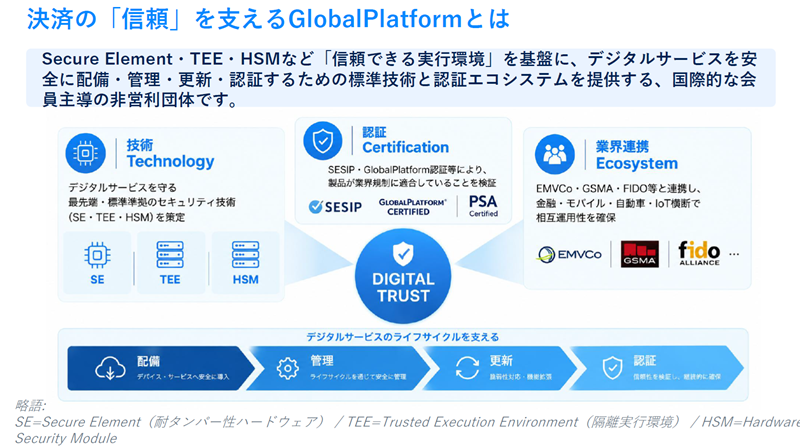
GP
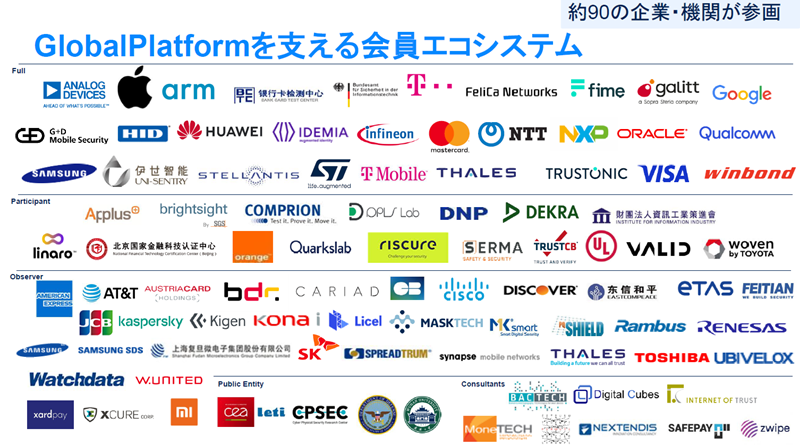
, with approximately 90 participating companies and organizations Supporting 96% of global in-person card transactions
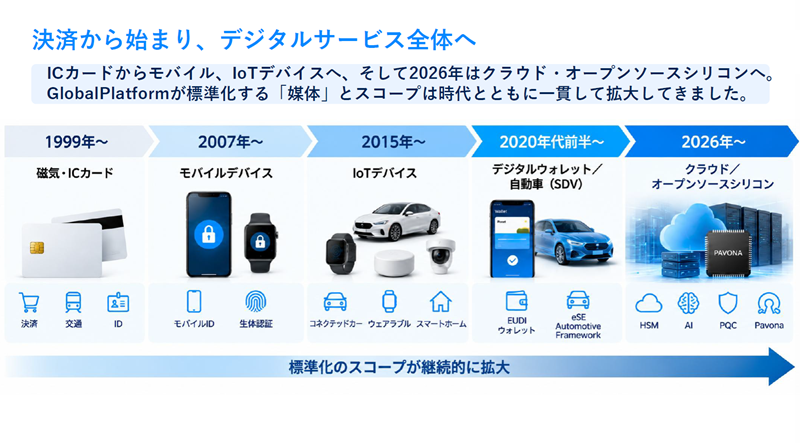
Looking back at the history of GlobalPlatform, around 1999, payments were already one of its use cases. Starting with magnetic stripe cards and contact cards, secure elements have since been incorporated into mobile devices and mobile wallets.
This has further evolved into the Internet of Things (IoT), expanding into automotive applications—such as connected cars and Software-Defined Vehicles (SDVs)—and has also extended to digital wallets. Furthermore, it has expanded to include cloud-based open-source silicon, all supported by GP’s technology.
In terms of numbers, there have been a cumulative total of 100 billion deployments of GP technology. While there are impressive figures—such as 89 billion secure element chips shipped and 14.7 billion GP-compliant bank cards in circulation—you don’t need to memorize them. If there’s one number to remember, it’s 96%.GP technology underpins 96% of global in-person card transactions.
These are the members of the GP, with approximately 90 companies and organizations participating. A wide range of stakeholders are involved, including chip vendors, card vendors, mobile providers, payment schemes, card brands, and laboratories.
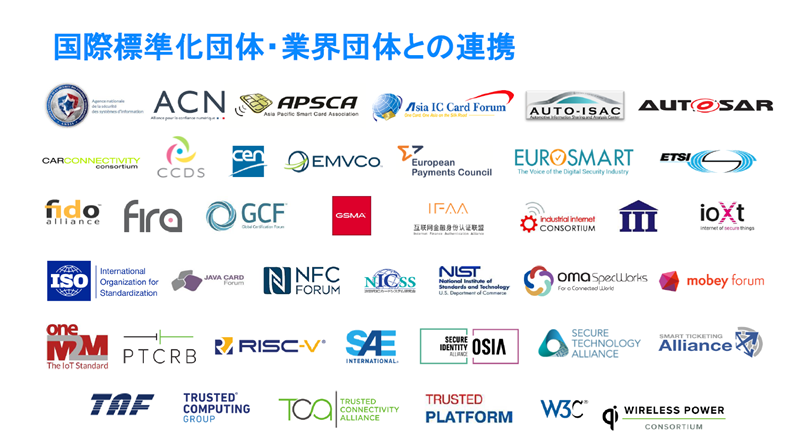
EMV refers to the international standard for IC chips embedded in credit cards and payment terminals. The most important aspect of payment processing is advancing EMV adoption.We have formed alliances with organizations focused on physical interfaces, such as EMV and the NFC Forum (a non-profit international industry organization that promotes the adoption of Near Field Communication (NFC) technology, standardizes technical specifications, and establishes certification systems).
There is also the Fira Consortium (a non-profit industry organization that promotes the adoption and standardization of ultra-wideband wireless communication technology).Recently, JR East has begun a pilot program for “walk-through” ticket gates—essentially, passing through the gates without having to tap a card. In the financial industry as well, companies such as JCB and Resona Bank are working to roll out contactless payment systems.The technology behind this is Ultra-Wideband (UWB) wireless communication. This is touted as the next-generation interface following NFC, and Fira is responsible for the technology in this area. However, GP handles the security aspects. We are currently in the process of finalizing the interface specifications.
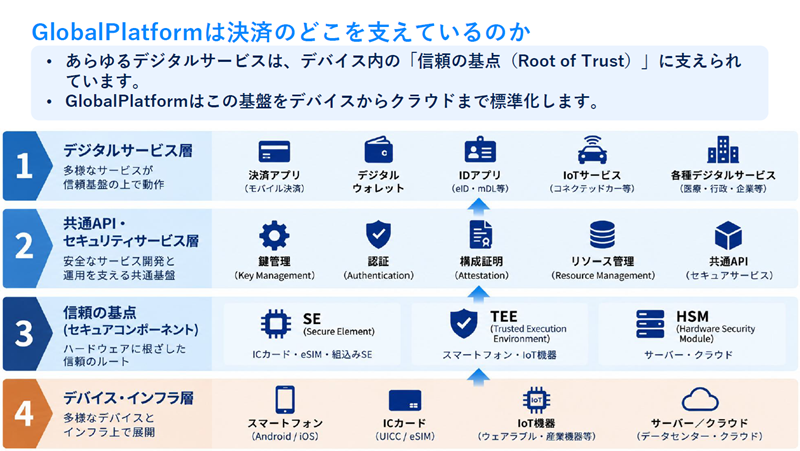
As for where GP’s technology supports the payment process, at the digital service layer, there are payment apps and mobile payments. Behind the scenes, GP handles key management, authentication, attestation, and components such as secure elements and TEE—essentially, GP manages the invisible aspects of the system.
Another Pillar
Supporting Payments: Providing Evaluation and Certification Programs
Another pillar supporting trust in payments is evaluation and certification. We are steadily proceeding with the development of specifications. Vendors use these specifications to implement their solutions and bring them to market, but before that, GP provides a mechanism and program to evaluate whether the products have been developed correctly.
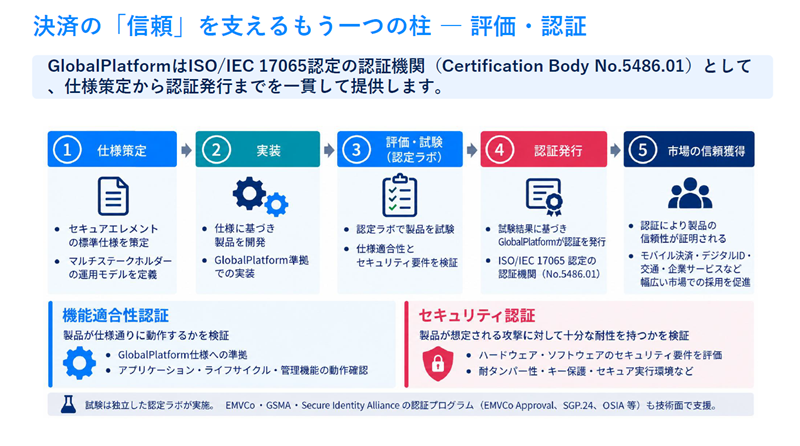
Incidentally, Japan also has an evaluation program related to IoT: JC-STAR, led by the IPA (Information-technology Promotion Agency, Japan). While this is a domestic scheme, GP also maintains a global evaluation program, and we are currently working on mapping the two.
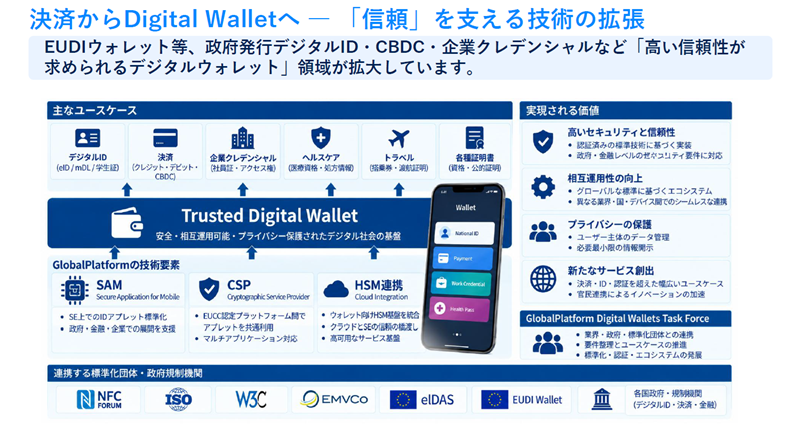
When considering the future of payments, digital wallets may be the first thing that comes to mind. In terms of identification, credentials are stored within smartphones.The technologies used here include SAM (Secure Application Mobile) and CSP (Cryptographic Service Provider), which act as a layer bridging the application layer and the semiconductor secure element. These are being developed with the aim of efficiently managing security keys and other elements.
As for the IoT, I believe NFC-based payments have been the mainstream method until now. However, methods using Wi-Fi, Bluetooth, and other technologies not specifically designed for payments are emerging, and we are currently discussing and defining how to ensure security in these scenarios.
In the automotive sector, cars are essentially like computers on wheels, and secure elements are used extensively in this context.Connected cars are one obvious example, but we’re also seeing a trend toward “in-car payments,” where the car itself functions like a smartphone. This is a use case where the car itself becomes the payment terminal—without the need to produce cash or even take out a smartphone. Security is, of course, paramount in this context, and that’s where GP comes in.
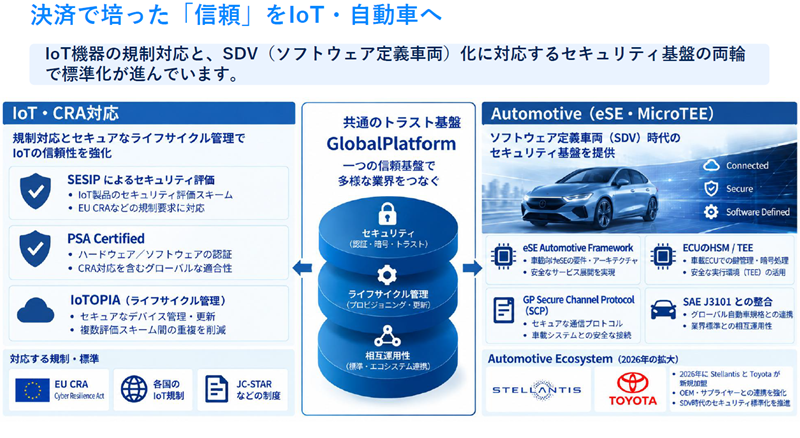
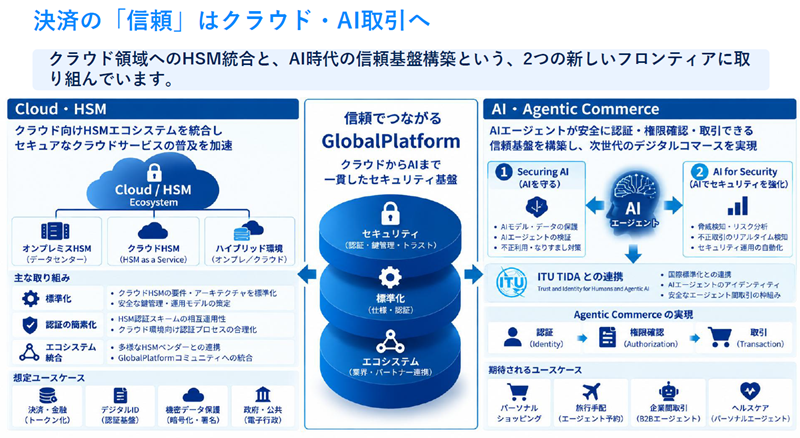
While payment methods have traditionally evolved through cards and mobile devices, the trend is now shifting toward cloud-based solutions. The most critical factor here is, of course, security, and the challenge lies in how to protect and manage encryption keys. GP is leading these efforts.
Until now, the payment process has been handled by humans, but in the future, AI agents may be the ones performing payment transactions and managing operations. Within GP, we are discussing how to ensure security in such scenarios.
Role
of the GP Japan Task Force Serving as a bridge between Japanese and global specification development
GP is also addressing PQC (post-quantum cryptography).In Japan, the adoption of PQC appears to be progressing primarily in the financial sector, but its deployment in IoT is also gaining momentum. However, the security levels required in the financial sector differ slightly from those required in IoT. Consequently, there is a discussion about whether security standards should be adjusted accordingly, and we are working with organizations such as NIST to advance standardization.
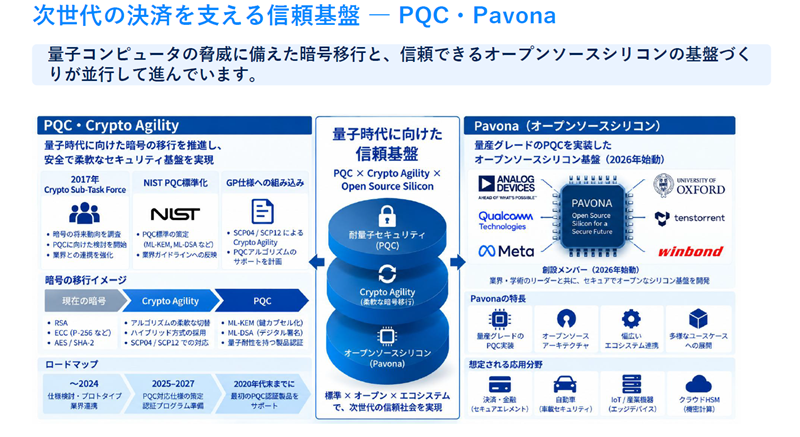
Open-source silicon is another emerging trend, with efforts underway to make silicon chips, IP, and reference designs openly available so that everyone can use them efficiently.
In GP’s organizational structure, the Technical Committee reports to the Board of Directors. It includes groups focused on secure elements and security evaluation, and beneath them are task forces organized by use cases, such as automotive and digital wallets. As a regional task force, I lead the Japan Task Force.
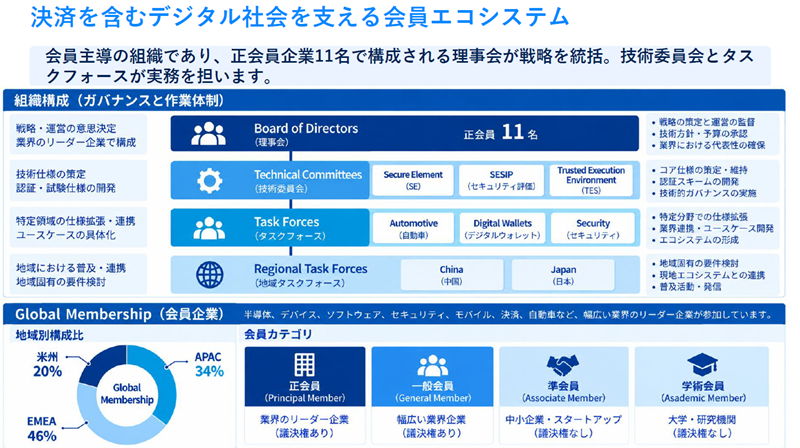
The role of the Japan Task Force is to bring specifications formulated globally to Japan and promote their adoption by Japanese companies. Conversely, it serves as a bridge to provide global input on Japanese use cases, helping to inform the development of specifications.
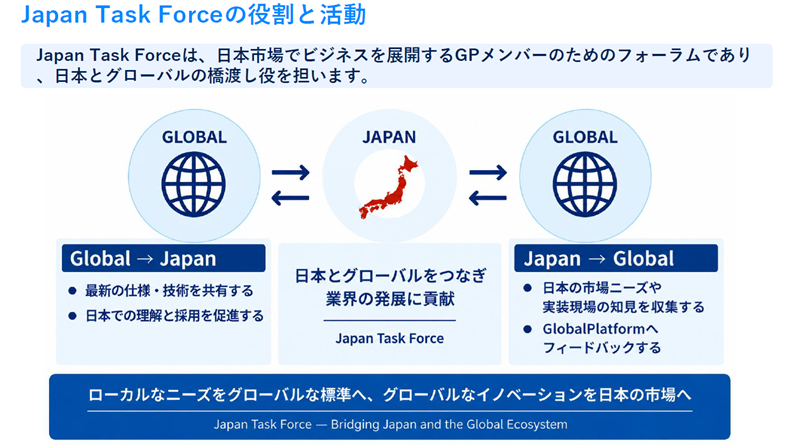
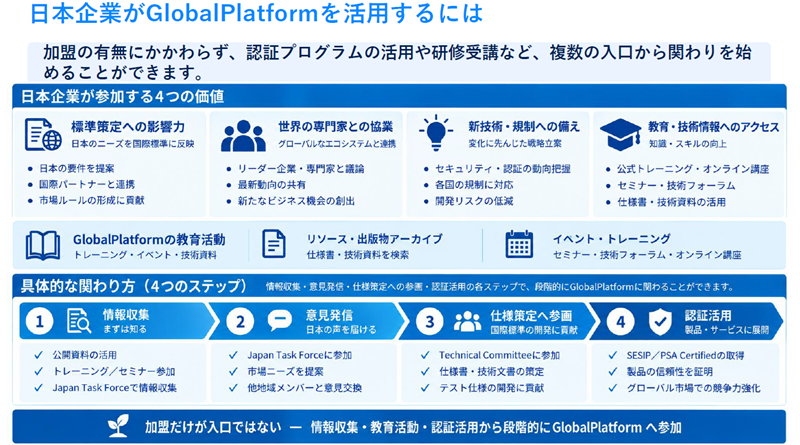
To utilize GlobalPlatform, whether you are a member or not, there are certification programs, workshops, and training sessions available, and we hope you will take advantage of them. You’re welcome to start by gathering information. You’re also welcome to simply exchange ideas. Please feel free to reach out to us.
To wrap up, GlobalPlatform remains committed to upholding trust in payments. Starting with traditional secure element chips, TEEs, and HSMs, we have established evaluation technologies and programs. We are leveraging these to contribute to the development of the entire lifecycle, and moving forward, we aim to expand our use cases to include digital wallets, IoT, the automotive sector, and more.
This has been a brief overview, but that concludes my presentation.