November 12, 2026, 3:11 p.m. (JST)
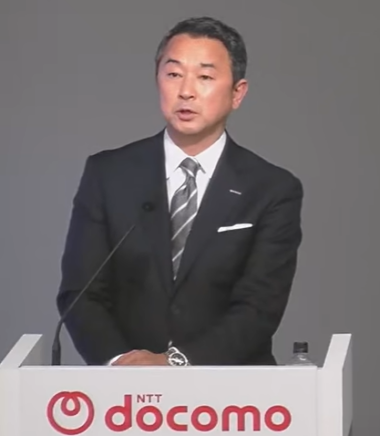
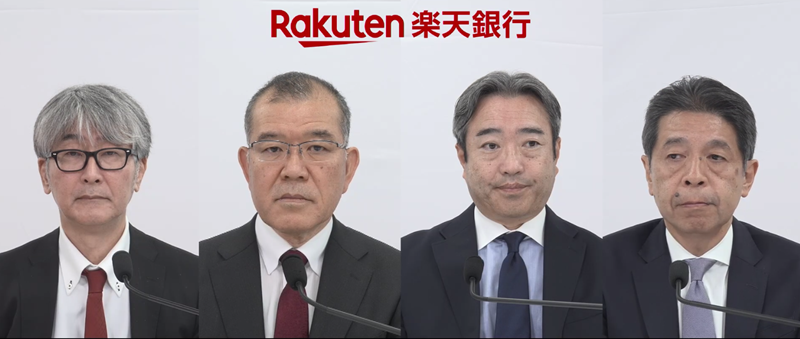
[Japan] On November 11, 2026, Rakuten Bank held a financial results briefing for the second quarter of the fiscal year ending March 2027. The briefing was attended by four executives: Tomotaka Higashibayashi, President and CEO of Rakuten Bank; Naoki Mizuguchi, Executive Vice President; Koichi Nakamura, President and CEO of Rakuten Card; andYuji Kusunoki, President and CEO of Rakuten Securities—provided an overview of the financial results, full-year earnings forecasts, and the synergistic effects of the fintech business reorganization that began in October.
The Birth
of the New Rakuten Bank Group Record-High Interim Profits
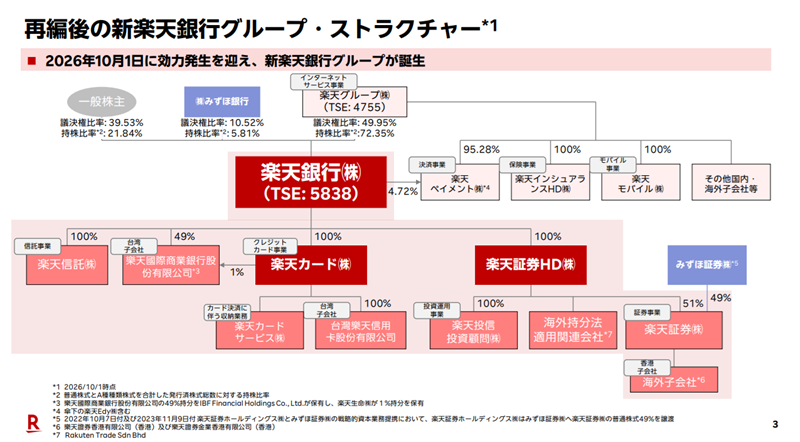
First, the fintech reorganization took effect on October 1, 2026, and the new Rakuten Bank Group was established as originally scheduled. “Going forward, we intend to further promote cross-usage of services centered on Rakuten Bank, Rakuten Securities, and Rakuten Card, and aim for further growth through the creation of synergies,” said Mr. Higashibayashi.
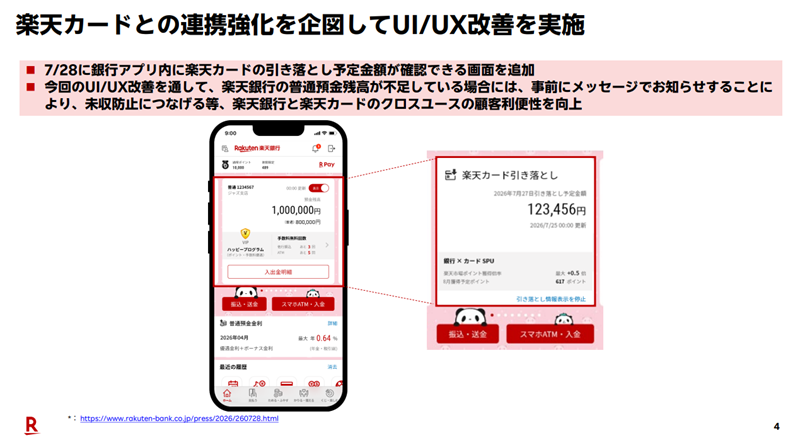
As key topics for this session, the company reported on new features resulting from UI/UX improvements within the Rakuten app, as well as measures to promote cross-usage with Rakuten Card.In the May and June financial results for the fiscal year ending March 2026, we highlighted a feature that displays ordinary deposit balances within the Rakuten Card app; this time, however, we have added a feature that displays scheduled Rakuten Card debit amounts within the Rakuten Bank app.
In addition, the company began offering “DUNK,” a sports lottery focused on basketball sold by the Japan Sports Promotion Center, simultaneously with its launch on September 15.While there have not been many opportunities to promote sports lotteries and similar products to general users in the past, the company states that by expanding its promotional budget for this new service, it has been able to create opportunities to reach a wider audience. The company aims to use this as a catalyst to accelerate the growth of non-interest income.
For the second-quarter financial results for the fiscal year ending March 2027, since the effective date of the reorganization is October 1, the interim results for April through June reflect Rakuten Bank’s performance.
Key financial highlights include double-digit growth in deposit balances driven by a strategy to attract deposits tailored to individual spending needs. As a result of asset under management growing at an even faster pace, the bank achieved record-high interim profits despite making selective and proactive investments in marketing,systems, and human resources—all aimed at expanding the customer base for future growth—the company still achieved a record-high interim profit.
Account numbers continue
to grow at a pace exceeding 1 million Full-Year Consolidated Earnings Forecast Revised Upward
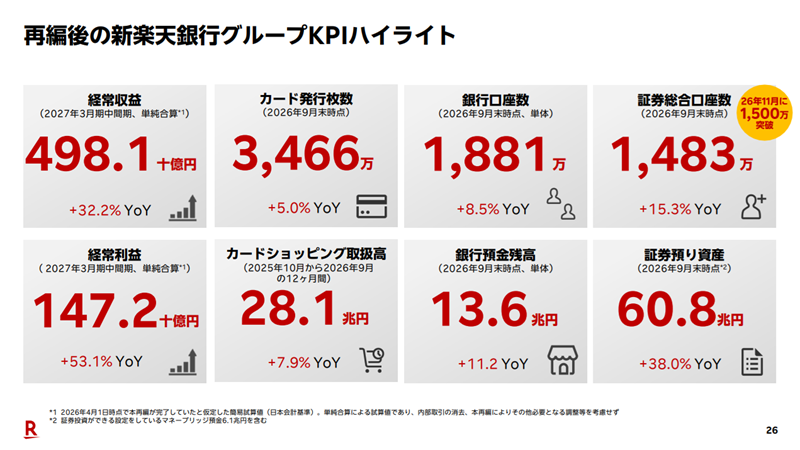
Consolidated ordinary revenue was 163.8 billion yen (up 38.4% year-on-year), consolidated ordinary profit was 63.0 billion yen (up 30.6% year-on-year), and the capital adequacy ratio stood at 11.3%, maintaining sufficient momentum toward financial business restructuring.ROE on an annualized basis for the interim period was 20%, an increase of 0.8 percentage points year-over-year.
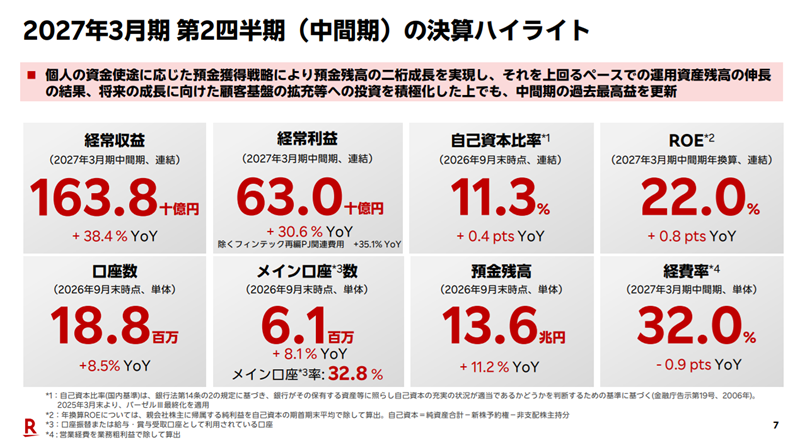
The number of accounts stood at 18.18 million (up 8.5% year-on-year), and the number of primary accounts exceeded 6.1 million as of the end of September.Deposit balances stood at 13.6 trillion yen (up 11.2% year-on-year), maintaining strong growth even as competition for deposits intensified.By strengthening promotional campaigns aimed at attracting direct debits and salary and bonus payments—with the goal of increasing the number of primary accounts—the bank promoted conversions to primary accounts, resulting in a steady increase in the net number of primary accounts in the second quarter compared to the first quarter.
Furthermore, based on the interim results and the policy interest rate hike in September 2026, the full-year consolidated earnings forecast (announced in August) has been revised upward.(*Assumptions: Policy interest rate of 1.25% (does not factor in additional rate hikes; earnings forecasts for Rakuten Card and Rakuten Securities Holdings resulting from the fintech reorganization are excluded).
Synergies
to Offset Headwinds from the Fintech Restructuring Promoting Cross-Usage and Main Account Adoption to Boost ARPU
Regarding the fintech reorganization, the Group will enhance resilience to changes in the macroeconomic environment through integrated ALM (Asset and Liability Management) operations. This will enable the Group to achieve business growth by better leveraging the tailwinds from each company, while also expanding investment opportunities for Rakuten Bank as a standalone entity.Furthermore, we aim to expand both interest and non-interest income through an increase in the number of primary accounts.
In the current macroeconomic environment, there are four major trends: rising inflation, the resulting increase in interest rates, the advancement of cashless payments, and the promotion of Japan as a nation focused on asset management. These trends represent different tailwinds and headwinds for each Group company.
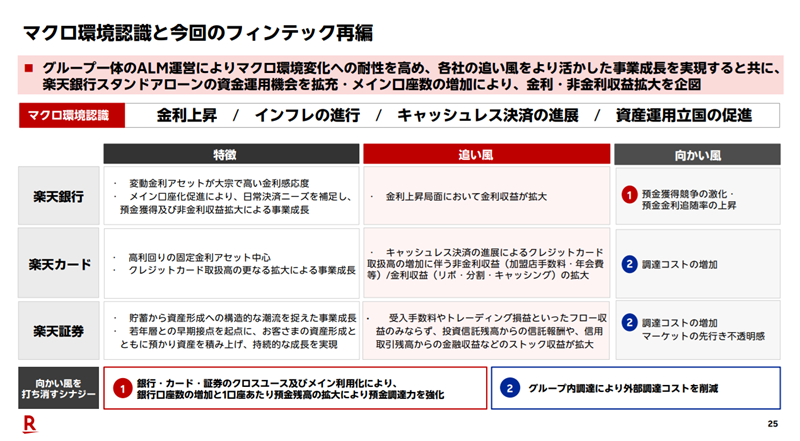
Rakuten Bank’s current strategy is to maintain a high proportion of variable-rate assets within its assets under management, while also capturing daily settlement needs by promoting the use of its accounts as primary accounts, thereby driving business growth through deposit acquisition and the expansion of non-interest income. Rising interest rates are having a positive effect on Rakuten Bank by increasing its interest income.On the other hand, this trend is intensifying competition for deposits and driving up the rate at which banks follow deposit interest rates.
Rakuten Card holds the top position in Japan for credit card transaction volume and is aiming for business growth through further expansion.Driven by the growth of cashless payments, credit card transaction volume is increasing; as a result, balances for revolving credit, installment plans, and cash advances are expected to rise, leading to growth in both non-interest income (such as Merchant Discount Rate) and interest income. On the other hand, rising interest rates are acting as a headwind, driving up funding costs.
As for Rakuten Securities, against the backdrop of a structural shift from savings to asset accumulation, the company is achieving sustainable growth by building up assets under management alongside its customers’ asset accumulation, starting with early engagement—particularly with younger customers.
The shift in individual financial assets from savings to investments is acting as a tailwind, driving growth not only in flow revenues—such as commission income and trading gains—but also in stock revenues, including management fees from mutual fund balances and financial income from margin trading.On the other hand, rising interest rates are increasing funding costs and creating uncertainty about market prospects, which also acts as a headwind.
Amid these conditions, the Group plans to offset the negative impact of these headwinds on individual companies through Group synergies. Furthermore, the Group believes that operating as a unified entity will enhance resilience to changes in the macroeconomic environment and enable business growth that better capitalizes on the tailwinds facing each company.
At the same time, Rakuten Bank, on a standalone basis, will expand its investment opportunities and aim to grow both interest and non-interest income through an increase in the number of primary accounts.
Key performance indicator (KPI) highlights for the new Rakuten Bank Group include the following customer base figures: for credit cards, 34.66 million cards issued with a net annual increase of 1.65 million; for Rakuten Bank, 18.81 million accounts witha net annual increase of 1.48 million; and for securities, 14.83 million comprehensive accounts with a net annual increase of 1.97 million—meaning each of the three companies has achieved customer base growth exceeding 1 million.
Moving forward, building on this solid customer base, the group has reportedly begun considering—as part of preparations for its medium-term plan—the establishment of new collaborative targets. These will involve treating deposit balances and securities assets under custody as integrated group assets, as well as working together as a unified card-and-bank entity to capture individual borrowing needs.Through comprehensive KPI management, the group aims to accelerate growth across the entire group without being significantly affected by changes in the macroeconomic environment.
In the consolidated earnings forecast for the fiscal year ending March 2027 for the new Rakuten Bank Group following the reorganization, the company announced consolidated earnings forecasts for Rakuten Card and Rakuten Securities that include only the six-month period from October through March 2027.For the fiscal year ending March 2027, consolidated ordinary revenue after eliminations is projected to be 646.7 billion yen, consolidated ordinary profit 189.4 billion yen, and net income attributable to the parent company 115.0 billion yen.Note that the standalone card business figures do not include real estate-related operations—some of which are subject to restructuring and others that are not—while the consolidated figures for the securities holding company do not include Rakuten Wallet, which is also excluded from the restructuring.
Furthermore, regarding Rakuten Securities Holdings, the company stated that because the securities industry is particularly susceptible to market fluctuations, it is difficult to formulate highly accurate forecasts; therefore, the projections were prepared based on certain assumptions.
As for synergies targeting individual customers, with the customer bases of Rakuten Bank, Rakuten Card, and Rakuten Securities currently expanding at a pace of over 1 million per year, the Group aims to improve ARPU across the entire Group by promoting cross-usage and primary use of the three services and enhancing customer engagement.
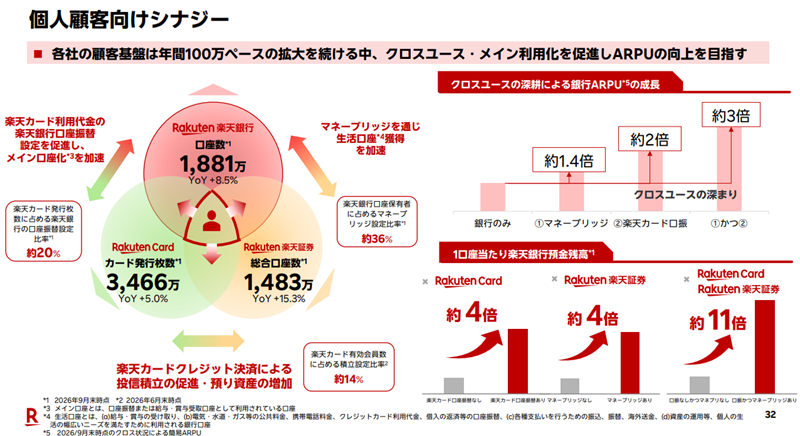
Going forward, the Group plans to further deepen its analysis of banking, credit card, and securities customers while taking a unified approach across payments, savings, and asset management to develop marketing strategies aimed at increasing ARPU per customer across the entire Group.
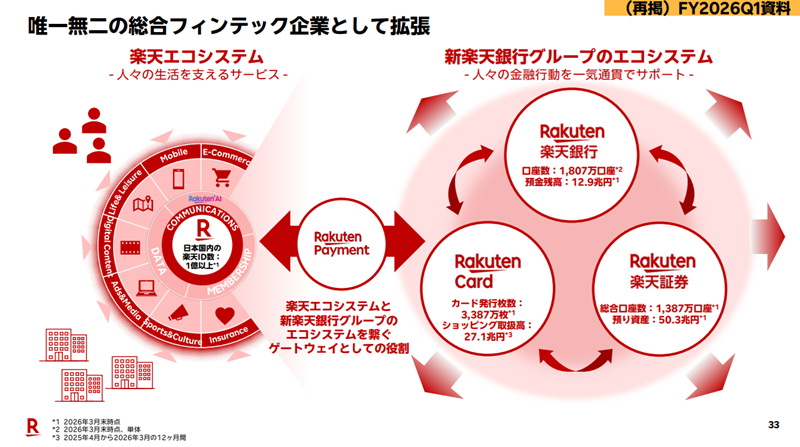
While aiming to realize synergies of at least 85 billion yen on an ordinary profit basis by the fiscal year ending March 2030 through financial synergies and synergies targeting individual customers, the group also aims to further increase the total amount of synergies by leveraging B2B synergies and the utilization of data and technology.