November 10, 2026, 8:53 a.m. (JST)
[Japan]Moneytree, a consolidated subsidiary of Mitsubishi UFJ Financial Group (MUFG) and Mitsubishi UFJ Bank, has launched a “Finance × Wellness” feature through the integration of its asset management service “Moneytree” with Google Health, as part of a new initiative to connect its comprehensive life-stage financial service “Emutt” with everyday life.The two companies held a press briefing at MUFG Stadium on November 5.

MUFG’s Efforts to Integrate Services Are Off to a Strong
Start Strategic Partnership with Google
On May 7, 2026, MUFG announced a strategic partnership with Google in the retail sector. As part of its wellness initiatives, the company outlined plans to integrate wellness features into “Moneytree” and offer a new service that combines these features with household budgeting.Here, we introduce the “Finance × Wellness” initiative that brings this vision to life. Starting November 6, 2026, Mitsubishi UFJ Bank and Moneytree have jointly launched the “Finance × Wellness” campaign titled “Build a Future of ‘I Can’,” designed to support those starting out.Among those who meet the eligibility requirements, 10,000 winners will be selected by lottery to receive Google’s wearable device, the “Google Fitbit Air,” and a one-year subscription to Moneytree’s paid plan, “Moneytree Grow.”
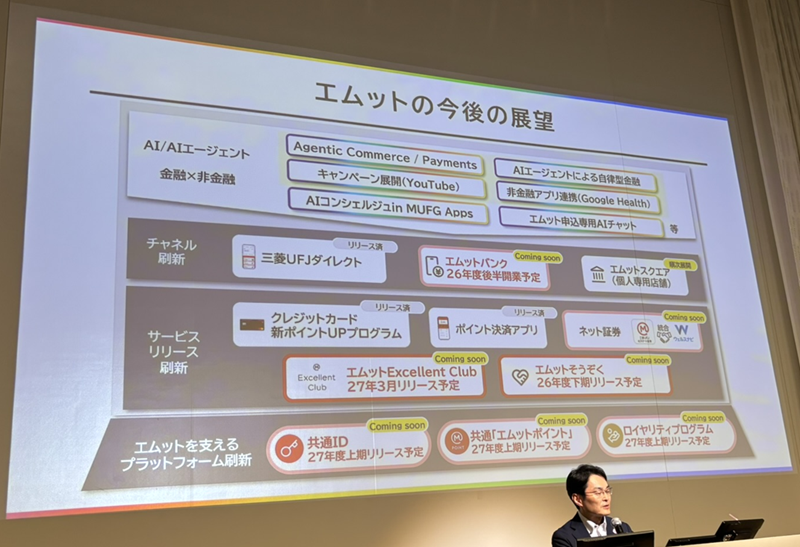
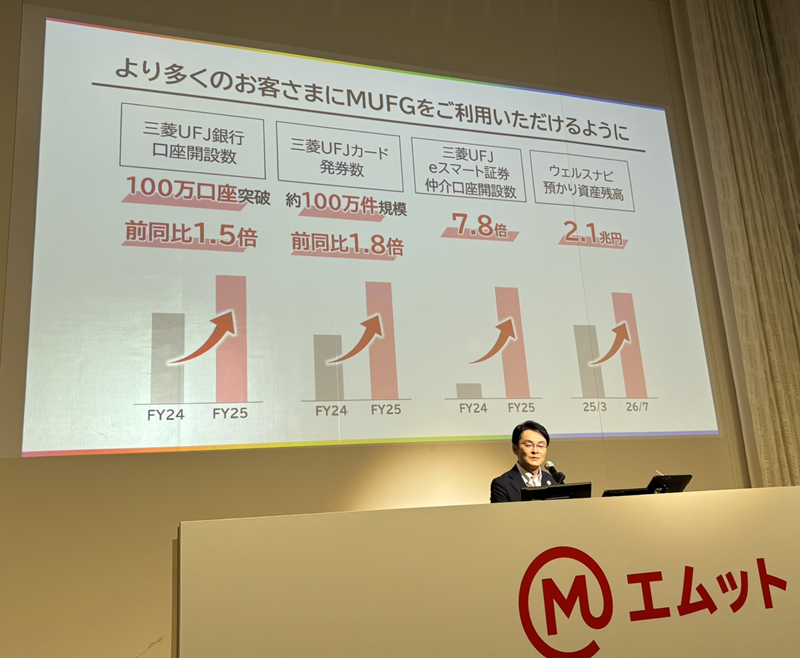
Under the slogan “Everything About Money, All in One,” Emutt has been reconnecting all of MUFG’s services and expanding each one to help customers feel more positive about money, making it more accessible and approachable. These efforts are beginning to show results.Tadashi Yamamoto, Senior Managing Executive Officer of Mitsubishi UFJ Financial Group, Head of the Retail & Digital Business Division, and Group CDTO, stated, “Account openings have increased 1.5-fold, card issuances 1.8-fold, securities account openings approximately 8-fold, andassets under management at WealthNavi, which we made a wholly-owned subsidiary, have exceeded 2 trillion yen,” he said.
As part of Emutt’s continued evolution, the company announced a strategic partnership with Google in the retail sector this past May. Through this partnership, the company aims to create a world where users naturally connect with Emutt in various aspects of their daily lives and life stages via AI agents, data marketing, and the integration of financial and non-financial services.
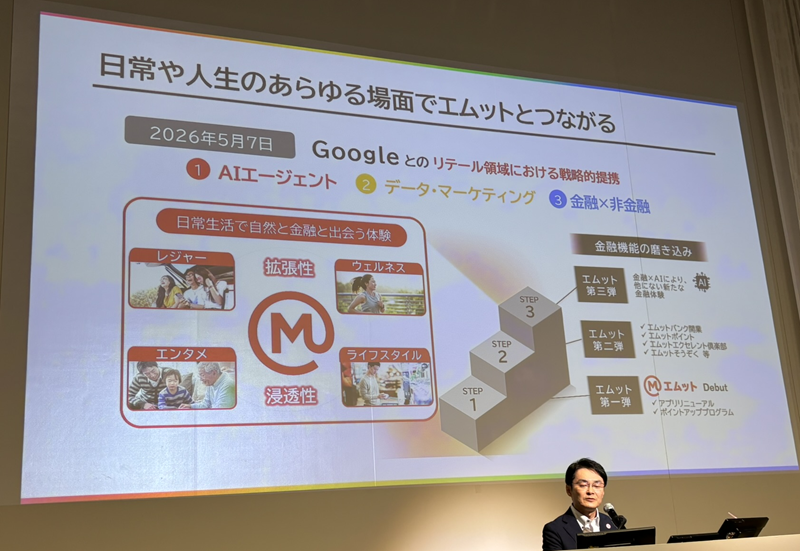
“Connecting Finance and Daily Life” Supporting a Better Daily Life Through
Finance × Wellness
This latest initiative serves to bring this vision to life. Until now, Emutt has connected MUFG’s various financial services, guided by the keywords of convenience, profitability, and innovation.“At the same time, we believe it is essential to evolve Emutt into a presence that allows customers to continuously recognize the value of finance in their daily lives—whether in health, travel, shopping, or other areas—in order to truly support them throughout their lives,” said Mr. Yamamoto.
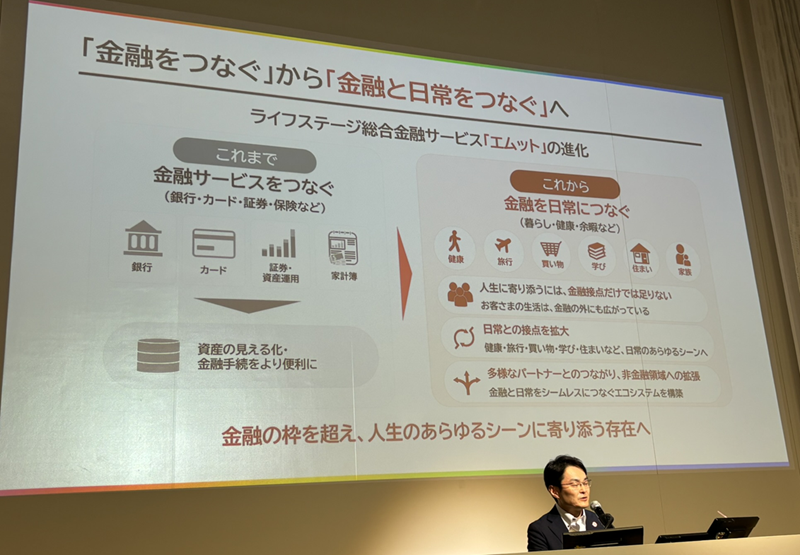
In other words, by collaborating with diverse partners and expanding the value we provide into non-financial areas, we aim to broaden our points of contact within users’ daily lives. We aim to evolve into a presence that connects finance with every aspect of users’ daily lives and their overall lives. As the first step toward this goal, we have focused on wellness.
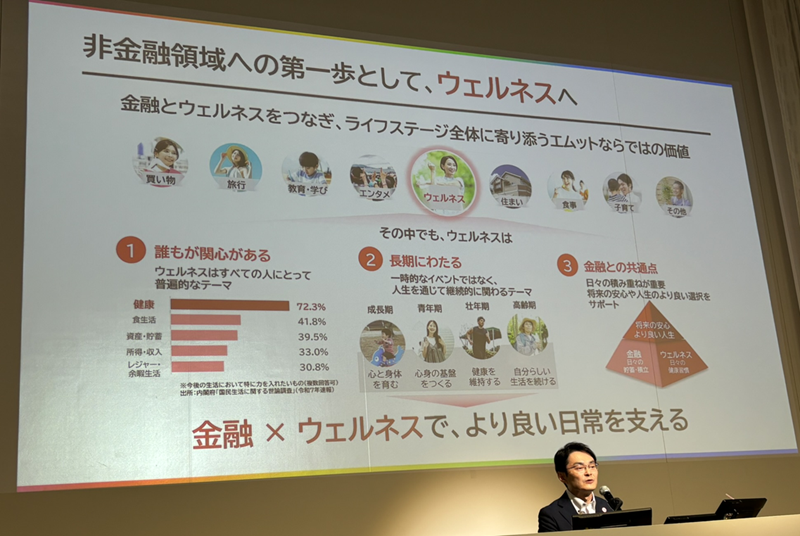
According to a survey by the Cabinet Office, more than 70 percent of people say they are interested in health. Furthermore, wellness is a theme that people engage with continuously throughout their lives.Furthermore, the company noted that both finance and wellness rely on small, daily efforts, and in the sense that they lead to peace of mind for the future and better choices that reflect one’s individuality, these are areas with many commonalities. By connecting finance and wellness, the company aims to support people through every stage of their lives and help them lead better daily lives. This is the reason behind the company’s current initiative to pursue “Finance × Wellness.”
Access
to Wellness Data and Personal Household Financial Data Providing New Insights Through AI
We are currently planning a series of stories spanning Phases 1 through 4. Our envisioned framework is as follows: In Phase 1, users gain a simultaneous understanding of their financial and wellness situations; in Phase 2, AI provides personalized insights tailored to each individual; in Phase 3, incentives are offered to support continued engagement; and in Phase 4, this expands to future choices and purchases.
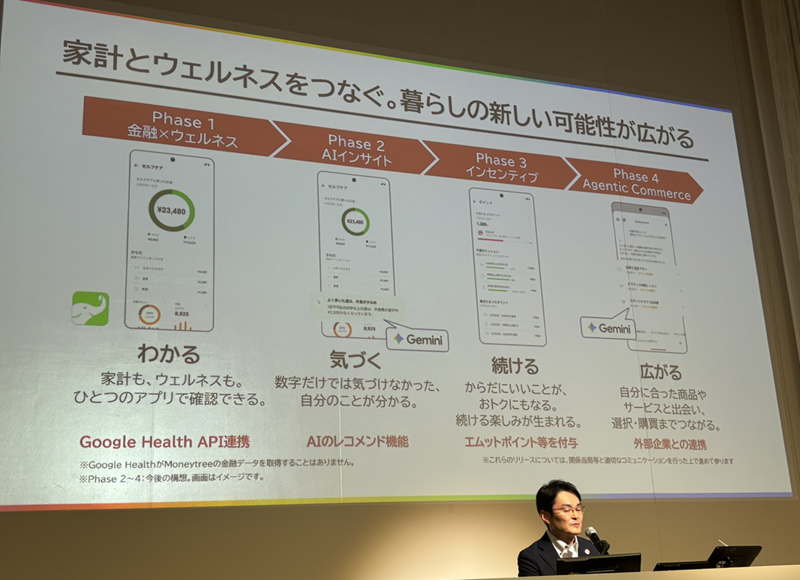
Specifically, in Phase 1, we’ll connect finances and wellness. While these two areas have often been viewed separately in the past, both can be vital elements supporting a person’s life and daily routine. By integrating with the Google Health API, users will be able to view their wellness data alongside their household financial data within the Moneytree app.
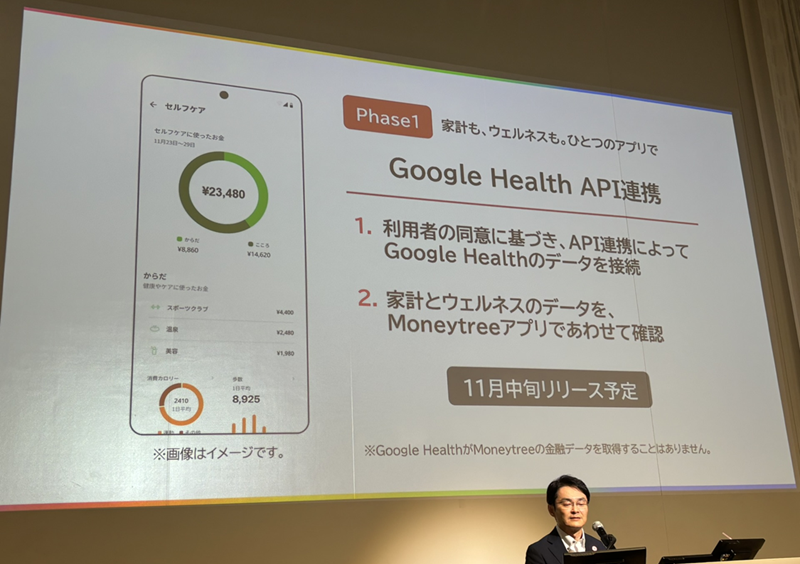
This feature is scheduled for release in late November. The Moneytree app—scheduled for release in late November—will allow users to view both their household finances and wellness data in a single app. In addition to the existing ability to check account information, expenses, assets, and investment status from various financial institutions, users will now be able to sync data with Google Health.Through this data integration, users can view their daily calorie consumption and see their step count displayed as a bar graph, allowing them to grasp their daily activity levels at a glance. It also visualizes sleep duration, enabling users to check both the length and quality of their sleep. “By viewing both household finances and wellness in a single app, users are sure to gain many valuable insights,” said Mr. Yamamoto.
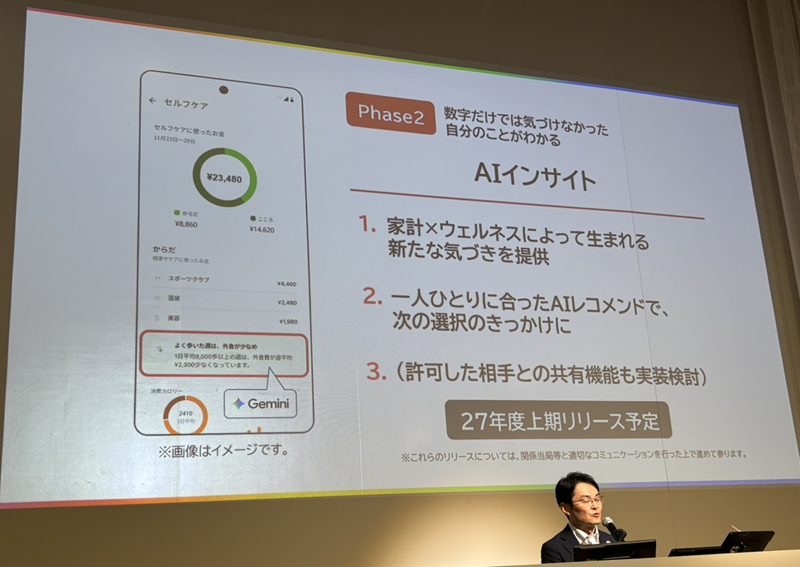
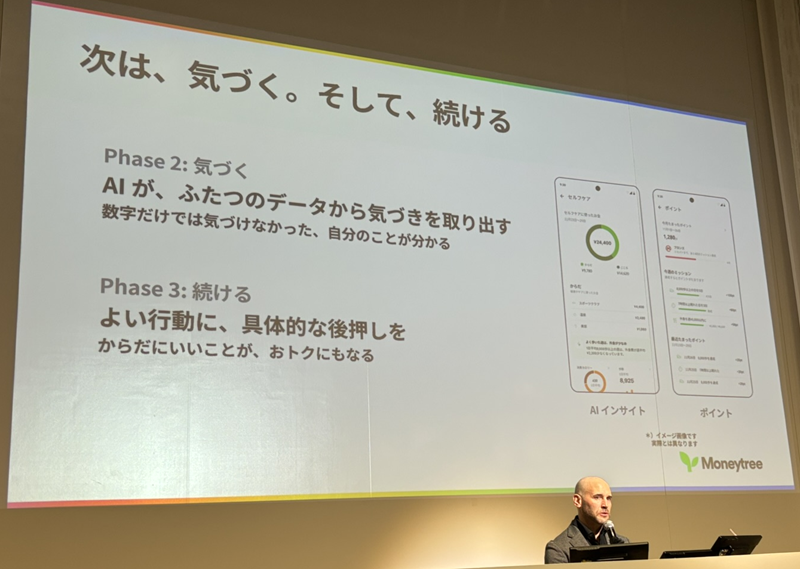
In Phase 2, the AI will identify trends arising from the combination of household finances and wellness and convey them clearly using language tailored to each individual. Furthermore, the company is considering a system that allows users to share these insights with family members and others, provided they give their permission. “The goal of Phase 2 is to provide opportunities for self-discovery,” said Mr. Yamamoto.This feature is scheduled for release in the first half of fiscal year 2027. Specifically, it will allow users to easily track trends in their household finances and wellness on a dashboard. For example, if someone who has started a gym subscription isn’t increasing their exercise volume, the AI will offer insights such as, “Why not start by exercising about once a week?”Furthermore, the company is considering offering hints to help users plan their next financial actions.
Offering
Emutt Points and Coupons Toward an Enhanced Payment Experience in Agentic Commerce
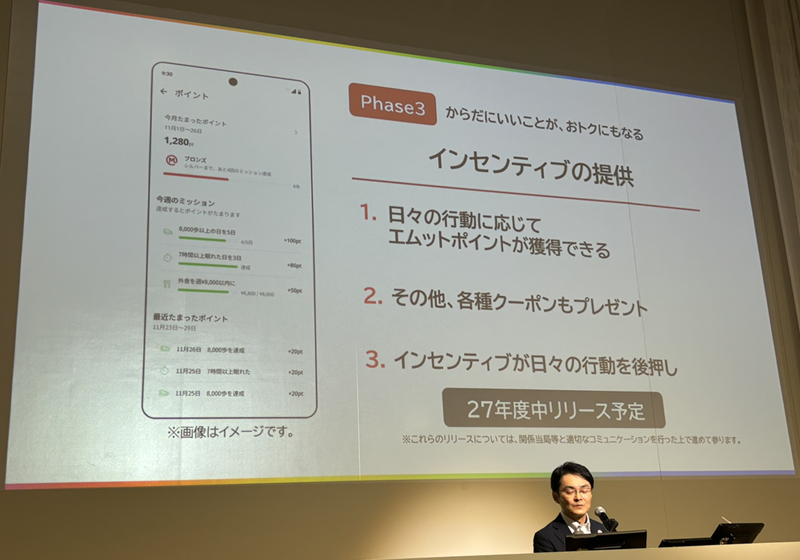
In Phase 3, we will translate the insights gained in Phase 2 into actual actions and help users maintain them. For example, by awarding incentives such as Emutt Points upon achieving goals, we aim to provide motivation for users to continue building better habits.This feature is scheduled for release during fiscal year 2027. Specifically, we plan to offer incentives that encourage consistency, such as awarding Emutt Points for achieving a weekly step goal of 100,000 steps.
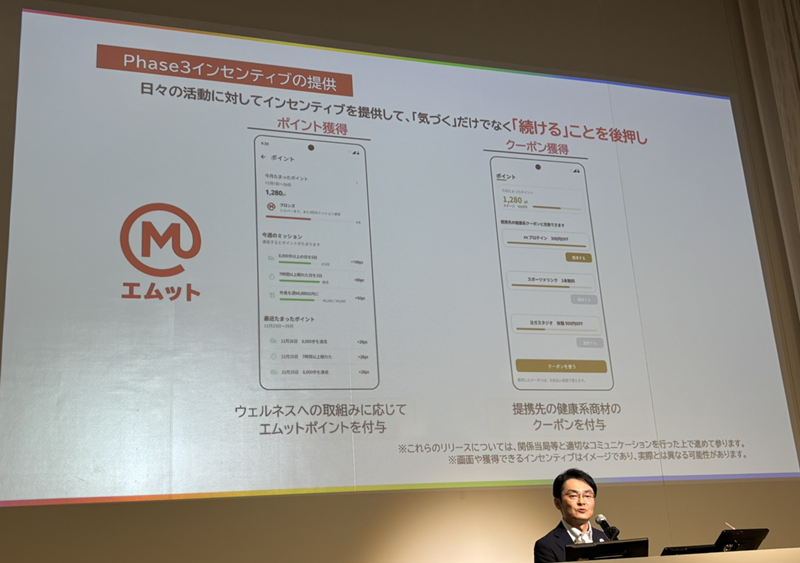
Insights lead to action, and value is returned for maintaining that action. By creating this cycle, we support users in continuing their actions without strain.
Furthermore, in Phase 4, the company envisions a world where AI recommends personalized purchases and experiences to users based on their insights and ongoing behavior. “This ties into the world of ‘Agentic Commerce’ that we introduced in our May announcement. We plan to release this feature during fiscal year 2028,” said Mr. Yamamoto.
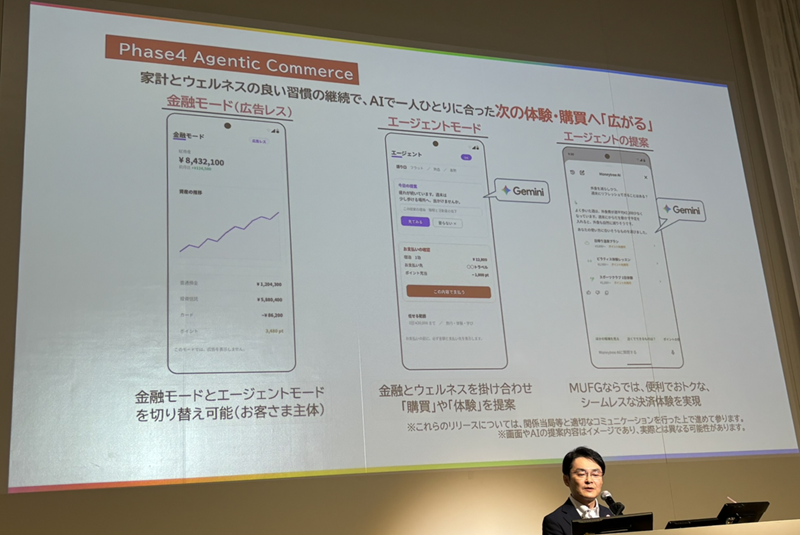
As a concrete example of this experience, the AI will present candidates for products and services aligned with users’ interests and preferences, allowing them to easily compare and evaluate options. “We are also envisioning an experience where the process can be seamlessly completed all the way through payment,” said Mr. Yamamoto.
On the other hand, users may not always want to receive such suggestions. The goal is to create a shopping experience where AI provides support only when and to the extent needed, allowing users to retain control.
Mr. Yamamoto noted that new possibilities arise by linking two sets of data: finance and wellness, as well as household finances and health. The AI will analyze the relationship between household finances and health, delivering new insights to each individual. These insights will then lead to behavioral changes.Points and special benefits will serve as incentives to keep users engaged, and in the future, the system will connect users with products and services tailored to their needs—guiding them from discovery through selection to purchase.
Leveraging
MUFG’s Three Strengths Expanding Household Management Features and the Rewards Program
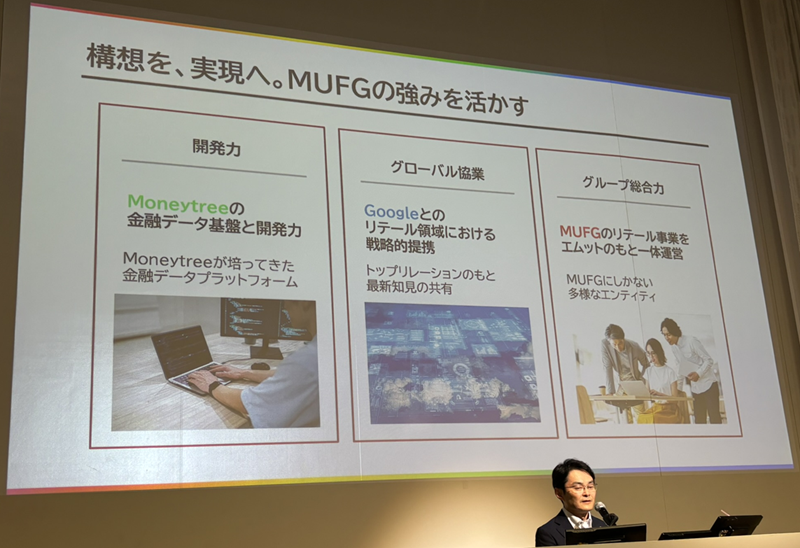
MUFG cited three key strengths: First, MoneyTree’s financial data infrastructure and development capabilities.The second is global collaboration; under a strategic partnership with Google in the retail sector, the company is advancing technical support and other initiatives. The third is the comprehensive strength of the MUFG Group. In particular, the Retail Digital Business Division has fundamentally strengthened integrated group operations.
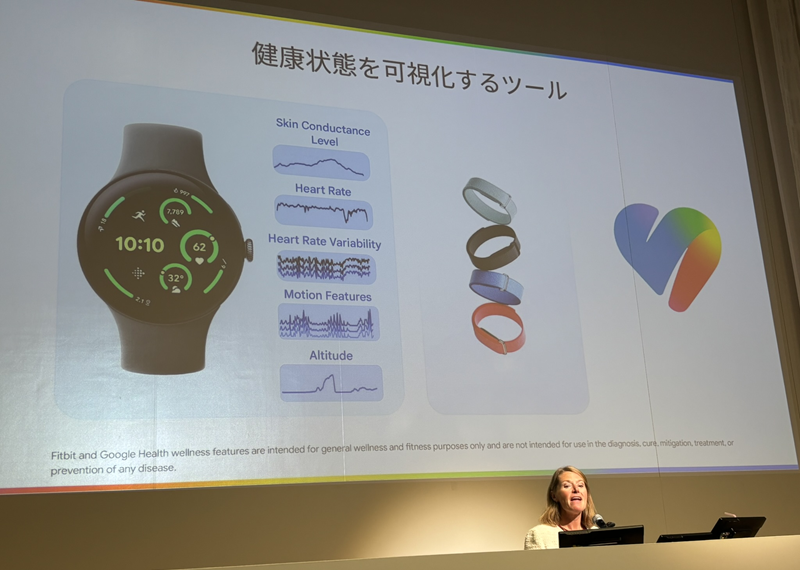
Amy McDonough, Managing Director of Strategic Health Solutions at Google, stated, “Through Google Fitbit and the Google Health API, we provide the foundation of wearable technology and a secure platform.This enables trusted partners such as MUFG and Moneytree to create new lifestyle experiences,” she said. The goal is to naturally encourage self-awareness through devices that can be comfortably worn on a daily basis, such as lightweight Fitbit devices and the Pixel Watch.These devices are equipped with AI based on Google’s “large-scale sensor model.” Trained on more than 40 million hours of sensor data, this AI transforms the constant stream of signals—such as heart rate, sleep quality, stress, and physical activity—into clear and intuitive insights.According to him, there are over 1 billion Google searches related to health per day, and health-related videos on YouTube have been viewed over 1 trillion times.
Seiji Umeda, Senior Executive Officer of the Sales Division at Google Cloud Japan G.K., stated that the company aims to support Agent-driven Commerce initiatives by focusing on three key areas: providing global insights, offering technical support for cutting-edge AI technologies such as Gemini, and ensuring financial-grade security and data governance.
According to Paul Chapman, CEO of MoneyTree, the company has supported healthy financial lifestyles and well-being based on privacy since its founding in 2012.Regarding the insights gained from this integration, the first is that different industries were able to work closely together. Banks, tech companies, and FinTech firms—all three parties—were able to move in the same direction and follow the same specifications.
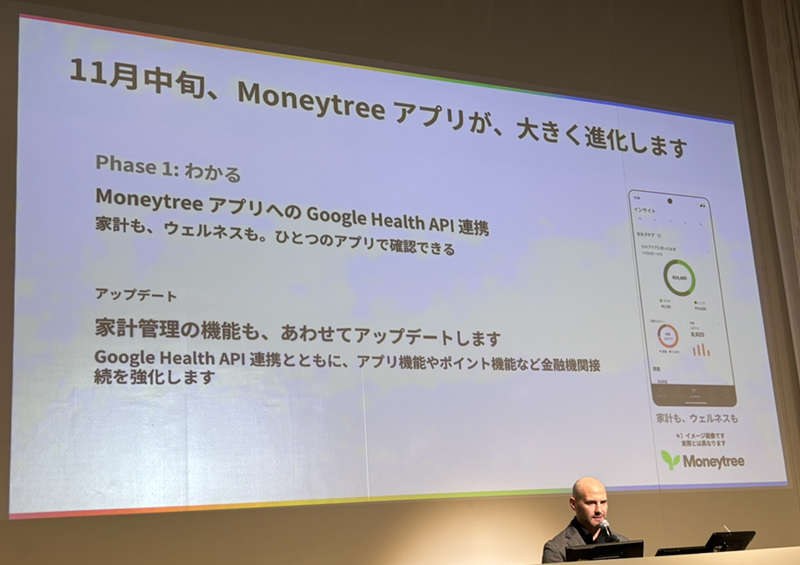
“Second, because we had 14 years’ worth of infrastructure in place, we were able to go from announcing the partnership to launching the service in just six months,” said Mr. Chapman. He explained that the framework for collaboration with financial institutions, the authentication infrastructure, security and auditing, incident response, and privacy-protecting operations were already in place; the only new component developed for this project was the wellness aspect.
Third, we made it possible to view financial and wellness data on the same timeline. “Connecting with financial institutions is something we’ve been refining since our founding. What took time this time was aligning data—which differed in units, update intervals, and granularity—into a format that made sense.“We will deliver the envisioned concept in a form that users can use with confidence by the promised deadline. We believe that is our role,” said Mr. Chapman. The November update to the Moneytree app will not only integrate the Google Health API but will also expand household budgeting features, the rewards program, and the infrastructure for connecting with financial institutions.
Through these features, we will evolve Emutt from a service that enhances the convenience of financial services into one that supports users in various aspects of their daily lives and personal journeys—including health, shopping, travel, education, and housing.While Emutt Bank is scheduled to launch in the second half of fiscal year 2026, there have been reports that it will not issue debit cards. The company plans to launch a universal ID, Emutt Points, and a loyalty program in fiscal year 2027.