November 9, 2026, 8:36 a.m. (JST)
[Japan] On November 4, 2026, PayPay held a financial
Revenue and Profit
Growth for the 7th Consecutive Period Expansion of Interest Income from PayPay Card
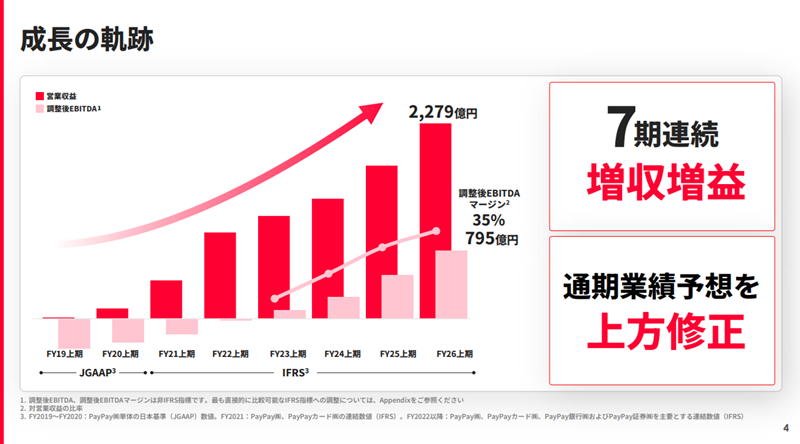
PayPay launched its service in 2018 and has steadily increased its operating revenue. On a first-half basis, the company has achieved seven consecutive periods of revenue and profit growth, with adjusted EBITDA growing at a pace that exceeds operating revenue. Based on these results, PayPay is revising its full-year earnings forecast upward, following a similar revision in the first quarter.Consolidated operating revenue for the first half of the fiscal year rose 28% year-over-year to 227.9 billion yen. Second-quarter revenue alone also increased 28% year-over-year to 118.1 billion yen.
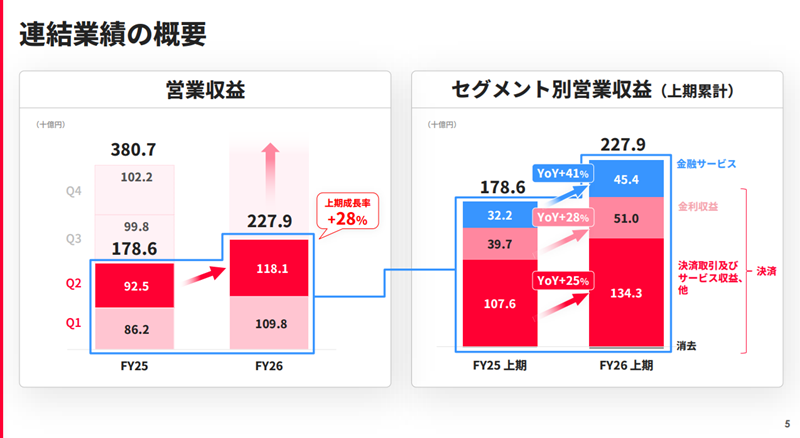
Mr. Nakayama stated, “In the Payments segment, in addition to the expansion of Total Payment Volume, higher Payment Processing Fees and the continued growth of PayPay Card’s revolving, installment, and cash advance balances led to a 25% increase in revenue from payment transactions and services, and a 28% increase in interest income.”Operating revenue in the Financial Services segment rose 41% year-over-year to 45.4 billion yen.
Improved
Profitability Through Measures Such as a Review of Point Rewards Full-Year Earnings Forecast Revised Upward
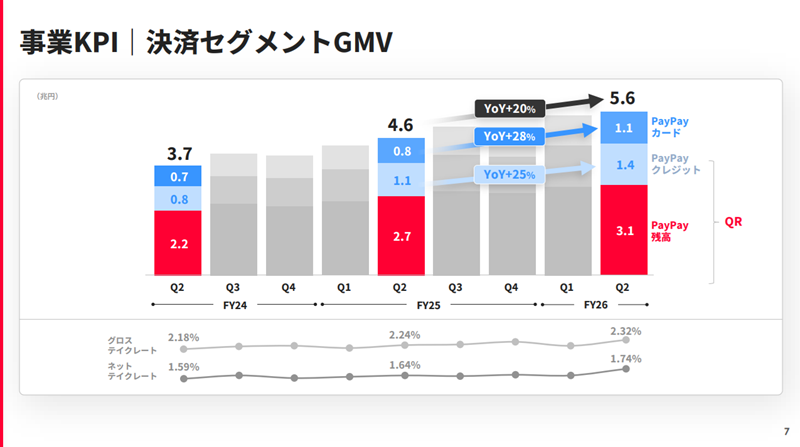
Profitability has improved thanks to cost-efficiency measures, including the revision of the points rewards program implemented in June. Additionally, the Payment Segment’s GMV for the second quarter rose 20% year-over-year to 5.6 trillion yen.Although offline payments were impacted by prolonged rain in September and there was a pullback from the last-minute surge in “Hometown Tax” donations seen in the same period last year, GMV continued to expand.
Reflecting these strong first-half results, the company has revised its full-year earnings forecast upward. Full-year operating revenue has been revised from the previous forecast range of 473.0 billion to 474.0 billion yen to a new range of 478.0 billion to 480.0 billion yen.
Accelerating
Group Synergies Through Payments Ecosystem Strengthened by Growth in Users Utilizing Two or More Services…
As for PayPay’s current standing, it holds a market share of approximately 70% in terms of transaction value and transaction volume for QR Code Payments, and 98% for peer-to-peer money transfers. In addition to PayPay’s payment transactions, it serves as a solid foundation for growing PayPay Card, PayPay Bank, and PayPay Securities.The number of active PayPay Cards in circulation increased by 3.5 million year-over-year to 18.7 million, while financial-related balances rose 26% year-over-year to 600 billion yen.Mr. Nakayama stated enthusiastically, “While PayPay Bank and PayPay Securities are still in the early stages of growth compared to PayPay Card, we intend to leverage the experience we’ve gained in customer acquisition and deepening usage through PayPay Card to develop the banking and securities businesses into our next growth engines.”

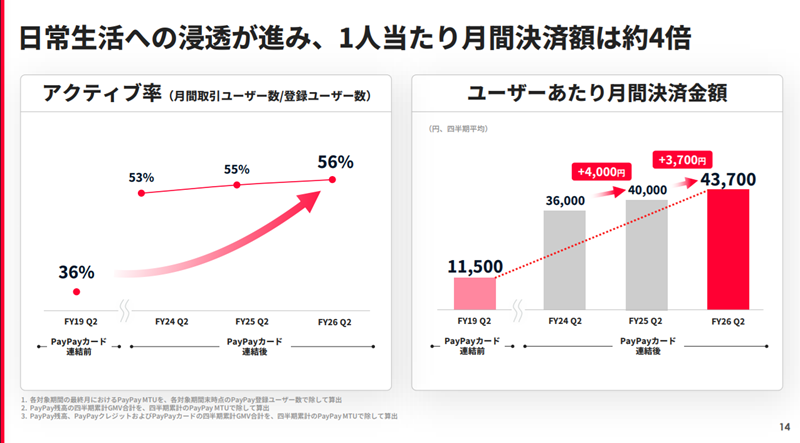
PayPay started out with an image as a service for Micropayments, but compared to the second quarter of fiscal year 2019, the active user rate—the percentage of registered users who make monthly transactions—rose significantly from 36% to 56%. Furthermore, as usage has expanded, the monthly transaction amount per user has grown approximately fourfold over the same period.
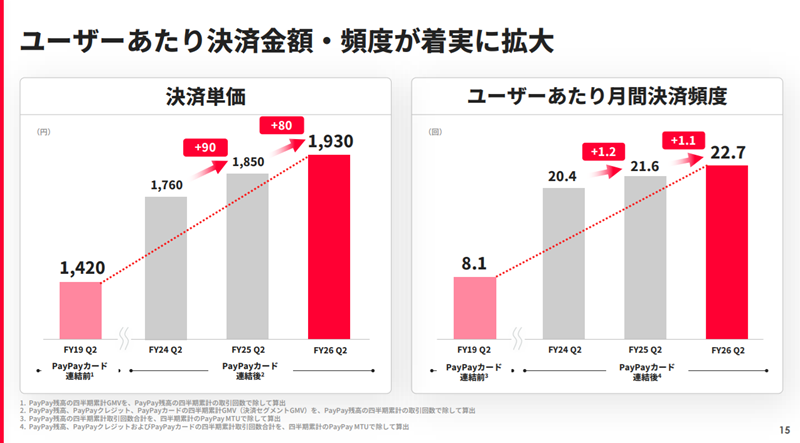
The average transaction amount per transaction rose to 1,930 yen this quarter, and the number of monthly transactions per user nearly tripled. PayPay usage is leading to conversions to PayPay Credit and other PayPay services.
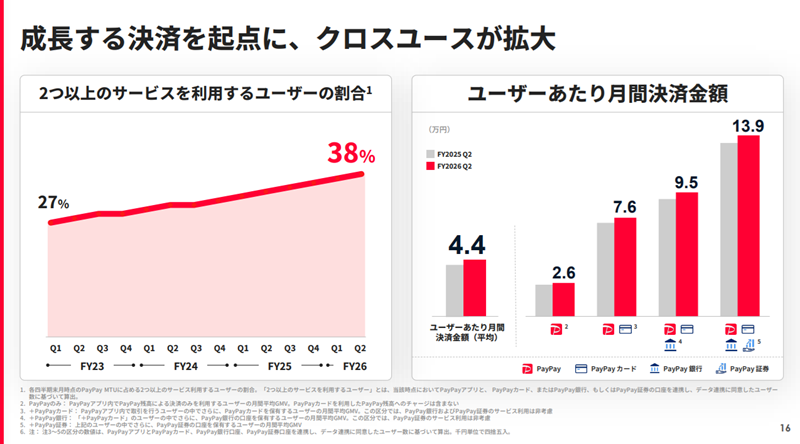
Cross-selling of financial services is also being promoted. Looking back to the first quarter of FY2023, the percentage of users utilizing two or more of the company’s group services—including PayPay—rose from 27% to 38%.The difference in monthly transaction value between users who use only PayPay and those who use four services was approximately fivefold. Furthermore, compared to the same period last year, monthly transaction value grew across all categories based on the number of services used.
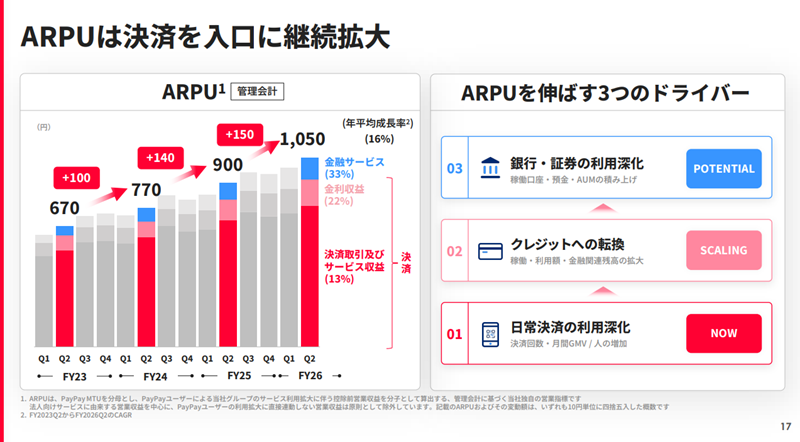
ARPU for the current fiscal year stands at 1,050 yen, with a three-year compound annual growth rate of 16 percent. Within this, the financial services segment achieved an average annual growth rate of 33 percent. Mr. Nakayama cited three key drivers supporting this growth: “deeper adoption of everyday payments,” “the shift to PayPay Credit,” and “deeper adoption of PayPay Bank and PayPay Securities.”
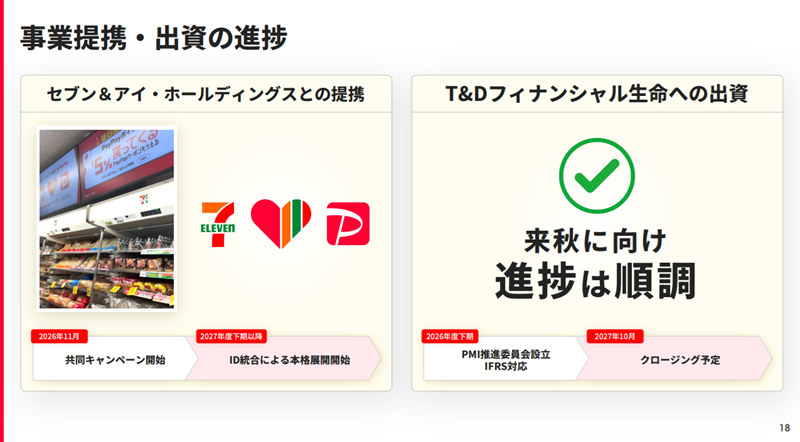
Of the two investments made this year, the partnership with Seven & i Holdings has seen the launch of a joint campaign starting November 1. The company plans to integrate user IDs and begin full-scale operations in the second half of fiscal year 2027 or later, connecting in-store and digital touchpoints. The investment in T&D Financial Life Insurance is also reportedly proceeding as planned.