November 18, 2026, 8:00 a.m. (JST)
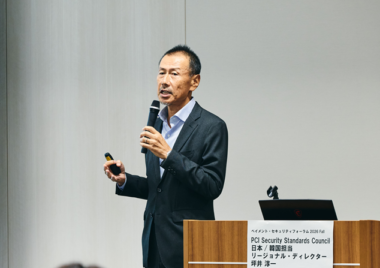
[Japan] The PCI Security Standards Council, which is celebrating its 20th anniversary this year, announced its plan to update the current version 4.0.1 of the “PCI DSS (Payment Card Industry Data Security Standard)”—an international security standard for the credit card industry established to ensure the secure handling of credit cardholder data—announced plans to update the current version 4.0.1, targeting the second quarter of 2028 (April–June). This marks the first time in Japan that a schedule for a new version update has been announced, and it is expected to have a significant impact on the payment industry.(From a presentation at the “Payment Security Forum 2026 Fall” held on September 25, 2026)
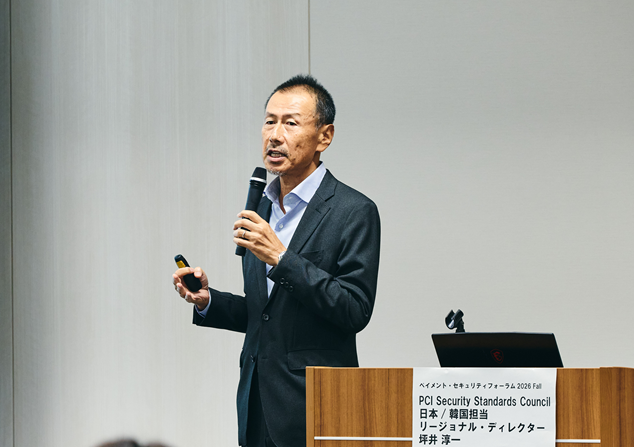
Junichi Tsuboi, Regional Director for Japan and South Korea, PCI Security Standards Council
PCI SSC
Celebrates Its 20th Anniversary Its Significance Grows Through Enhanced Security
My name is Junichi Tsuboi of the PCI Security Standards Council (PCI SSC). I assumed my role as the Regional Director for Japan and South Korea at the PCI Security Standards Council in January 2025. Today, I would like to speak about the “next chapter” of PCI DSS.
The PCI SSC is a U.S.-registered nonprofit organization established 20 years ago with the support of five international payment brands. American Express, Discover, JCB, Mastercard, and Visa are the five founding members of the PCI SSC.Two years later, UnionPay joined and is now a member of the Executive Committee, which makes major decisions.
As implementing these decisions naturally requires various operational measures, I hope you understand that these operations are carried out under the leadership of the PCI SSC.The PCI SSC’s mission is to strengthen data security by developing, revising, and consolidating security standards—with the protection of card data as its central focus—and by providing related services.Rather than simply providing services or solutions, I hope you will view it as an organization that develops guidelines such as “Let’s do it this way,” “We need a system like this,” and “Here are the requirements for that.”
In a sense, it is a rare organization that has maintained a 20-year history, continues to have a clear purpose, and will carry out its mission into the future.
Utilizing
Automation Tools for Guidance Development Using AI to Improve Laboratory Quality
PCI comprises a total of 15 security standards. Last year, we established a “product family” framework. With an eye toward the future, we re-examined and reviewed what these standards should entail, formulated a future strategy, and divided them into seven domains.
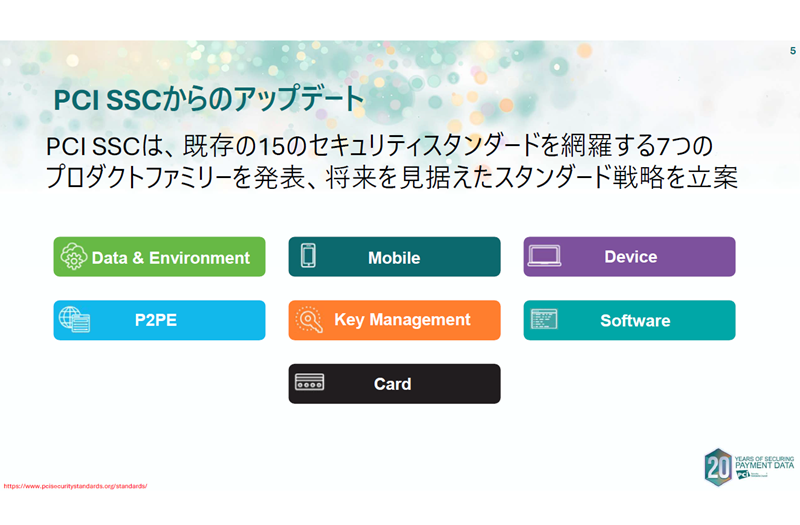
We intend to consider PCI DSS—a representative security standard—within the “Data and Environment” framework moving forward. As the environment evolves in the future, this framework may also change. In your daily lives, for example, various terminals and devices are becoming necessary for mobile payments. We plan to continue monitoring this closely within the PCI framework as well.
Recently, we have been issuing various security standards and guidance documents. In addition to PCI DSS, we have also published the Key Management Operations standard, which is designed to manage the entire lifecycle of keys—from generation to disposal. I would like you to keep in mind today that such revisions and updates to standards will continue to occur.
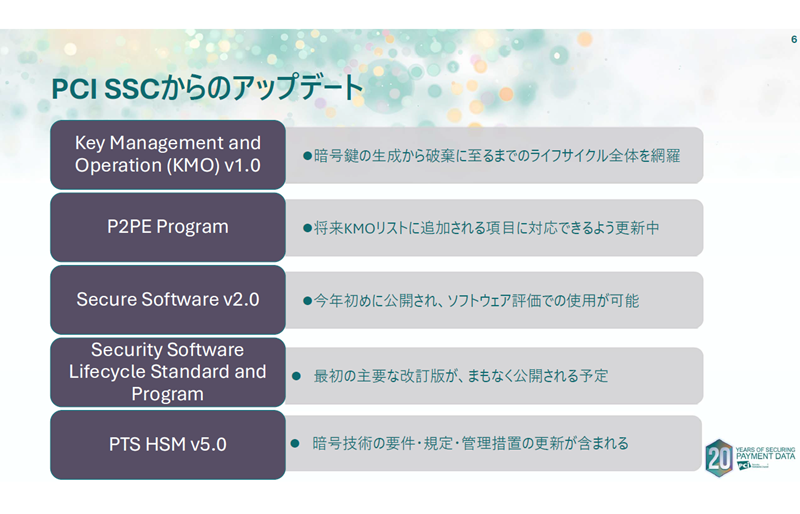
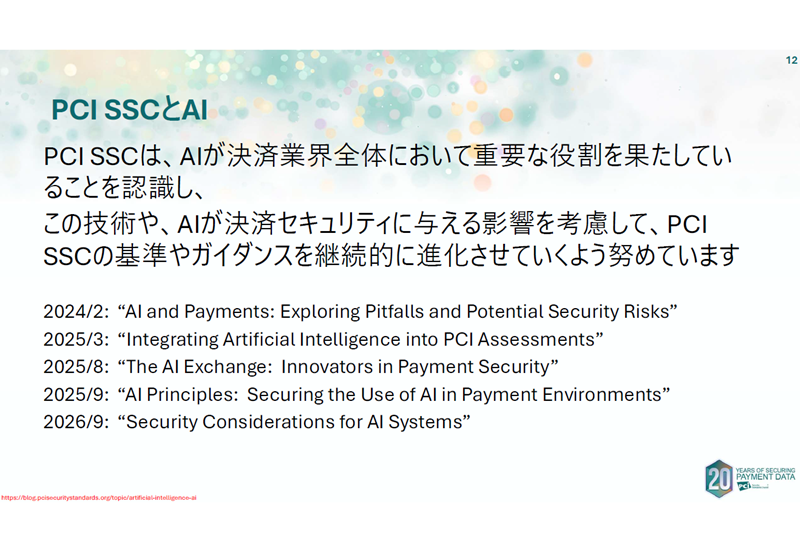
Regarding AI, which has become an integral part of our daily lives, the PCI SSC regularly issues guidance on how to engage with it and what steps should be taken. In the past, PCI DSS was inevitably provided in PDF format, which was time-consuming and difficult to understand; however, by making it machine-readable, it is now possible to use automation tools.
We are currently conducting various tests and are on the verge of launching this initiative, so there are companies and organizations that are undergoing these efforts and obtaining various certifications. Strengthening quality management in these laboratories is also one of the PCI SSC’s key activities.
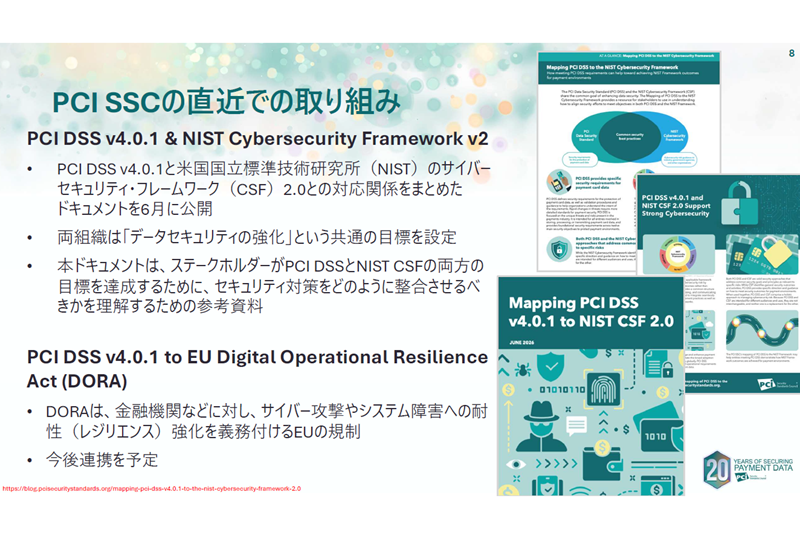
A recent highlight is our collaboration with NIST (National Institute of Standards and Technology). Both NIST and PCI share the common goal of strengthening data security. Our stance is to foster mutual understanding and collaborate wherever possible. We have published new documentation, and I believe you will find the information provided to be a valuable resource moving forward.
The EU’s Digital Operations Resilience Act (DORA) includes regulations mandating resilience against cyberattacks and system failures. The PCI SSC is working collaboratively to issue new guidance and other materials in the near future. This is an area I am personally very interested in.
Toward
the Next Chapter of PCI DSS 900 Comments on the Current Version
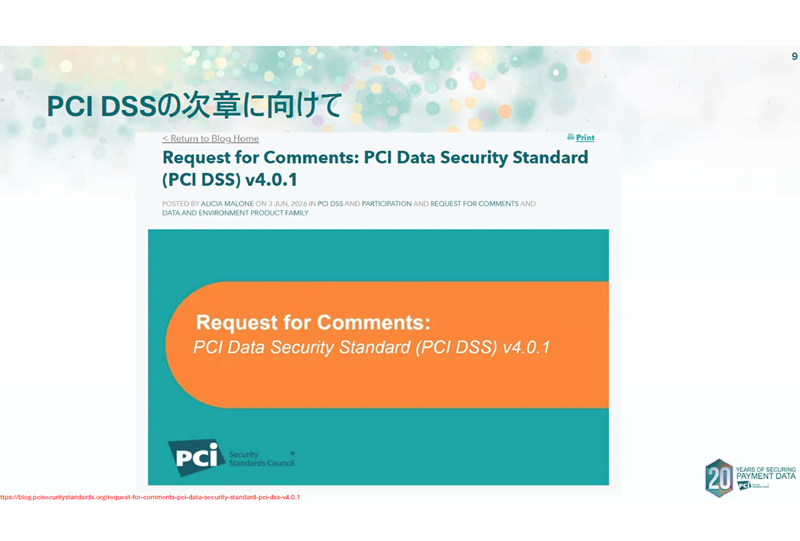
I’d like to touch on the next chapter of PCI DSS, which is today’s main topic. While PCI DSS is a leading security standard, the current version is 4.0.1.It was launched two or three years ago and has become well-established in the market, but we actually conducted an RFC on the current version from June through July. RFC stands for “Request for Comment”; it is a process designed to solicit feedback and opinions by asking, “What do you think of the current PCI DSS?”
Although some time has passed since this version was launched, the PCI DSS will be updated. We will need a little time to complete this update. This is because the RFC is a process in which we gather your opinions and incorporate them into the standard.In this process, the PCI SSC prepares a draft, and there is a period during which we solicit feedback from specific members, as well as from assessor firms and Participating Organizations (PO).
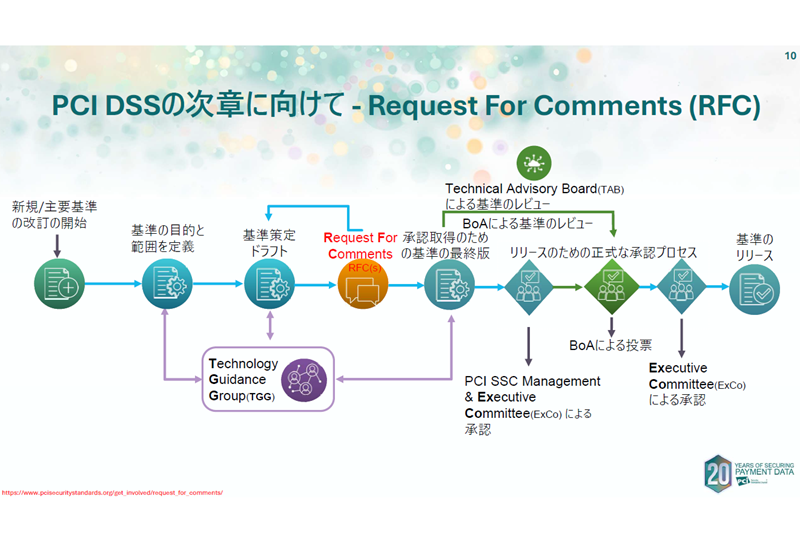
This year, the PCI SSC is taking an approach that asks, “What are your thoughts on the current version?” Once a draft is prepared, PCI creates a revised version based on it. It then goes through processes such as working groups and task forces, and finally receives approval from the Executive Committee before being released.This process takes time. The goal is to gather sufficient feedback and determine how best to incorporate it into the next version. Incidentally, we received just under 900 pieces of feedback on the current version globally [JT3.1]. We understand that we also received a significant amount of feedback from Japan. After receiving this feedback, we will work on creating a revised version.
Incidentally, we are working toward publishing the next version in Q2 of 2028—that is, we plan to announce the new version sometime between April, May, and June.Since the first Request for Comments (RFC #1) process has just concluded, the standards team is currently organizing the feedback and taking steps toward the next phase.
The next RFC will take place in Q2 of 2027, so we are looking at around April, May, and June of next year.The process of having the PCI SSC draft a new version and conducting another RFC to gather feedback on it will take place in Q4 of 2027—around October, November, and December of next year.
I hope you understand that, following this process, we are currently targeting publication around Q2 of 2028. This is the first time we’ve discussed this in Japan.
Through this process, we’ll receive a great deal of feedback, which will lead to the next version. It inevitably takes time, but I’d like you to understand that the standard will be published in about 20 months. Whether you view that as fast or slow, I hope you’ll take this as my main point today.

Blogs on our website and international meetings
Strengthening Information Dissemination and Communication
Regarding AI, which I mentioned earlier, we recognize that it naturally plays a crucial role in our payments industry. At the PCI SSC, we are taking an approach that involves regularly issuing announcements and guidance on how to address the ever-evolving AI technology.
Most recently, we’ve discussed AI on the PCI website as well; since we typically post updates every few months, I encourage you to pay attention and check them out. To help you stay informed, PCI provides various communication tools. You can access the document library on our website, and we also regularly post blog entries to keep you updated.
You’ll be able to find information about AI and upcoming standards on our blog. As I mentioned, there are about 20 months until the standards are published, and I expect the PCI SSC will be issuing updates frequently over the next 20 months. I strongly encourage everyone to regularly check the PCI SSC website.
One way to stay informed is to visit the PCI SSC website and click on “Resources” to view the blog. There is also a process where you can subscribe by clicking “Subscribe Here,” so I encourage you to take advantage of this feature. Since updates will be sent regularly to your email address, I recommend signing up.You can also subscribe by viewing the “News” section, which features updates from the PCI SSC. Just like the email newsletter, this section provides data and information, so please be sure to check it when you receive the emails.
As I mentioned, we’ll be sharing information frequently over the next 20 months. I’m very sorry to say that much of this content is in English, and not everything is translated into Japanese, so you may find it a bit challenging at times.I’m in charge of Japan and South Korea, and while this language issue remains an ongoing challenge, I intend to continue making efforts to ensure the information feels as accessible as possible to all of you. I hope you’ll use translation tools or other means to review the content.
Finally, we hold an annual Community Meeting. Last year, approximately 30 companies from Japan participated, and the PCI SSC aims to share various updates timed around the Community Meeting.
In fact, the PCI SSC Community Meeting was held in the U.S. last week, and I had the opportunity to discuss topics similar to those I touched on today. The next meetings will be held in Europe in October and in Kuala Lumpur, Malaysia, in November.
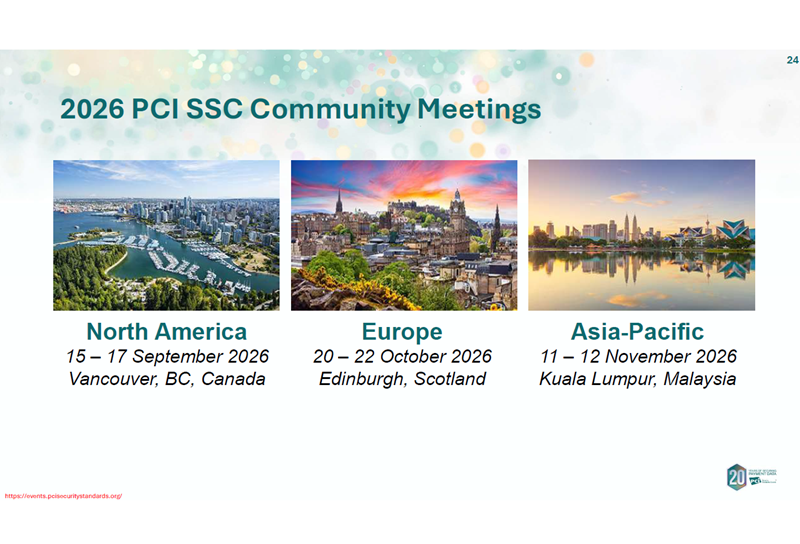
I expect we’ll be sharing even more information there than I’ve covered here today, so if you have the chance, I’d really like you to attend. I know it’s a long way to travel, but I hope you’ll make it work and join us in person.
As I mentioned, this year marks our 20th anniversary, and I believe the PCI SSC’s mission will remain unchanged going forward. Our goal is to gather as many of your opinions as possible and apply them to the future of data security. I’d like to conclude today’s message by asking for your diverse feedback. That concludes my remarks. Thank you very much for your attention.