August 4, 2026, 8:40 a.m. (JST)
[Japan] TOPPAN (Tokyo, Japan) has developed the world’s first “PQC CARD Dual,” a dual-interface IC card capable of supporting both contact and contactless communication methods and equipped with post-quantum cryptography (PQC)—a cryptographic system considered difficult to decrypt even by quantum computers(according to the company’s research). The company aims to begin supplying the card to the government and healthcare sectors starting in fiscal year 2027 for implementation in applications requiring high security, such as national ID cards and medical authentication cards.
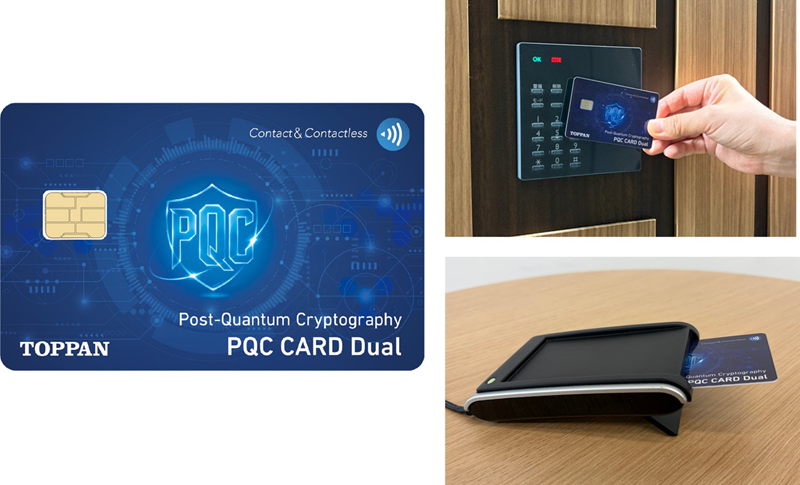
The “PQC CARD Dual” utilizes proprietary memory-saving technology to optimize the memory capacity required for the massive cryptographic computations involved in PQC. This enables the implementation of PQC—which requires larger data sizes than conventional cryptographic methods—on dual-interface IC chips with limited memory capacity.Furthermore, the card’s algorithms comply with cryptographic standards selected by the U.S. National Institute of Standards and Technology (NIST), ensuring long-term security. By supporting both PQC and current cryptographic standards, the card also facilitates a smooth transition from existing cryptography to PQC.
Specifically, PQC has been implemented on a dual-interface IC card that supports both contact and contactless communication methods.The card incorporates PQC algorithms standardized by NIST (ML-KEM, ML-DSA) as well as conventional cryptographic technologies (such as RSA and ECC), enabling a single card to support both cryptographic systems.As a result, even during the transition period from current cryptography to PQC, a smooth transition to a PQC environment can be achieved while leveraging the existing infrastructure. It is also reported that standalone PQC support is possible for both contact and contactless modes.
Furthermore, implementing PQC requires a vast amount of working memory, and there was the challenge that general-purpose operating systems—which are the mainstream platform for IC cards—consume a large amount of memory.Using memory-saving technologies cultivated over many years of IC card development, TOPPAN has succeeded in smoothly executing the massive computational processing required by PQC without straining the limited memory space.
Furthermore, the company has implemented PQC functionality on “Java Card,” a general-purpose OS that serves as a global standard for IC card platforms and is widely used in existing IC cards. This enables operations such as updating only the cryptographic functions to PQC while leaving existing applications—such as payment, employee ID cards, and access control—on existing IC cards unchanged.
TOPPAN aims to conduct field trials of the “PQC CARD(R) Dual” and related systems during fiscal year 2026, targeting sectors such as government and healthcare that require high levels of security.Following verification of its effectiveness, and with an eye toward the full-scale PQC migration roadmaps targeted by countries such as the United States and Europe for the 2030s, the company aims to begin offering “PQC CARD Dual” starting in fiscal year 2027. (paymentnavi Editorial Team)