
October 9, 2026, 9:00 a.m. (JST)
[Japan] Digital travel platform Booking.com(Amsterdam, Netherlands) marked its 30th anniversary by hosting the “Booking.com Innovation Summit Japan 2026” on September 15, 2026, at the Takanawa Gateway Convention Center as a forum to co-create the future of travel and tourism in Japan.On the day of the event, Booking.com Chief Business Officer James Waters and other executive leaders from the company—including those responsible for AI technology, fintech, and cybersecurity—visited Japan.Through dialogue with guest speakers—experts in their respective fields—the event addressed themes focused on the future of the tourism industry, such as travel technology, safe and secure travel, and the development of regional tourism. It provided an opportunity to reflect on changing traveler expectations, the potential of technology to transform tourism, and models for sustainable tourism that leverage regional attractions.
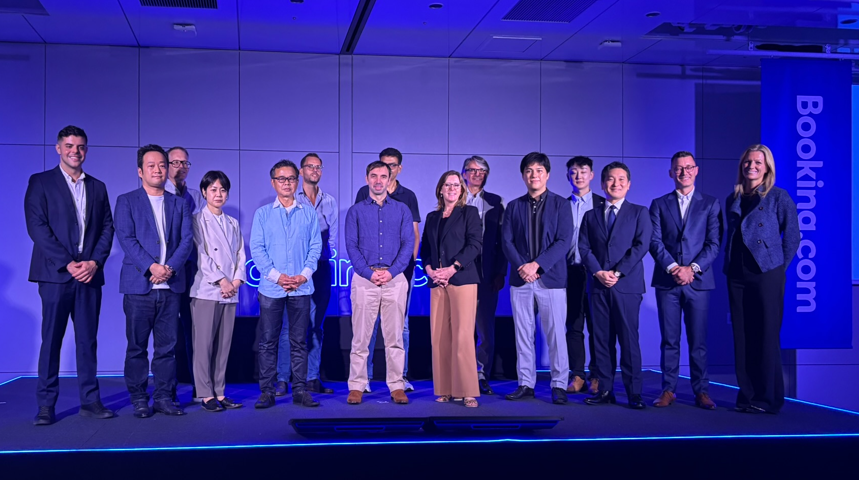

Kazuo Hiyane (Head of the AI Innovation Promotion Office at Mitsubishi Research Institute). The session was moderated by Simon Clark (Global Communications, Booking.com).



Simplifying
Complex Travel APAC Travelers Who Embrace Travel with a Positive Attitude
The event was attended by accommodation partners, tourism organizations, government officials, industry associations, university students, innovators, media representatives, and external experts.
Booking.com traces its origins to 1996, when a Dutch student in the Netherlands launched the platform to make it easier to book accommodations online. Thirty years later, that vision lives on as Booking.com, helping millions of travelers every day plan their trips from start to finish.Travel can be complicated, but the company aims to simplify it by bringing everything together in one place.
From boutique hotels, city apartments, and countryside villas to flights, rental cars, taxis, and experiences, the company makes it easy for travelers to plan a smoother, more seamless journey. With millions of options across 220 countries and regions, travelers can book with confidence and, above all, focus on enjoying their trip.

Laura Houldsworth, Managing Director for Asia-Pacific at Booking.com, said, “Looking to the future, we are leveraging our deep expertise in AI and machine learning to create a new era of travel that is smarter, more seamless, and more personalized than ever before.”
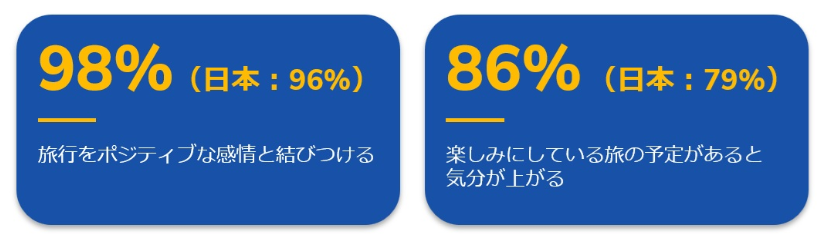
The company conducted a detailed survey of 10,000 respondents across 11 markets in the Asia-Pacific region to explore how travel adds value to their lives. The findings revealed that 84% of travelers said travel is important for their physical and mental health, and 98% of respondents reported that it brings them positive experiences and emotions.They concluded that travel is more than just a transaction or a purchase; it holds greater value and meaning.
Furthermore, while AI is advancing, it is making the discovery process more human. It enables travelers to find unique and completely different experiences by leveraging human sensibilities. Booking.com aims to harness the power of this technology to reduce complexity, support decision-making, and preserve travelers’ freedom of choice.
Attracting
Visitors to Regional Areas Through AI and Website Innovation Launch of the “Authentic Japan” Project
The Japanese government aims to expand inbound tourism and has set a goal of increasing the number of international visitors to Japan to 60 million by 2030.Since it is not ideal for tourists to be concentrated in Tokyo, Kyoto, and Osaka, there is a need to strike a balance between tourism and its value. Therefore, the combination of AI and innovation at Booking.com is expected to help harness this potential, including by attracting visitors to regional areas.
This time, we delved a bit deeper into four key themes: AI technology; regional economic development and the collaboration needed to support it; fintech in the travel sector; and online safety and security, which are particularly important right now.
Last year, the company launched the “Authentic Japan” project. It is collaborating with local organizations, regional accommodation partners, DMOs (Destination Management Organizations), and local community development organizations to achieve balance in tourism. The goal is to encourage travelers to venture beyond major cities to deeply explore and understand the authentic Japan.
Leveraging
Hundreds of Machine Learning Models in Business Operations Building a Sustainable Travel Model

Matthias Schmid, Senior Vice President of the company’s Accommodations division, stated, “Our mission remains the same: to make it easier for everyone to experience the world.”As a peer-to-peer marketplace, the company achieves this by connecting travelers and partners worldwide across more than 200 countries. The company consistently acts with a focus on value, ease of use, and trust—three strategic pillars that underpin all its activities.
Schmid noted that people today have the same questions about travel as they did 30 years ago: “Where should I go?”, “How should I get there?”, and “Where should I stay?” The only difference compared to 30 years ago, he said, is likely the way people obtain information.
In the past, information spread through word of mouth and trusted travel agencies, but today it primarily flows through online channels. The company stated that there is no doubt Gen AI will play a crucial role in this process in the future. Over the past 30 years, hundreds of millions of travelers have made reservations using the Booking.com platform. The company also provides trustworthy reviews.
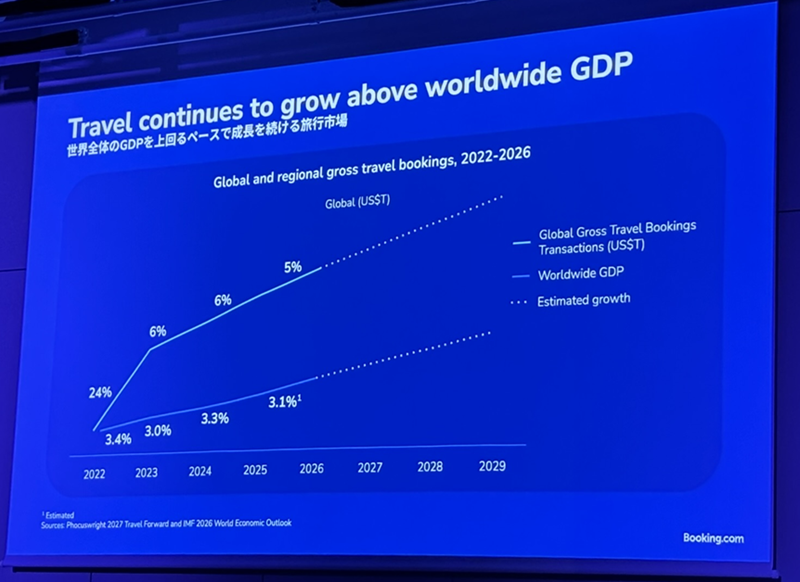
Growth in the travel industry has consistently outpaced global GDP growth. Travel remains one of the top categories for discretionary spending.The global travel market is projected to reach annual revenue of $3 trillion by 2036. In fact, the majority of global tourism growth is driven by Asia. In many Asian markets, annual growth rates significantly exceed the rates shown in the chart.
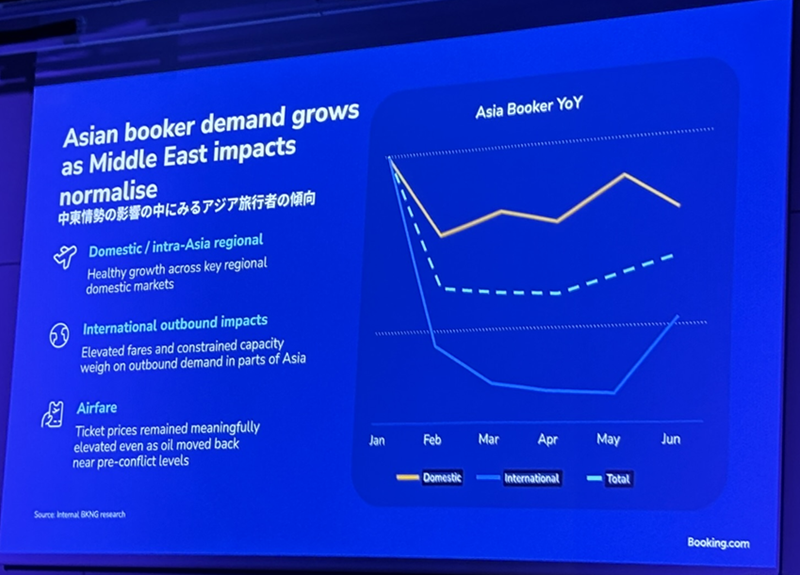
While outbound travel from Asia was negatively impacted from February through May of this year, domestic travel and travel within Asia remained consistently strong. Furthermore, according to search data from the past eight months, the most popular travel destinations in the Asia-Pacific region are Japan, India, and Australia. Demand for Japan is extremely high, and Japan remains one of the region’s most popular destinations.
On the other hand, one of the challenges facing the industry is attracting the right talent and developing staff with the appropriate skills. In Japan, in particular, this is essential to maintaining the globally acclaimed “omotenashi” (hospitality).According to a government survey conducted in Japan, more than 70% of hospitality industry professionals report labor shortages. The resulting consequences include increased workloads, rising recruitment costs, and declining service levels.
“To overcome this challenge, we need to actively explore and build new operational models based on creating better jobs, targeted transitions, automation, simplification of service processes, and more effective utilization of demand,” said Mr. Schmid.
The second challenge is meeting the very specific needs and interests of today’s travelers. Modern travelers often have very clear travel goals and intentions because they have access to a wealth of information from diverse sources, including social media.
In Europe, interest in Japan remains very high. Additionally, there is a growing number of travelers seeking experiences that allow for a more authentic engagement with Japanese culture. For example, they are looking for destinations such as Takayama, Hiroshima, Fukuoka, and Kanazawa. In the Asia-Pacific region, demand for modern short-term trips—particularly centered on cities like Osaka, Fukuoka, and Nagoya—is rising sharply.Furthermore, seasonal travel—such as winter skiing—shows a very strong trend. Of particular note is the seasonal fluctuation in the number of travelers actually visiting Japan. They come in the fall to explore culture and in the winter to enjoy skiing and other winter activities. The timing and type of accommodations travelers choose are also said to be very important.
Ryokans and other alternative accommodations are becoming increasingly important to the Japanese travel experience; 37% of all room bookings made on the company’s platform are for alternative accommodations, which include ryokans.
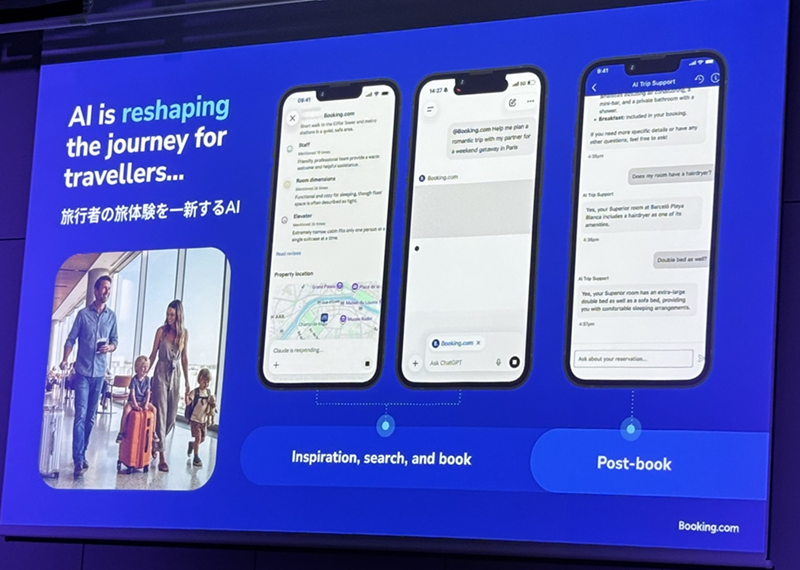
How will the application of GenAI change the way people plan and book trips? As one of the world’s largest technology organizations—particularly in the travel technology sector—the company has long leveraged AI. It deploys hundreds of machine learning models across various business areas.However, GenAI is significantly transforming the world as a whole, and it is also changing the way travelers plan, search for, book, and pay for their stays. At the same time, travelers’ expectations are rising significantly, as they anticipate more advanced personalization and, ultimately, the ability to entrust many tasks to AI agents.Travelers and partners expect the company to operate its platform safely and securely to protect people from fraud and scams.
“The travel industry is incredibly resilient, and Japan’s travel ecosystem holds tremendous potential,” said Schmid. “By blending technology with human care, strengthening trust, and supporting local partners, we can build a sustainable travel model that is inclusive and promotes balance across regions.”Given Japan’s highly ambitious goal of welcoming 60 million international visitors by 2030, Booking.com is committed to working with travelers, businesses, local communities, and public sector partners to build the future together,” said Schmid.