November 19, 2026, 8:00 a.m. (JST)
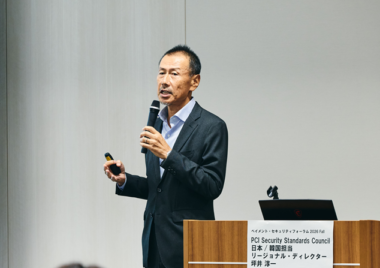
The rise of “Agentic Commerce”—where AI handles product recommendations and payment processing—is significantly transforming the e-commerce purchasing process.Key figures from Adyen Japan—a global leader in Agentic Commerce—and Mastercard engaged in a discussion, highlighting the latest trends in payments and security for transactions facilitated by AI agents. They also covered technological developments such as Adyen Agentic and Mastercard Agent Pay, and outlined specific “preparations” that Merchants should implement or consider right now.(From a presentation at the “Payment Security Forum 2026 Fall” held on September 25, 2026)
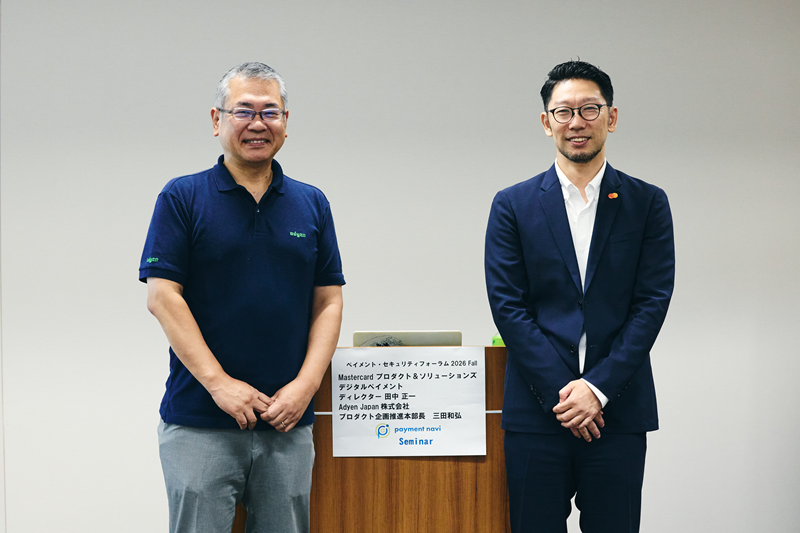
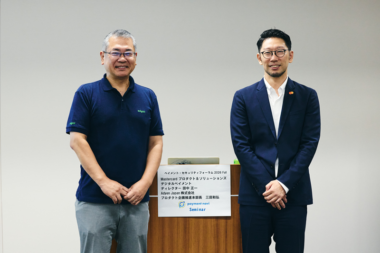
Kazuhiro Mita
, General Manager, Product Planning and Promotion Division, Adyen Japan Co., Ltd. Shoichi Tanaka, Director of Digital Payments, Product & Solutions, Mastercard
Transaction Processing
for Both Contactless and In-Person Payments on a Single Platform Eight Years in the Japanese Market… Adyen Japan’s Growing Presence
Mita: Hello, everyone. My name is Kazuhiro Mita from Adyen Japan. Today, I’d like to co-host a session with Mr. Tanaka from Mastercard on the topic of “Security with an Eye Toward Agentic Commerce: Building an Ecosystem of Trust Through Payment Infrastructure and Networks.”
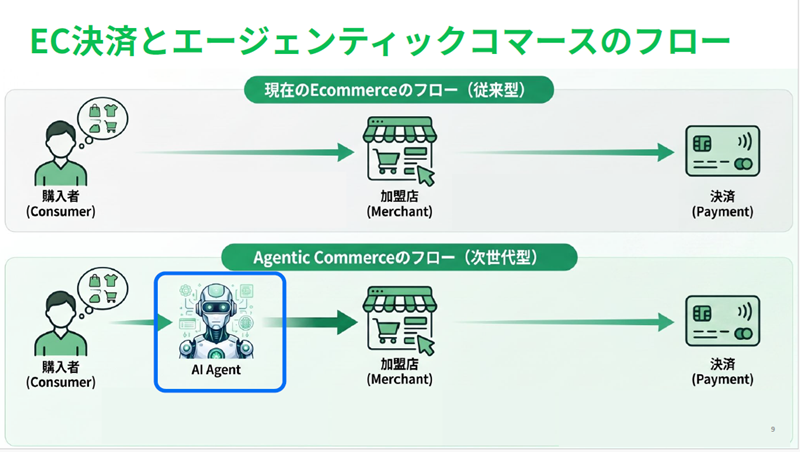
I believe everyone here is familiar with agentic commerce. Essentially, the mainstream model involves a flow between the buyer, an AI agent, and the Merchant.However, when it comes to card payments, it’s essential to understand how agentic commerce fits into the broader payment ecosystem—which includes the Acquirer, international card brands, and the Issuer—that lies behind the transaction. With that in mind, I’d like to focus our discussion on how we can establish security within this payment ecosystem.
Tanaka: I’m Tanaka from Mastercard Product & Solutions. Even with agent-based commerce, when we implement it at Mastercard, we approach it with tokenization as a prerequisite, and I’m in charge of agent-based commerce as well.
Mita: I am the Head of the Product Planning and Promotion Division, and my primary responsibility is planning and promoting Adyen’s products for the Japanese market.
First, I’d like to introduce Adyen. Adyen is a fintech company founded in the Netherlands 20 years ago, in November 2006. We are an Acquirer, processing 257 trillion yen in transaction volume worldwide.According to a Forrester Research survey, we’ve been recognized as a top leader in the global fintech industry. We process transactions for many global Merchants.
Adyen Japan was established in October 2018 and will soon celebrate its 8th anniversary. We are registered in Japan as a business operator authorized to handle credit card numbers and other sensitive information, as well as an Acquirer, and we are also a member of the Japan Credit Association.Together with major PSPs (Payment Service Providers), we participate in the E-Commerce Payment Council. We operate with the goal of strictly complying with Japanese laws and regulations while providing convenient and secure payment solutions for Japanese Merchants, Buyers, and Shoppers.
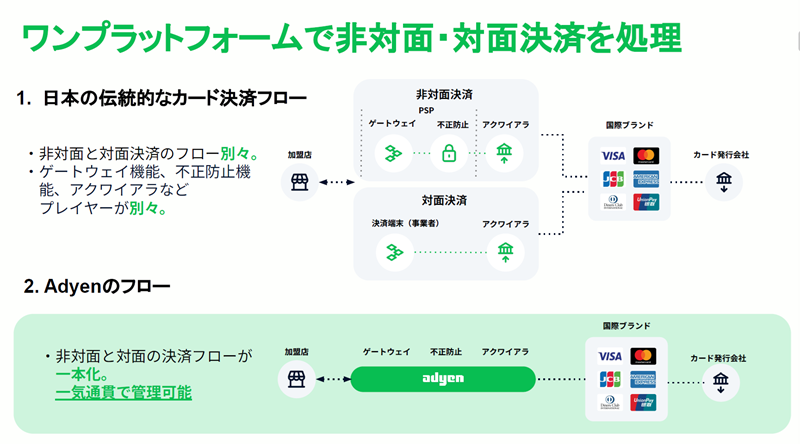
A key feature of Adyen is that it performs contactless and in-person transaction processing on a single platform. Furthermore, even for contactless transactions, it can perform transaction processing end-to-end.
We support seven international card brands, as well as Apple Pay, Google Pay, PayPay, and Rakuten Pay. However, since the APIs and reporting are consistent globally, the processing and operations remain exactly the same for customers from overseas. This consistency is also a key feature for merchants based in Japan looking to expand overseas.
We also support payment methods unique to Japan, such as bonus payments, Installment Payments, and Japanese error codes. We take pride in the fact that few foreign PSPs support bonus payments. Among our merchants are luxury brands, and they also utilize bonus payments.
As a global Acquirer, we support the latest products, network tokens, Passkey, and more. Furthermore, because we have a strategic partnership with Apple, we are capable of handling transactions involving new network tokens such as those used by Apple Pay.
Since the theme of this session is Agent-Driven Commerce and Security, I’d like to hear from Mastercard.
Supporting
the Infrastructure of Agent-Driven Commerce The Strengths of International Brands Like Mastercard
Tanaka: When we talk about agent-based commerce, it generally implies that AI makes shopping more convenient. From a payment perspective, the process is shifting from simply viewing a product and clicking “buy” to members asking an agent to make the purchase on their behalf, which changes the payment experience flow. Therefore, for security reasons, we need to establish rules and mechanisms tailored to this new model.For many years, Mastercard and other international brands have supported the development of such systems by collaborating with Acquirers, Issuers, and Merchants. Even in the era of agent-based commerce, continuing to build such systems as part of the payment infrastructure is both a strength and a role of international brands.
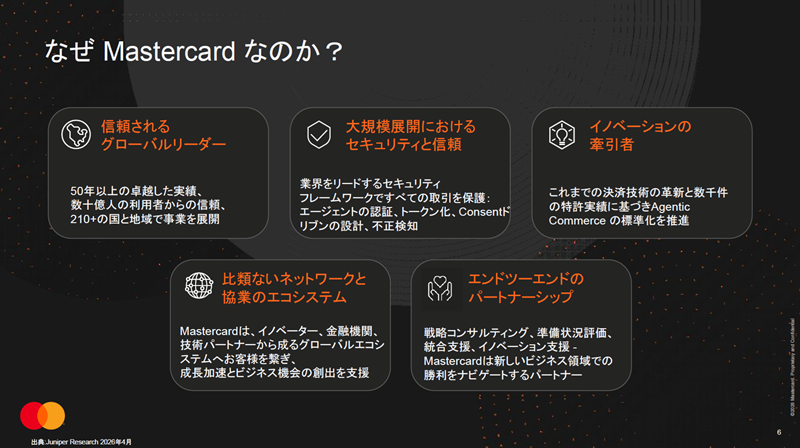
We are already working with partner companies, merchants, issuers, and acquirers to conduct live transactions via agents in a production environment. For example, there have been reports of agent-mediated transactions in Australia, Singapore, Malaysia, India, and South Korea. In May, we also processed Japan’s first live agent transaction.
While this is a pilot project, it is not merely a simple AI demo or simulation; we have actually reached the stage of obtaining authorization on the existing Mastercard network.
Adyen is also a key partner, and in the U.S., we’ve been invited to participate in meetings to establish these specifications.
Mita: I think there has been an increase in articles about agent-based commerce in the industry recently.An article came out in August stating that purchases made via AI had already exceeded 20% at a major e-commerce marketplace. Upon further investigation, I found another article indicating that traffic from AI agents had surpassed 20% as early as February. As transactions via AI agents continue to expand, I’d like to delve a little deeper into agent-based commerce.
What Will
Happen Once Agent-Driven Commerce Takes Off? Merchants’ Concerns: “Middlemen Cutting Out the Middleman, Proliferation of Specifications, and Incorrect Classifications”
There are various forms of agent-driven commerce. The first stage is product discovery and search. This is the stage where, when you use AI to look up a product you want and click “Buy,” you’re redirected via a link. In official materials from Adyen, a U.S.-based company, “in-chat payments” are highlighted with a star, but my sense is that Japan hasn’t quite reached that point yet.
Since it’s daunting to let AI handle everything, the second stage involves human involvement—whether that’s a human making the final decision or simply clicking the “buy” button at the start.
The third stage is the fully autonomous phase unique to agent-based commerce. It’s a world where, if you say, “I want to buy this,” the product arrives in just two or three days.Of course, this would still be based on your instruction—such as “I’d like something like this”—but when I visit Merchant stores to discuss this, they often ask me, “Does this really exist?” “Is this acceptable under Japanese business practices?” and “Is it compliant with the Act on Specified Commercial Transactions?” However, it’s said that the world is moving in this direction.
Finally, there are transactions between agents. This vision describes a world where agents negotiate and conduct transactions directly with one another.
Adyen does business with many major Merchants worldwide. We conducted interviews with about 70 of them, asking, “What are your concerns if agent-based commerce takes off?” and found that there are three major concerns.
The first is the “middleman” issue. When an AI agent comes to make a purchase, the Merchant has no way of knowing who actually made the purchase.Even the buyer cannot determine what was purchased or where it was bought. The only indication is the AI agent’s name listed on the transaction details. From the Merchant’s perspective, this raises the concern: “Where has the loyalty we’ve built up over time gone?” How to address this issue is the first major concern.
The second concern is the proliferation of different specifications. OpenAI has announced the ACP protocol, and Google has announced the UCP protocol, but the question is what protocols the players entering the market later on will adopt.
As those familiar with card systems know, card transactions operate using a message format called ISO 8583.Mastercard’s ISO 8583, Visa’s ISO 8583, and JCB’s ISO 8583 are similar in some respects but completely different in others; even for the same field, different data must be entered. Merchants are concerned that a proliferation of similar protocols will force them to develop systems to support them all.
The third issue is fraud detection. Until now, when a bot appeared, it was generally safe to assume it was fraudulent; however, since AI agents are non-human entities, determining how to classify them poses a challenge. Even if an AI agent is legitimate, the person who made the purchase and the agent that actually made the purchase are not physically the same.
In the event of a chargeback, who bears the responsibility—the Merchant or the Issuer? There are also concerns regarding fraudulent bots, chargeback bots, and compliance with regulations.
Acting
as a Mediator Between Merchants and AI Agents What Is the “Universal Translator”?
Adyen addresses this by acting as a “Universal Translator” between Merchants and AI agents. To prevent the first type of “middleman” issue, it ensures that the identity of the purchaser is clear regardless of which Merchant or AI agent the purchase is made through.Second, merchants only need to connect to Adyen via a single API; Adyen will handle any API requests that come through. Third, Adyen is equipped with fraud prevention features to detect and defend against fraudulent transactions.
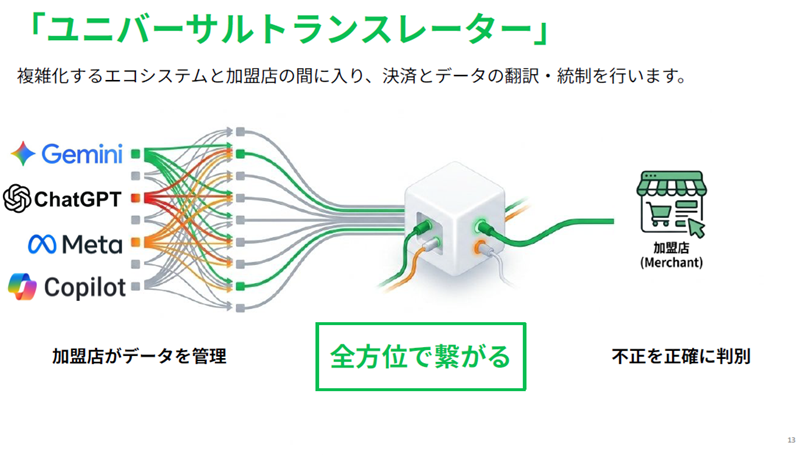
In June of this year, Adyen released “Adyen Agentic” as a product. If merchants connect via a single specification for the Agentic Feed, Adyen will transcribe the data in a format tailored to the specific agent, regardless of which agent the request comes from.The second is “Agentic Cart,” which identifies the individual when an item is added to the cart and displays shipping costs, total amounts, and other details accordingly. Additionally, “Agentic Payments” handles fraud detection while ensuring the buyer’s information is properly shared with the Merchant when a payment is processed via chat. Although it is currently available only in the U.S. market, we are coordinating internally—including with our sales team—to expand it to other countries as soon as possible.
What
Information Is Required for Agentic Commerce? Enabling Secure Transactions with Agent Pay
You mentioned that Mastercard is a step ahead in the field of Agentic Commerce. You’ve launched Mastercard Agent Pay—could you please explain what that entails?
Tanaka: Agent Pay is a system designed to enable secure agent-based commerce. For example, you might ask an agent, “Find me some running shoes for under $100.” The AI then reviews the options and responds with, “Here are some suggestions.”Suppose you tell the agent, “OK, I kind of get it—just go ahead and buy something like this,” or “These shoes are $120 right now, so buy them when they drop below $100.” Based on that, the AI makes the purchase, completes the payment, and the product is delivered. In that case, proof is needed to confirm that you actually gave the go-ahead to make the purchase.
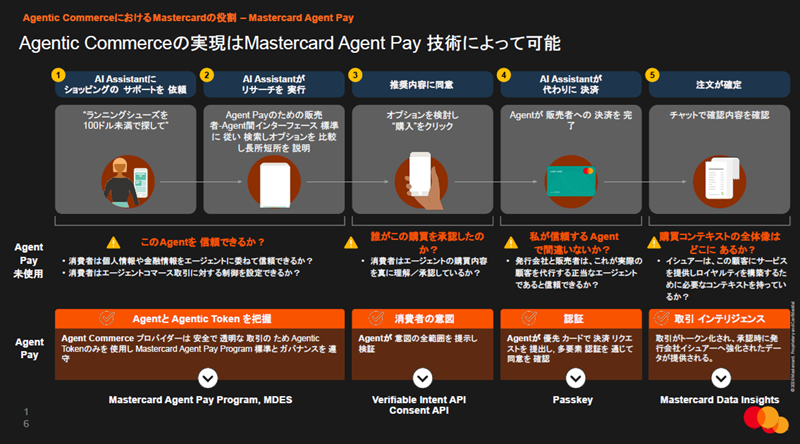
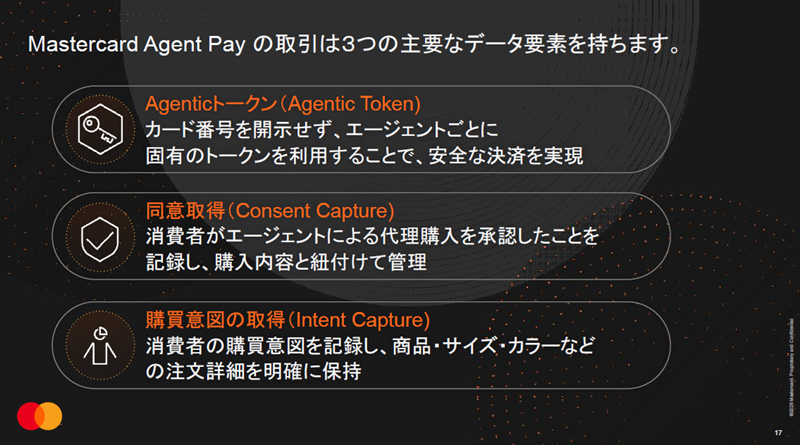
From the Issuer’s perspective, it’s also crucial to determine who bears responsibility for chargebacks in the unlikely event of a problem. To resolve this issue, three key pieces of data are required.
First is the buyer’s intent—information indicating, “I want this kind of item.”Second is consent—we need confirmation that the buyer actually said, “Yes, I’m okay with this purchase.” Once these two elements are established, it goes without saying that an agent-specific token is required; however, the Issuer also needs agent-specific data detailing exactly what transactions were carried out by the agent. Agent Pay has established a system that processes transactions based on these three elements, aiming to create secure transactions.

■Contact
Information  Adyen Japan Co.
, Ltd. 150-0002
2-24-12
Shibuya, Shibuya-ku, Tokyo Scramble Square, 39F