August 25, 2026, 8:38 a.m. (JST)
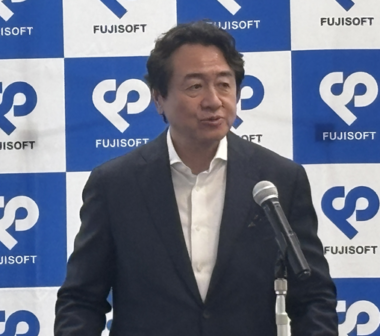
[Japan] On August 6, 2026, Fujisoft held a press briefing on its “Fujisoft Gen.2 Commerce Strategy for the Age of Agent-Driven Commerce.”In agent-driven commerce, a system that seamlessly integrates ordering, payment, and operational processing is required to convert recommendations made by AI agents into actual purchases; the company announced that it will partner with the U.S.-based Payment Service Provider Stripe.
Are Corporate Purchasing Behaviors Undergoing Major Changes?
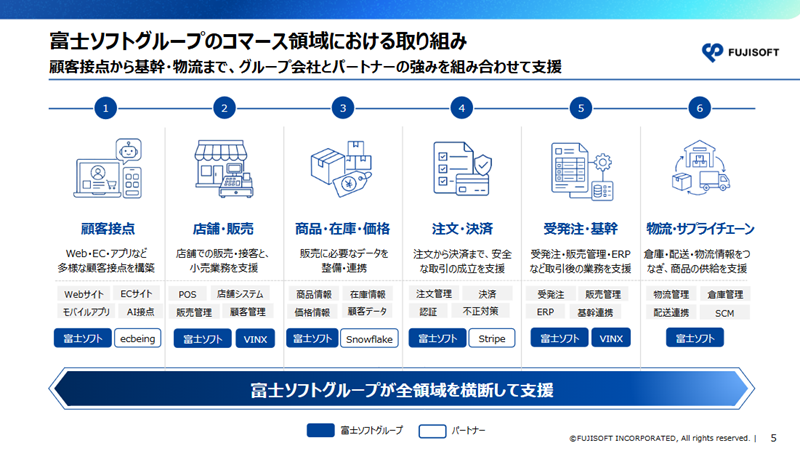
Supporting Everything from Customer Touchpoints to Ordering, Payment, Core Systems, and Logistics
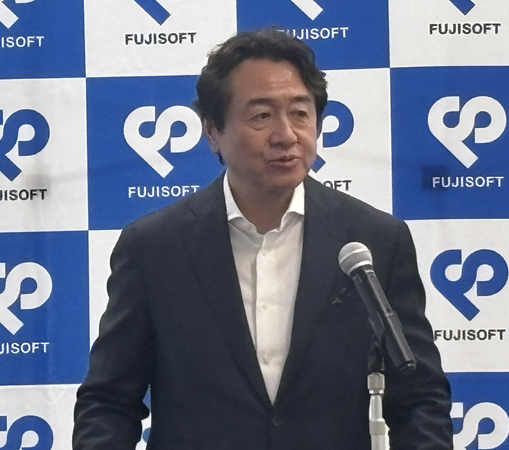
Regarding Agenetic Commerce, Mr. Mitsuhiro Murooka, Representative Director, President, and CEO of Fujisoft, stated, “We believe this is bringing about a transformation not only in operational efficiency but also in corporate purchasing behavior itself.”
The domestic e-commerce market is expanding; in addition to B2C, which has become firmly established as a purchasing channel for daily life, its use is also growing in B2B transactions between businesses. He cited the expansion of purchasing touchpoints, market areas, and transaction domains as reasons for this trend.
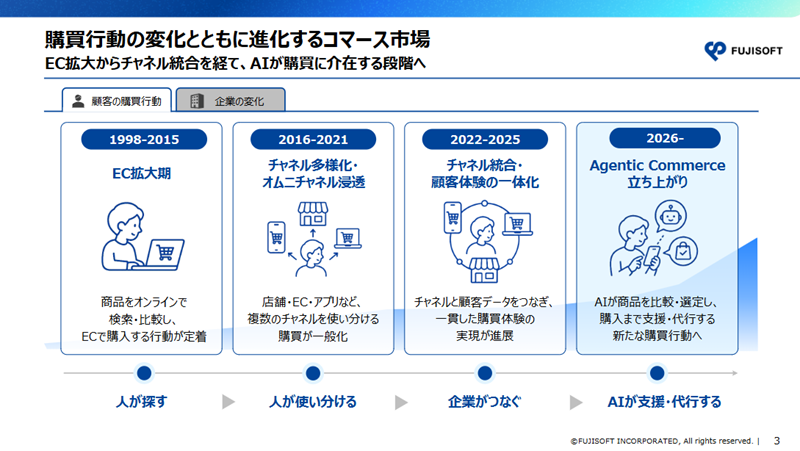
He also noted that following the e-commerce expansion phase through 2015, the market moved through the diversification and penetration of omnichannel approaches from 2016 to 2021, and the integration of channels and customer experiences from 2022 to 2025. He stated that starting in 2026, the market has now entered a stage where AI is becoming involved in the purchasing process.
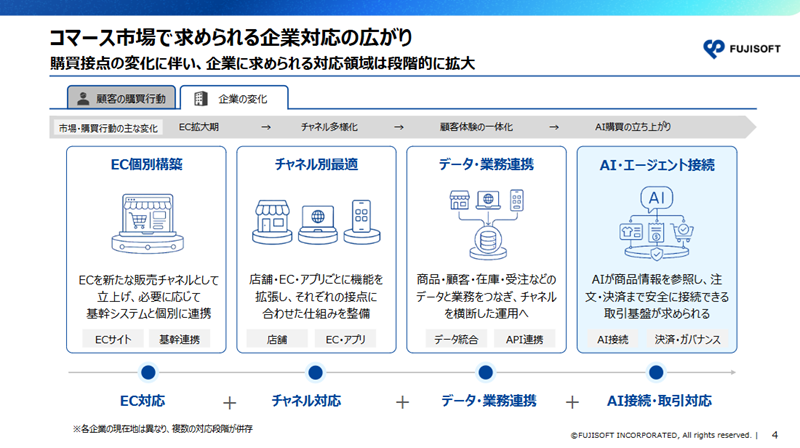
Against this backdrop, the report noted that there is a growing need for a transaction infrastructure that allows AI to reference product information and securely connect all processes through to ordering and payment. In particular, demand in the B2B sector is expected to grow significantly going forward.
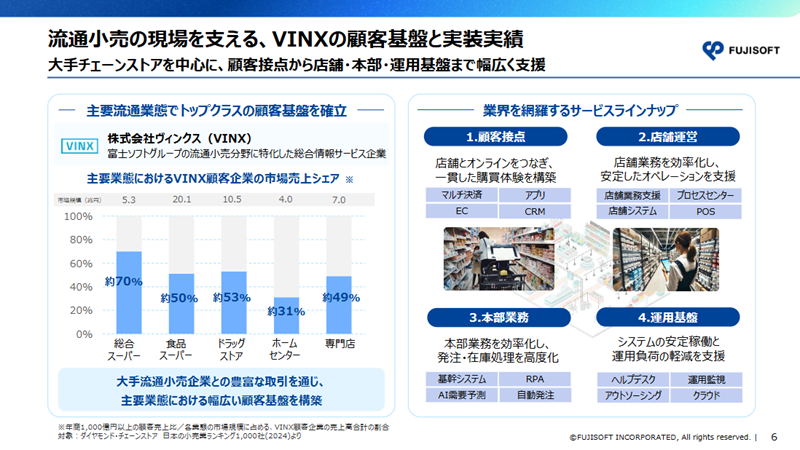
The Fujisoft Group combines the strengths of its own VINX with those of partners such as ecbeing, Snowflake, and Stripe to provide support ranging from customer touchpoints to ordering, payment, core systems, and logistics. For example, VINX reportedly provides extensive support—from customer touchpoints to headquarters and operational infrastructure—primarily for major chain stores such as Aeon.
VINX reportedly holds a high market share in key retail sectors and has built a broad customer base in these sectors through partnerships with major retail distribution companies.
Starting in the U.S., will adoption in Japan follow soon?
Connecting AI touchpoints with corporate operational infrastructure
It is said that an environment is now taking shape where AI can take over for users, handling everything from search, comparison, and selection to purchase. With commercialization having begun in the U.S., expanded adoption and full-scale competition among companies are expected in Japan in the future. Furthermore, these changes are not limited to the shopping experience but are spreading to customer touchpoints, sales activities, and business operations.
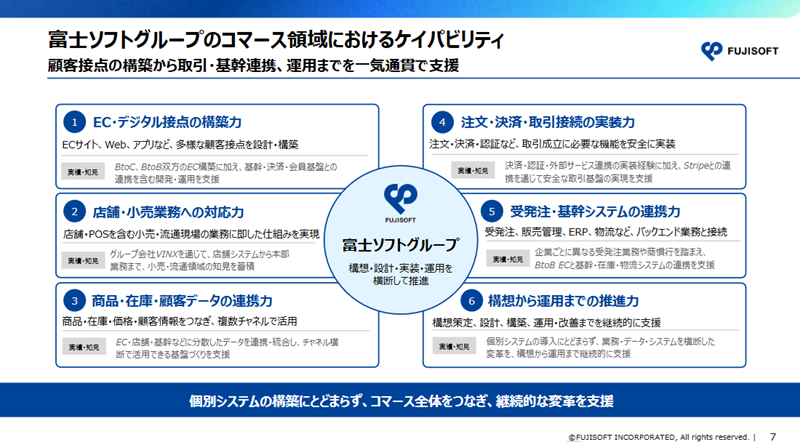
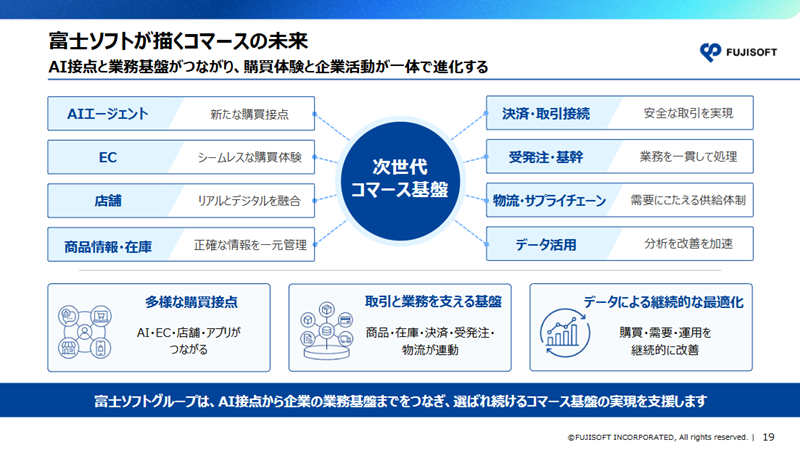
In the realm of agent-driven commerce, the company connects AI touchpoints with corporate operational infrastructure, providing end-to-end support for the realization of agent-driven commerce.
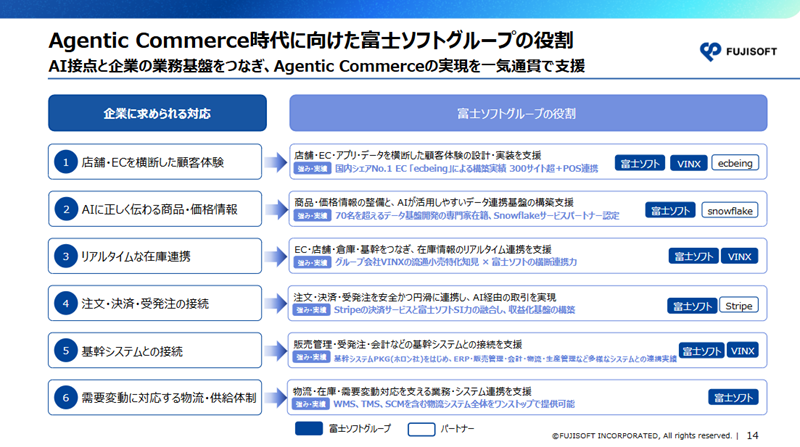
In supporting the design and implementation of customer experiences that span physical stores, e-commerce, apps, and data, the company leverages its track record of building over 300 e-commerce sites using the “ecbeing” platform, as well as the FujiSoft Group’s strengths in POS integration.
In terms of organizing product and pricing information and supporting the construction of a data integration platform optimized for AI use, the company highlighted its strengths, including a team of over 70 data infrastructure development experts and its certification as a Snowflake Service Partner.
Leveraging
expertise in integration with Stripe, including ACP and UCP support Streamlining the entire transaction flow—from AI touchpoints to orders, payments, and operational processing—into a single workflow
For integration between e-commerce, stores, warehouses, and core systems—as well as real-time inventory data synchronization—the solution leverages VINX’s specialized expertise in distribution and retail, combined with Fujisoft’s cross-functional integration capabilities.
Regarding initiatives to securely and seamlessly integrate orders, payments, and order processing to enable AI-mediated transactions, the company aims to build a monetization foundation by combining the payment services of Stripe—an international payment service provider—with Fujisoft’s system integration capabilities.
Stripe is a pioneer in the agent-based commerce field, including the development of industry standards, and the partnership will leverage that expertise.
Regarding integration with core systems, the partnership will reportedly support connections with sales management, order processing, and accounting systems. Fujisoft and VINX have a proven track record of integrating with a wide range of systems, including the PKG core system (from Holon), as well as ERP, sales management, accounting, logistics, and production management systems.
Furthermore, in supporting operational and system integration to handle logistics, inventory, and demand fluctuations, they state they can provide a one-stop solution for the entire logistics system, including MS, TMS, and SCM.
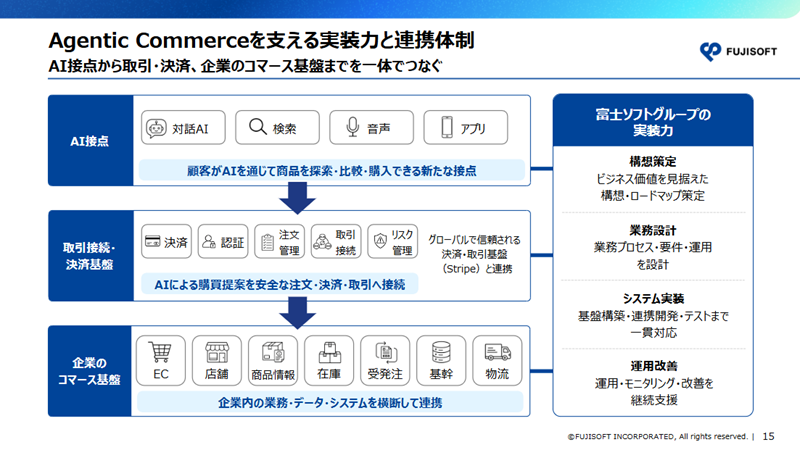
Furthermore, the Fujisoft Group states that it can seamlessly integrate everything from AI touchpoints to transactions, payments, and corporate commerce infrastructure. They noted that they are capable of handling everything from concept development and business process design to system implementation and operational improvements.
In the payment sector, through the aforementioned integration with Stripe, the company can connect multiple AI touchpoints and protocols to a company’s transaction infrastructure, enabling secure purchases.Key challenges in corporate e-commerce transactions include: (1) Even if AI makes a recommendation, the transaction is not completed unless it leads to an order and payment; (2) For purchases made via AI, the importance of authentication, fraud prevention, and order integration increases; and (3) A common foundation spanning multiple AI touchpoints and protocols is required.
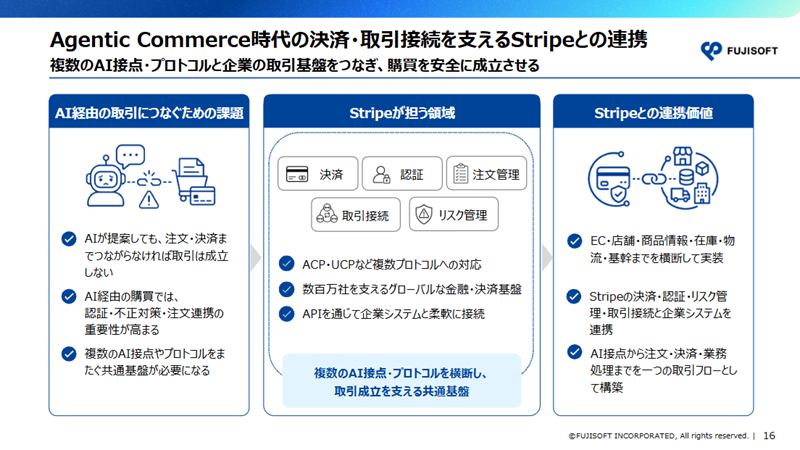
Stripe’s strengths include support for multiple protocols such as ACP (Agentic Commerce Protocol) and UCP (Universal Commerce Protocol); a global financial and payment infrastructure that supports millions of companies; and flexible integration with enterprise systems via APIs.“Companies will need to support ACP and UCP,” said Akihiro Shibata, Executive Officer and General Manager of the Net Solutions Business Division, Solutions Business Unit. Implementation has already begun in the U.S. at companies like Amazon, and through the partnership with Stripe, the company aims to bring that expertise to the Japanese market at an early stage.
Furthermore, through collaboration with the Fujisoft Group, the company can implement solutions that span e-commerce, physical stores, product information, inventory, logistics, and core business systems. It is also possible to integrate Stripe’s payment processing, authentication, risk management, and transaction connectivity with enterprise systems
. Furthermore, the solution reportedly enables the construction of a single transaction flow spanning from AI touchpoints to orders, payments, and operational processing.
As a partner in the Stripe Partner Ecosystem, Fujisoft supports companies in implementing digital payment and monetization infrastructure, integrating with existing systems, and continuously improving operations.
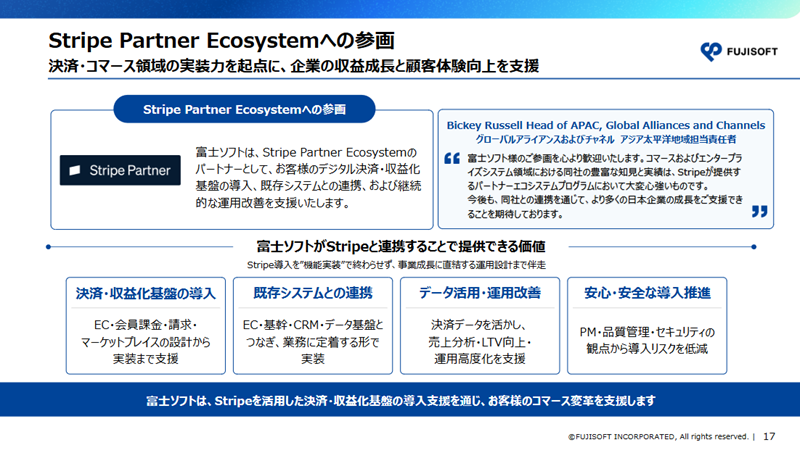
Fuji Soft stated that it aims to work closely with companies to understand their current situation and jointly realize a “connected commerce platform” for the age of agency-driven commerce.
In July, the company announced its unique strengths, competitive advantages, and business strategy for the era of AI transformation.Upcoming events include the unveiling of the “Smart Factory” in September—a concrete example of Fujisoft’s next-generation manufacturing transformation centered on physical AI—as well as a review of FY2026’s transformation efforts and the announcement of a new management strategy for FY2027, scheduled for November–December.