July 29, 2026, 9:26 a.m.
Adyen conducted a survey titled “Adyen Index Japan Retail 2026” on payment trends in the retail industry, targeting Japanese retailers and consumers. The survey suggests a significant gap between Japanese retailers’ and consumers’ attitudes toward AI-powered shopping assistants.
While 97% of retailers plan to invest in agentic commerce over the next two years, 62% of consumers reported having “reservations” about entrusting their purchases to AI assistants.This gap stems from “security risks in the AI era,” and the key to the future adoption of agentic commerce in Japan will be whether retailers can demonstrate appropriate security measures to alleviate consumer concerns.
In addition, more than one in three consumers reported having used an AI assistant while shopping in the past 12 months.Amid the overwhelming amount of information available online—including on social media—AI is becoming increasingly accepted as a “tool for sorting through information noise and making optimal choices.” However, consumers remain notably cautious about entrusting the entire purchasing process, right up to the final payment, to AI.
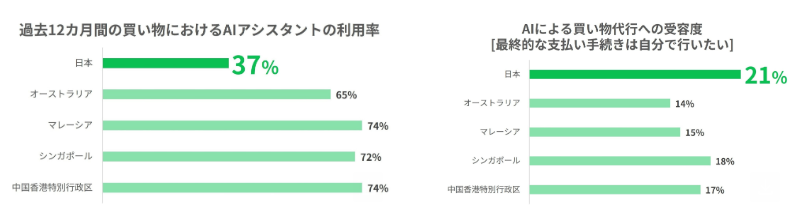
Compared to other countries in the Asia-Pacific (APAC) region, the adoption rate of AI assistants in Japan remains relatively low at 37%.Furthermore, the percentage of people in Japan who prefer to “handle the final payment process themselves” stands at 21%, which is 3 to 7 percentage points higher than in other surveyed countries and regions (14–18%, with an average of 16%).
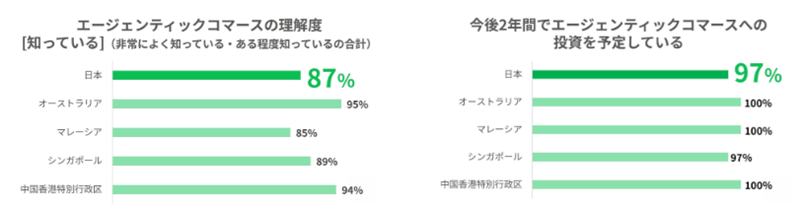
Furthermore, in contrast to consumers’ cautious attitude, retailers are reportedly moving quickly to prepare for the advent of “agent-driven commerce.” Eighty-seven percent of retailers are aware of this concept, and nearly all plan to make some form of investment over the next two years.
The primary drivers behind this rush to invest are “improving payment risk management and addressing challenges arising from the transaction speeds enabled by AI.” As AI-driven transaction speeds and processing volumes increase, concerns are mounting regarding the impact on identity verification and payment processing, underscoring the growing importance of modernizing payment backend systems to meet the demands of the AI era.
Japanese retailers’ awareness of and willingness to invest in agent-based commerce are on par with those in other APAC countries, and their sense of urgency regarding AI readiness is among the highest.
With the widespread adoption of AI in the shopping experience, security measures are shifting from being merely a backend issue to a factor that directly influences the customer experience itself.As the use of AI becomes commonplace in daily life, consumer awareness of safety is rising more than ever before. In fact, more than one in four consumers believe that “AI raises security concerns but is unavoidable,” and only a small minority of consumers said they would prefer “faster payments even if it means simplified security checks.”
The fact that the response “AI raises security concerns but is unavoidable” topped the list at 28% is said to be a trend unique to Japan. This trend is not observed in other APAC countries, suggesting that Japanese consumers are far more sensitive to the security risks associated with AI than consumers in other countries are to its convenience.