November 24, 2026, 8:00 a.m. (JST)
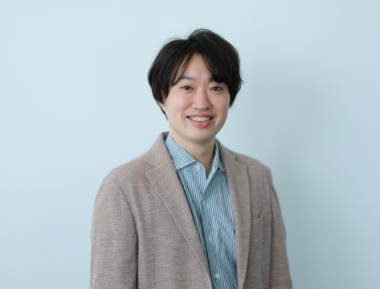
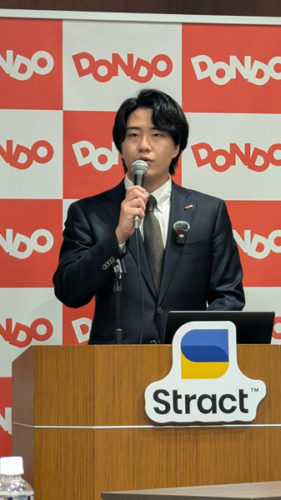
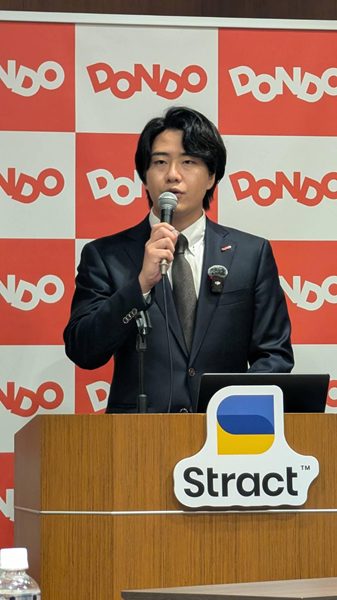
[Japan] On November 18, 2026, STRACT officially announced “DONDO,” a personal AI agent specialized for the domestic e-commerce market. The service compares products across multiple e-commerce sites, displays the effective price after factoring in rewards such as point rebates, and handles the purchase process on the user’s behalf right up until the final confirmation. The service is free for users.Akira Ito, President and CEO of STRACT, first highlighted consumers’ explicit desire to “buy cheaply and get the best deals,” and explained the company’s strategy to eventually expand the service into an experience that eliminates the hassle of shopping.At the same time, the company announced the full-scale launch of “ureteku AI” for e-commerce operators, as well as the raising of approximately 1.2 billion yen in funding through investments and loans.
Transforming the Shopping Experience, Starting with the Desire to “Shop for the Best Deals”
STRACT has revamped “PLUG,” a shopping app with a cumulative total of 3 million downloads and approximately 800,000 monthly active users, and is relaunching it as DONDO.Mr. Ito described the company’s vision of “agent-driven commerce” as extending beyond AI-powered product search and recommendations to encompass the entire process—from searching and comparing to completing the purchase.
During the Q&A session, Mr. Ito explained consumer needs by dividing them into “explicit” and “latent” categories. Explicit needs include “low prices,” “good deals,” and “not getting ripped off,” so the company will initially focus on driving adoption by highlighting the lowest prices and coupons.On the other hand, entrusting shopping to AI to gain time and peace of mind is a latent need, and the company aims to expand this experience as users engage with the service.
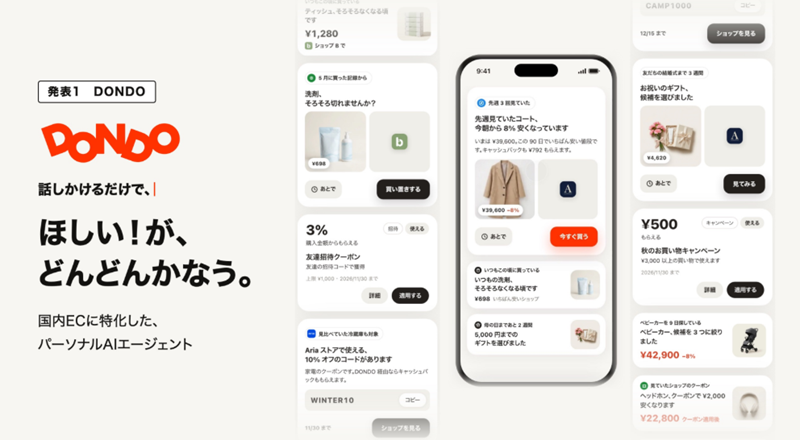
DONDO proactively suggests products of interest and price drop information based on users’ browsing and purchase histories, with their consent. Drawing on approximately 1 billion product data points, it compares prices across platforms such as Amazon and Rakuten Ichiba. Users can find the most advantageous place to buy by considering not only the listed price but also points, membership tiers, and promotions—all factored into an “effective price.”
The user makes the final purchase decision; card information is managed on the device
Once a product is selected, DONDO assists users on the corresponding e-commerce site by adding the item to the cart and entering shipping addresses and payment methods. However, the user must press the final Purchase button themselves. Mr. Ito cited the fact that the AI does not independently execute the payment process as a key element of the service’s safety design.
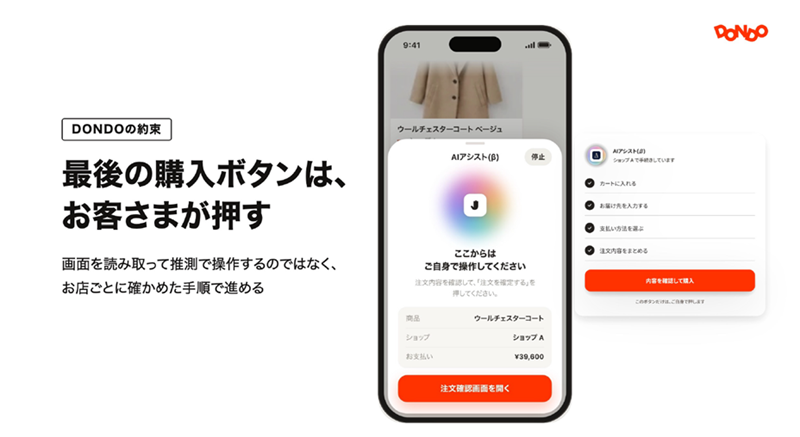
During the Q&A session at the press conference, the company explained that e-commerce site IDs, passwords, and credit card information are not stored on STRACT’s servers; instead, the input process is handled within the user’s smartphone browser.
In a press roundtable following the conference, one of the company’s engineers introduced a concept whereby the AI learns users’ preferences—such as e-commerce sites they do not wish to use—and reflects these non-price criteria in its recommendations. However, he noted that this feature has not yet been implemented. He also acknowledged that for users who shop exclusively on specific e-commerce sites, it may be difficult to fully leverage DONDO’s strength in comparing multiple options.
Free Service Funded by Performance-Based Fees from E-Commerce Operators; Commissions Average Single-Digit Percentages
DONDO does not charge consumers a monthly fee; instead, it receives performance-based commissions from e-commerce operators when products are sold. According to the press release, the standard commission rate for merchandise-based e-commerce is approximately 1–10% of sales. During the Q&A session, Mr. Ito explained that the current average rate is “a single-digit percentage,” determined through negotiations based on the product category and the specific operator.
The company has partnerships with approximately 2,200 e-commerce sites and maintains a pre-prepared database of product information. Furthermore, since purchase operations are executed using standard programs following procedure manuals tailored to each e-commerce site, the company claims it can reduce computational costs compared to a system that requires the AI to perform inferences on a case-by-case basis.
The relationship between product recommendations and advertising was also discussed. Mr. Ito explained that the system does not mechanically prioritize merchants who pay higher commissions. However, since partner merchants can provide detailed product information, their products may consequently be more likely to be recommended. The company plans to offer separate paid PR slots where merchants can specify promotional copy and other details.
“ureteku AI” for Sellers Also Offers Free Initial Setup and No Monthly Fees
“ureteku AI,” designed for e-commerce businesses, analyzes how AI systems like ChatGPT and Gemini describe a company’s products and identifies ways to differentiate from competitors and improve product descriptions. In addition to formatting product data into a format that AI can easily read, it also provides CRM features such as email and coupon distribution.
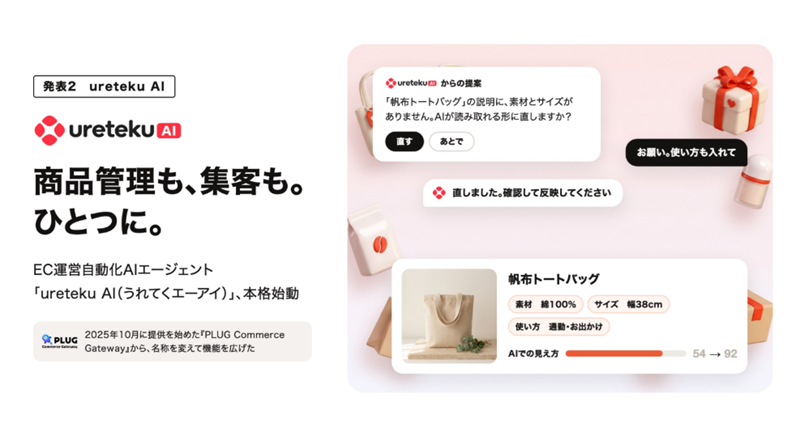
There are no setup or monthly fees; the company earns a commission only when products are sold through DONDO. During the Q&A session, the company explained that, as a general rule, using ureteku AI entails a contractual obligation to list products on DONDO as well. The company aims to have the service adopted by 15,000 shops within one year.
Expanding to Reservations and Contracts; “Premium” to Verify Security
The company is also planning “DONDO Premium” (tentative name), a service that will handle travel reservations, contract signings and cancellations, and phone support on behalf of users, with the goal of launching it by the end of 2026. However, it is currently in the design and prototyping phase, and pricing and an official launch date have not yet been determined.
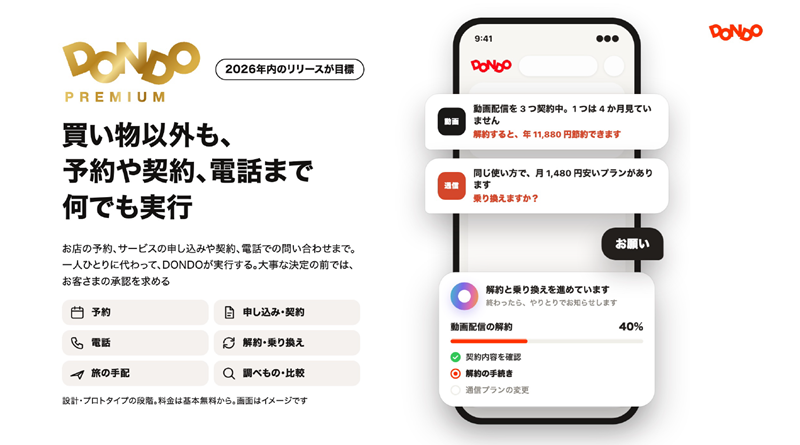
Since Premium will handle confidential data such as authentication credentials, it will employ a different mechanism than the free version.Principal Product Engineer Yu Usami explained the design, which incorporates AWS Nitro Enclaves’ isolated execution environment, open-source code, and the ability to undergo third-party verification. The plan requires user approval via digital signature for payments and contracts, and communication will be blocked if approval is not granted.
Raised Approximately 1.2 Billion Yen; to Strengthen Adoption Initiatives Starting in Spring 2027
The company raised approximately 1.2 billion yen through a combination of investments and loans from NTT Docomo Ventures and others, bringing its cumulative funding to 2.62 billion yen. The funds will be allocated to computing resources, feature development, and the enhancement of security measures.
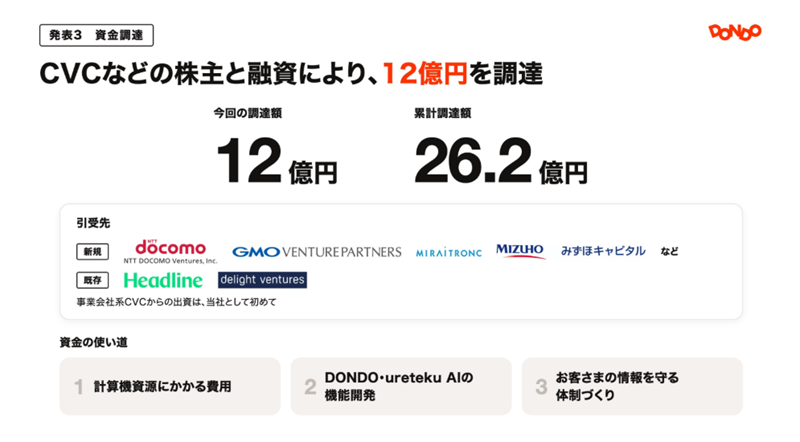
Mr. Ito indicated the company intends to launch a mass marketing campaign, including TV commercials, starting around spring 2027.The company aims for a cumulative total of 10 million DONDO downloads over the next year and targets an annual gross merchandise volume (GMV) of 1 trillion yen in five years. The key challenge will be whether the service can establish AI-powered shopping assistance as a regular part of daily life, using clear price benefits as an entry point.