October 30, 2026, 8:40 a.m. (JST)
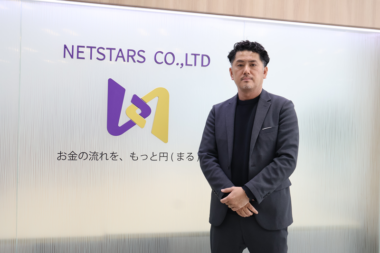
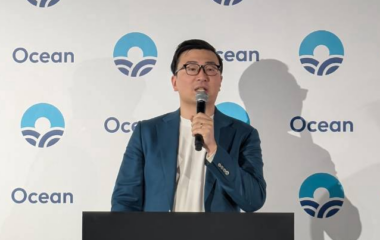
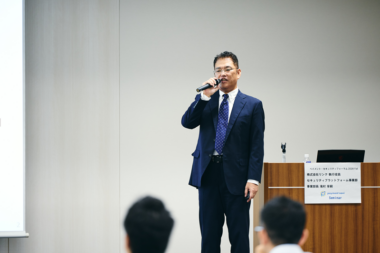
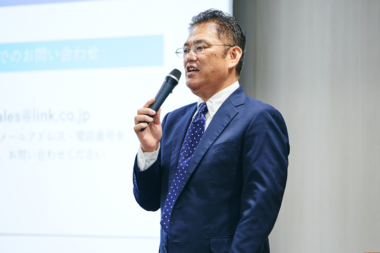
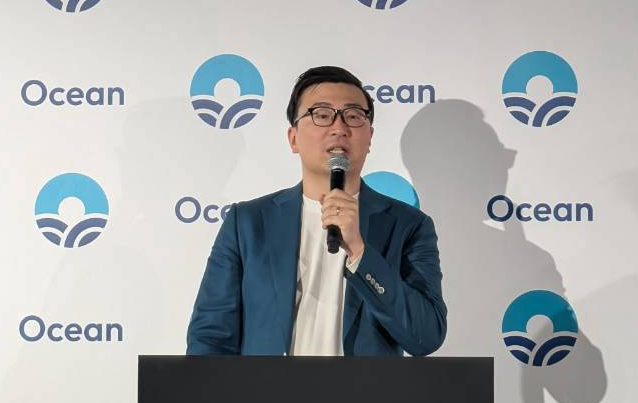
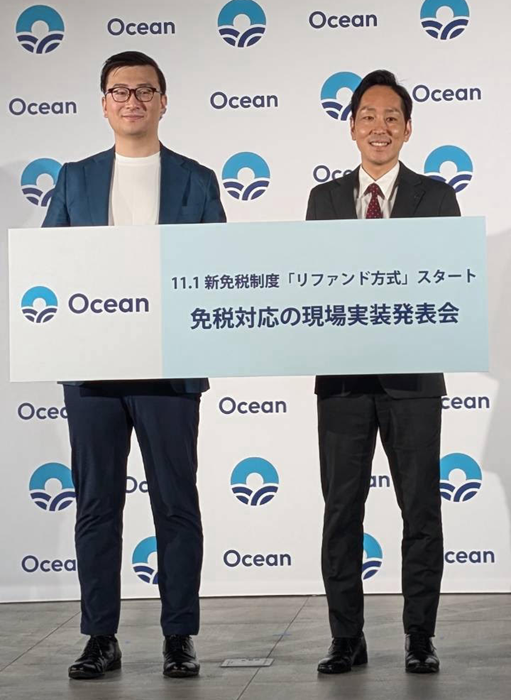
[Japan] On October 29, 2026, Ocean held a press conference in Tokyo titled “Announcement of ‘On-Site Implementation of Duty-Free Support’ in the Era of the New Duty-Free System,” where it explained its preparations for the refund-based consumption tax exemption system set to begin on November 1.The company’s duty-free platform, “Ocean Tax Refund,” waives initial setup and monthly fixed fees for retailers and streamlines duty-free operations through AI, OCR, and POS integration. As of early October, the company had received applications from over 500 stores, and with investment from Yamato Holdings, it aims to expand its business beyond mere duty-free processing.
Concerns Over a Simultaneous Shift to the Refund System and
Stores Withdrawing from the Tax-Free Program
Starting November 1, 2026, Japan’s consumption tax exemption system will shift from the traditional in-store instant tax-free system to the “refund system,” in which the amount equivalent to the consumption tax is refunded after verification of the goods’ removal upon departure.
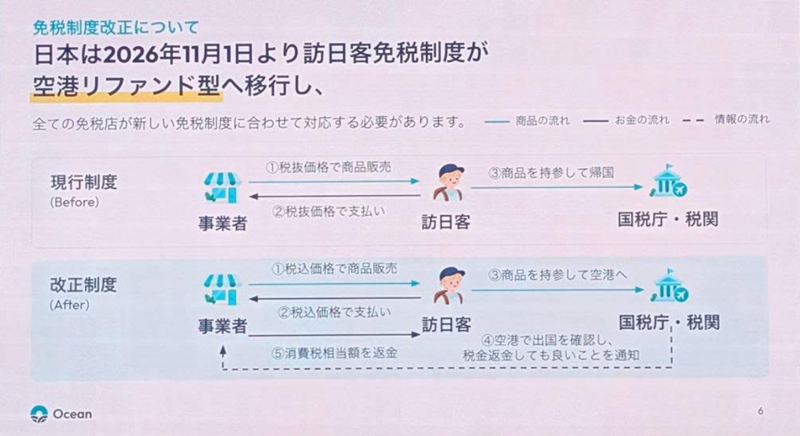
Under the previous system, visitors to Japan paid the pre-tax price at the store; under the new system, they will first purchase items at the tax-inclusive price and then receive a refund after customs officials verify that the goods have been taken out of the country upon departure. This will create new operational tasks for retailers, such as obtaining customs verification information and processing refunds.
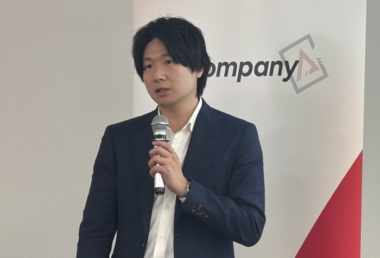
Ryo Hoshino, CEO of Ocean, cited fraud prevention, a review of responsibilities regarding tax-free sales, and alignment with international systems as the reasons behind the policy change.
On the other hand, he pointed out that since there is no transition period during which both the old and new systems can be used concurrently, challenges will arise, such as system upgrades for stores, staff training, and providing multilingual support for visitors to Japan. He noted that small and medium-sized stores, in particular, may choose to discontinue tax-free sales—a phenomenon known as “tax-free withdrawal”—due to the costs and effort involved in adapting to the new system.Mr. Hoshino explained that it is the role of private-sector operators, including Ocean, to bridge the gap between the system and its practical implementation on the ground.
No initial or monthly fees,
Tax-free procedures in as little as 10 seconds using AI and OCR
“Ocean Tax Refund,” provided by Ocean, is a tax-free shopping platform newly developed in anticipation of these regulatory changes.
It features a pricing structure that waives initial and monthly fixed fees for participating merchants, making it easy to implement regardless of store size. Mr. Hoshino explained that the goal is not to engage in price competition, but rather to reduce the number of stores that give up on offering tax-free services due to implementation costs.
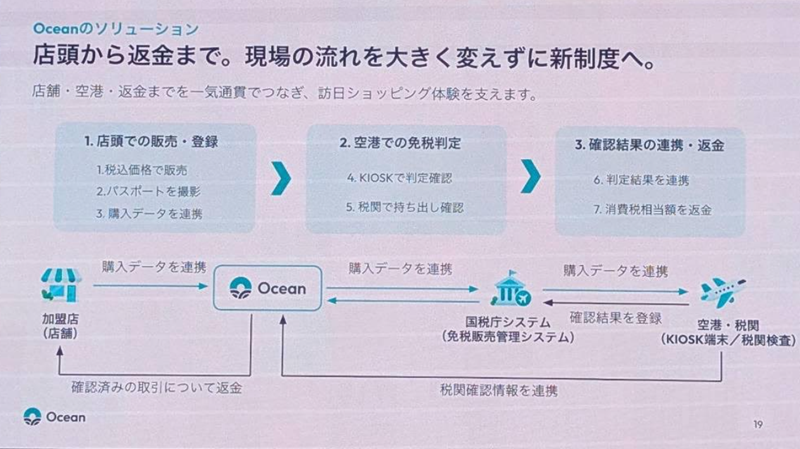
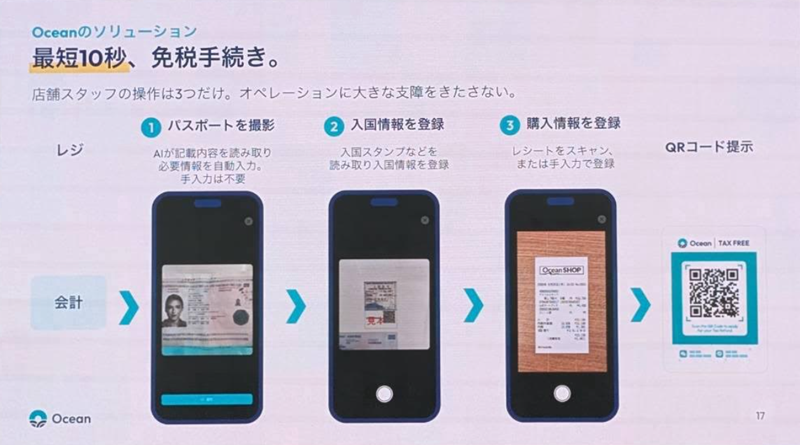
The system is designed so that store staff can complete the process in a few simple steps, enabling tax-free procedures in as little as 10 seconds. When a passport or landing permit is photographed with a camera, AI and OCR automatically input the necessary information; the system also integrates with POS systems to automatically import purchase data.
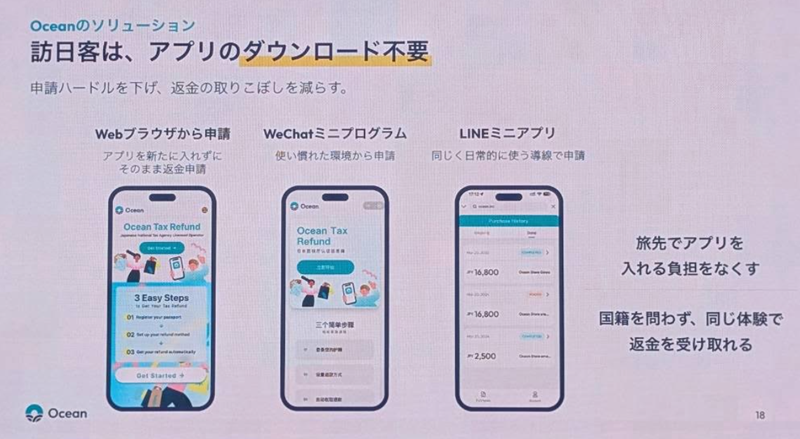
Visitors to Japan do not need to download a dedicated app; they can apply for refunds via a web browser, as well as through a WeChat mini-program for mainland China and a LINE mini-app for Taiwan.
Additionally, the company provides multilingual instructional materials and a support desk for retailers. It also offers multilingual support to visitors to Japan regarding how to apply for refunds and the status of their refund requests.
In terms of fees, the service is free for merchants to implement; instead, it generates revenue by deducting a fee from visitors’ refunds. According to the presentation materials, the standard system usage fee paid by visitors is 1.55% of the purchase price, and a Payment Processing Fee also applies depending on the refund method.
During the Q&A session, Mr. Hoshino explained that, at this time, there are no plans to charge merchants any new fixed fees.
Operations began on November 1 at 64 Seiyu stores,
with over 500 stores having applied
In terms of implementation, the service is expanding to major retailers.
On October 29, Ocean announced the rollout of the service to Trial Group’s “Trial” and “Seiyu” stores. Seiyu will begin operations on November 1 at all 64 of its duty-free-eligible stores.
The system automates the entry of purchase information—which was previously entered manually at service counters—by using AI and OCR to read receipts, thereby streamlining the tax-free processing. Trial is also rolling out the system at additional locations, starting with the “Trial Seiyu Machida Store,” and plans to proceed with importing purchase data through POS integration in the future.
In addition, the system has been approved for implementation at stores such as Animate and Yamada Denki.
During the Q&A session, Mr. Hoshino explained that, based on information disclosed as of early October, the number of stores that have applied exceeds 500. He noted that applications are coming not only from major chains but also from small and medium-sized stores.
With the program’s launch approaching, last-minute inquiries are on the rise; he cited an example of a sake brewery in Shimane Prefecture that contacted them hoping to be ready in time for the program’s start on November 1.
However, the company has not disclosed targets for the number of participating stores or transaction volume for the first year. It plans to monitor market trends after the program launches to determine which industries and regions to prioritize.
Yamato HD Invests, Explores Collaboration Leveraging Nationwide Customer Touchpoints
On October 9, 2026, Yamato Holdings announced an investment in Ocean through its corporate venture capital (CVC) fund, “KURONEKO Innovation Fund No. 2.”
Kenji Mori, Manager of Innovation Promotion at Yamato Holdings, who spoke at the press conference, cited three reasons for the investment.
First, Mr. Hoshino has a direct understanding of the challenges faced by inbound tourists and duty-free shops and is actively driving the business forward. Second, the company is building systems that prioritize convenience for inbound tourists by utilizing platforms such as WeChat and LINE. Third, the company praised the fact that the system can be easily and inexpensively implemented by stores and offers scalability for future data-driven marketing.
Yamato HD already offers delivery services that support “hands-free” tourism and maintains points of contact with inbound tourists and retailers through its approximately 2,800 branches and sales drivers nationwide.
Mr. Mori mentioned the potential to collaborate with Ocean to resolve challenges identified through these touchpoints. However, he noted that specific joint services are not yet ready for announcement, and the two companies are currently exploring future business collaboration.
From Duty-Free Operations to Inbound Tourist Referral and Marketing Support
In the future, Ocean aims to evolve from a system that handles duty-free processing into a customer referral and marketing platform that leverages the purchasing data of visitors to Japan.
Mr. Hoshino explained that they are envisioning a system that utilizes purchasing trends and other data obtained through duty-free procedures to support customer acquisition and sales promotion for stores.
In addition to duty-free procedures, they are also considering integration with services such as payment processing, logistics, and tourism. The goal is to enhance the overall shopping experience—including both before and after the purchase—such as by delivering goods purchased by visitors to Japan to their desired locations.
Mr. Hoshino stated that the company aims not only to reduce the burden on retailers resulting from regulatory changes but also to build a foundation that connects Japanese products and brands with overseas consumers. Taking the transition to the refund system as an opportunity, Ocean plans to digitize its duty-free operations and expand its services in the inbound market.