November 25, 2026, 8:00 a.m. (JST)
[Japan] NTT DOCOMO Business(formerly NTT Communications, Tokyo, Japan) announced on October 28, 2026, the launch of “docomo business ANCAR Agent,” featuring an AI agent function, and “docomo business ANCAR Marketing,” an AI marketing function, as new additions to its “docomo business ANCAR” lineup of communication services that integrate AI and telecommunications.ANCAR Marketing is scheduled to launch in December 2026, and ANCAR Agent is scheduled to launch within fiscal year 2026.
Creating
New Revenue Opportunities Leveraging Voice and Interaction Data for Sales Activities
Amid a severe labor shortage that has become a major social issue, the company has unveiled a strategy that not only streamlines customer touchpoints—such as contact centers and retail stores—but also leverages data obtained from customer conversations and inquiries for sales and marketing activities, thereby creating new revenue opportunities.
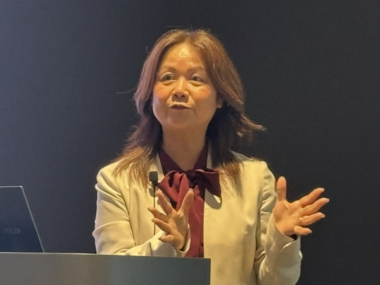
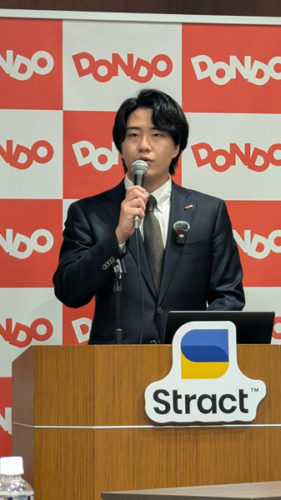
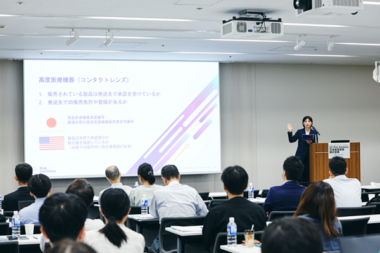
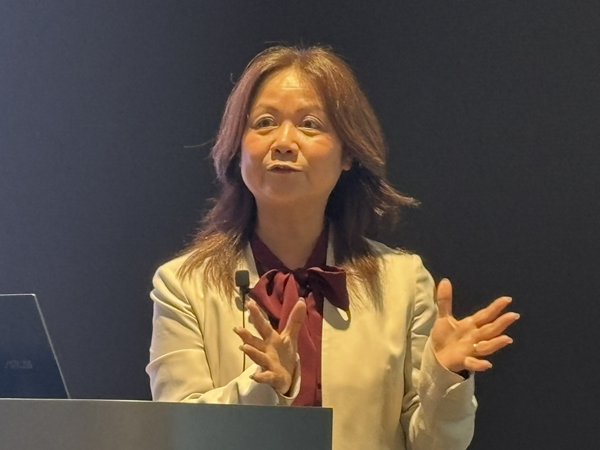
Speaking at the briefing, Satoko Takahashi, Executive Officer at NTT Docomo Business and General Manager of the Communication & Application Services Department, Platform Services Division, stated, “We will leverage data from customer touchpoints not only to improve the quality and efficiency of customer service but also to drive corporate revenue growth and create new business opportunities.”
ANCAR has previously provided services such as AI-IVR (Interactive Voice Response) capable of recognizing free-form speech, call transcription and AI-powered summarization, and customer experience analysis as SaaS solutions.The newly launched ANCAR Marketing is a feature that performs cross-functional integration and analysis of audio data, interaction histories, and call data accumulated at contact centers, retail stores, and sales offices, alongside customer attributes, purchase histories, and online behavior data held by companies.
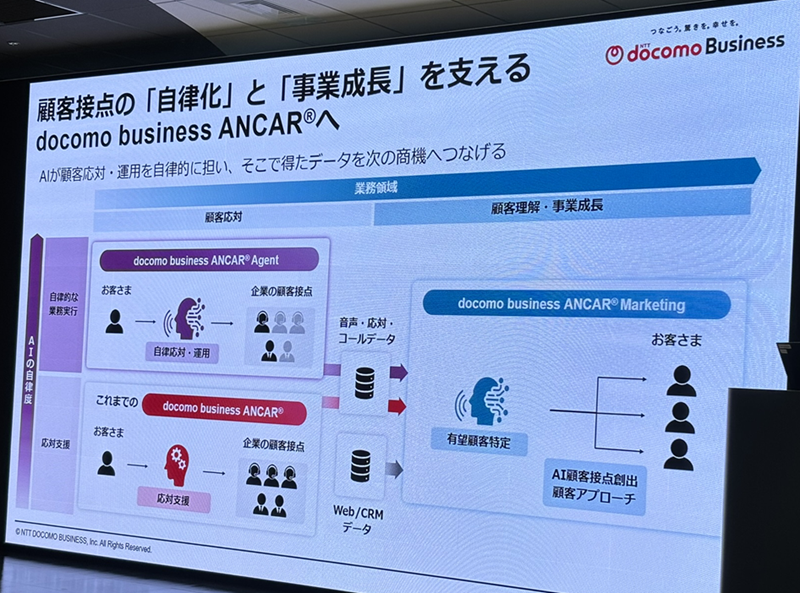
According to the company, this service extends the use of inquiry data—which has traditionally been used to improve customer service quality and streamline operations—into the sales and marketing domains.
Specifically, the service identifies areas of interest and challenges based on the conversation content and inquiry history of each individual customer, thereby assisting in the identification of high-potential customers and the selection of prospects to be approached first. Furthermore, through dialogue with AI, it delves deeper into customer segment trends and factors leading to purchases, which in turn helps refine the planning of marketing strategies, such as messaging and approach methods.
Mr. Takahashi explained, “This is an AI marketing feature that captures previously unseen demand and creates new business opportunities.”
Data Utilization
Leveraging a Telecommunications Infrastructure Serving Over 100,000 Companies Japan’s First SaaS-Based AI Marketing Function
A key feature of ANCAR Marketing that the company highlights is the integration of its voice service infrastructure—including toll-free numbers provided to over 100,000 companies as a telecommunications carrier—with its own carrier network.
Data is fragmented across customer touchpoints—such as phone calls, chat,and physical stores—and are not being fully utilized for product and service improvements or marketing. The company positions its ability to integrate and analyze call data (such as connection information) and voice data obtained through toll-free numbers and IP phones, along with the customer and purchase data held by the company, on a single platform as a key differentiator.
The company positions this as Japan’s first SaaS-based AI marketing solution that integrates call data from telecommunications carrier networks with customer data on a single platform to support AI-driven strategy development.
Affordable implementation with no dedicated equipment required?
AI autonomously handles everything from customer service to infrastructure operations
Meanwhile, ANCAR Agent is a service that allows companies to use their existing phone numbers—currently used as customer service hotlines—as the entry point for AI agents. It is characterized by its ability to be implemented easily and affordably without requiring dedicated equipment or significantly altering the existing voice infrastructure.
Users simply speak their inquiry as they would on a regular phone call, and the AI—connected via the carrier network—understands their request. In addition to answering inquiries and providing support, it completes a full range of tasks, including reservations, orders, and various arrangements that require integration with external systems.
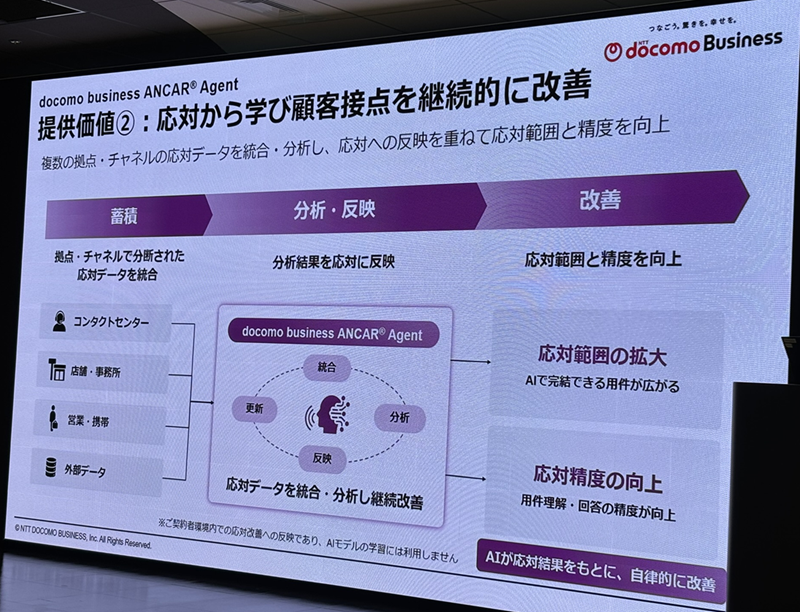
Furthermore, the company envisions a system where AI continuously and autonomously learns and executes tasks—including the management of customer touchpoints—by integrating and analyzing response data from multiple locations and channels. Based on changes in circumstances and operations, the AI will: (1) generate and update FAQs; (2) improve call flows; (3) analyze response data; and (4) optimize the operation of communication infrastructure.This approach supports the continuous enhancement of customer touchpoints while reducing the burden of securing personnel to manage operations.
By fiscal year 2030, the company aims to establish a system where AI agents handle 80 percent of incoming calls to client customer service centers as the first point of contact, transferring calls to human agents only when necessary.
From “Customer Service” to
“Business Growth Support” Aiming for 60 billion yen in revenue by fiscal year 2030
During the briefing, survey results were presented indicating that, despite the expansion of AI adoption at customer touchpoints from the pilot phase to full-scale implementation against the backdrop of labor shortages, only a limited number of companies have progressed to company-wide utilization.
Mr. Takahashi cited the following challenges as the reasons for this: (1) the inability to roll out the system across a broad range of customer touchpoints; (2) the significant burden of post-implementation information updates and continuous improvement of AI operations, in addition to the initial implementation costs; and (3) a shortage of personnel to handle operations and data analysis.
To address these challenges, the company aims to evolve into a platform that not only streamlines customer service but also transforms customer feedback into a corporate asset, thereby supporting sales expansion and business growth—by combining the automation of customer interactions and operations through ANCAR Agent with the cross-functional utilization of siloed data via ANCAR Marketing.
As part of its “Customer Zero” initiative—in which the company serves as its own first user—NTT Docomo Business is implementing ANCAR at its nine major contact centers to verify its functionality. The company reports that the introduction of AI-based call routing at its contact centers has already yielded results, such as reducing wait times to connect with an agent by approximately 30%.Moving forward, the company plans to leverage the insights gained from its own implementation to enhance and improve new features, with the goal of generating 60 billion yen in revenue from ANCAR-related businesses by fiscal year 2030.