November 25, 2026, 8:15 a.m. (JST)
[Japan] On November 19, 2026, Smart Bank, in collaboration with Take and Give Needs (T&G), held an event titled “The Absolute Basics of Money: What You Should Discuss as a Couple” in Omotesando, Tokyo, targeting couples considering marriage and newlyweds.This initiative, aimed at users of the “OneBank” household budgeting app’s couple accounts, was designed to provide an opportunity for couples to discuss the division of household financial responsibilities and their future financial plans. According to the company’s survey, 69.5% of married men and women regretted a lack of communication on certain topics before or shortly after marriage.At the event, in addition to advice from financial planners, participating couples shared their specific household financial concerns and insights.

“Money and household finances” were the most common source of regret
In October 2026, Smart Bank conducted a survey on “Pre-marital Discussions and Regrets” among 440 married men and women aged 25 to 49.The percentage of respondents who discussed their future lives and values before or shortly after marriage was 56.4%. Among those married for less than three years, this figure reached 86.5%, significantly exceeding the 43.4% among those married for 10 years or more. This suggests that couples who have been married for a shorter period tend to place greater importance on premarital communication.
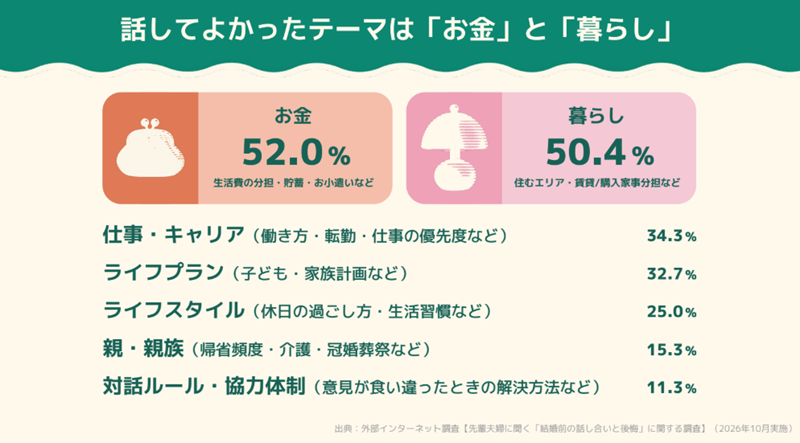
On the other hand, 69.5% of respondents felt they “should have discussed certain topics more thoroughly,” with “money and household finances” being the most common source of regret at 31.4%. Conversely, “money and household finances” also topped the list of topics respondents were glad they had discussed, at 52.0%.Specific topics of discussion included “sharing daily living expenses and managing bank accounts” at 67.4%, followed by “disclosing and sharing current income, savings, and debt” at 62.0%. The focus is not only on the amounts themselves but also on how to establish rules for payments and financial management.
“Separate Wallets” Are Also an Option,
The Key Is to Prevent Savings from Becoming a “Black Box”
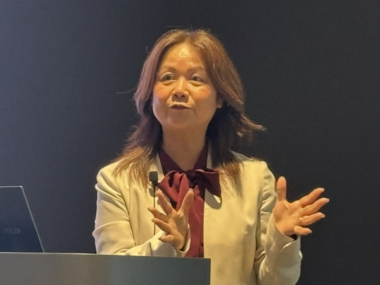
During the workshop, financial planner Masako Hatanaka addressed a typical question among newlyweds: “Should we have one joint wallet or separate ones?” With the number of dual-income households on the rise, she noted that precisely because both partners can manage the household finances, conflicts often arise over methods and priorities.
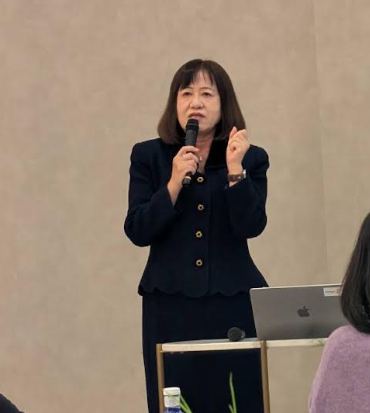
Ms. Hatanaka did not rule out separate finances, but she recommended that couples share their respective savings balances at least once a year. This is because if couples only pool funds for shared living expenses without keeping track of how the rest of their money is spent, it can lead to unexpected disagreements when major expenses—such as a home purchase or education costs—arise.
In a one-on-one interview after the session, Ms. Hatanaka emphasized, “It doesn’t matter which partner manages the household finances, but it’s important not to create a ‘black box.’” She added, “A simple method that can be sustained over the long term is best.” Rather than blaming each other for being good or bad at managing household finances, she said couples should choose a system that both can agree on and stick with.
Build an Emergency Fund Before Opening a NISA Account,
Review Your Couple’s Financial Plan Every Five Years
Regarding asset management, he advised that before starting a NISA account or similar investments, people should secure at least three months’—and ideally six months’—worth of living expenses in highly liquid assets such as savings.If you prioritize investing too much and run short on cash, you’ll be forced to sell assets when the market is down. In individual interviews, he also mentioned cases where clients continued using NISA while covering living expenses with cash advances, stressing that “the order is important.”
Mr. Hatanaka also pointed out that modern couples, precisely because they have access to so much information, tend to become overly fixated on their ideal life plans.“Life doesn’t always go as planned. It’s best to make plans in five-year increments and adjust course as needed,” he said, urging couples to maintain a flexible attitude toward discussing changes in plans, such as having children or buying a home. He added that AI-generated financial information is merely one option among many, and that the core question of “how do we want to live?” remains essential.

Participating Couples:
Visualizing “What We’ve Discussed and What We Haven’t”
At the venue, the event began with a presentation of survey results from married couples with more experience, followed by a Q&A-style session led by a financial planner. Participants used a “Checklist of What We’ve Discussed” to review topics such as money, work, daily life, family, and relationships with relatives.They also took part in a workshop where they selected three topics they’d like to discuss in the future and wrote down together when they planned to have those conversations. Those who wished to do so took commemorative photos in the chapel holding their declaration statements.
One participant, who had started living with their partner last month, attended because they wanted to consider how to manage their finances—which they had previously handled separately—moving forward. Reflecting on the workshop, they said, “We were able to take stock of what we’ve discussed and what we haven’t.”
Another couple also felt the need to clarify their respective priorities regarding their future lifestyle, such as housing, and expressed enthusiasm for future conversations, saying, “Let’s talk about this before the proposal.” The workshop served not only as an opportunity to learn about financial literacy but also to identify topics that need to be discussed.
Visualizing
Joint Expenses Moving Toward Cashless Household Management
“OneBank Pair Card,” provided by SmartBank, is a service that allows a shared balance to be accessed via two Visa prepaid cards. Both partners can add funds to the balance, and transaction history appears in the app regardless of who makes the payment. This system makes it easy for both partners to track their daily spending together.This event also aimed to link the digitization of payments and household budgeting to communication between married couples.
At the venue, T&G also introduced a service that allows couples to estimate wedding costs. Living expenses aren’t the only costs that arise when getting married.As dual-income households become the norm, the focus extends beyond simply earning a combined income to include how couples share their income, savings, and spending, and how they update their rules to adapt to changing circumstances. The role of financial services is also expanding from merely tracking expenses to supporting dialogue between partners.