July 30, 2026, 8:34 a.m.
Datachain has begun offering a beta version of its Service API for “KuraPrivacy,” its on-chain privacy protection platform for enterprises, to enable payment and wallet providers to integrate privacy protection features into their own services.In addition, the company has begun offering “Kura Pay,” a confidential payment demo application that allows partners to experience KuraPrivacy’s key features directly in a web browser.
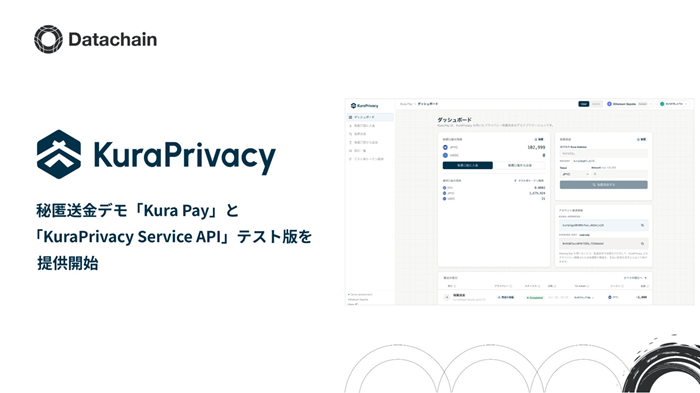
By utilizing the KuraPrivacy Service API (currently available on the testnet), companies can integrate privacy-preserving features into their own payment and wallet services. This allows payments from standard wallets to be executed while keeping the recipient’s identity confidential.On-chain, the sender’s address and the amount remain public, while only the recipient (which private account received the funds) is kept confidential. This is designed for scenarios such as in-store payments, where the payer’s identity can be identified but the recipient’s identity must remain anonymous.
Furthermore, by having both the sender and recipient hold anonymous accounts, the sender, recipient, and amount can all be concealed from third parties. This not only hides “who sent what to whom,” but also prevents the tracking of fund flows by linking multiple transactions.
Furthermore, by providing a viewing key, designated parties (such as auditors or the accounting department) can be granted permission to view only the transaction history and balance within a specific account range, without transferring the authority to send funds. The viewing key is read-only; transferring assets requires separate approval via a signing key.The design is not “invisible to everyone,” but rather “allows you to choose who can see it.”
In addition, it supports various authentication and signature methods already in use, such as EOA, WebAuthn/Passkeys, and contract wallets (including multisig). Since these existing keys can be used directly for ZK proof authorization, privacy protection features can be incorporated without significantly overhauling the authentication infrastructure.
Going forward, the company plans to provide an SDK for developers to facilitate integration into their services.