November 9, 2026, 9:26 a.m. (JST)
[Japan] On November 4, 2026, NTT Docomo held a financial results briefing for the second quarter of fiscal year 2026 and announced increased revenue driven by strong growth in its Smart Life business. The financial and payment services sector—led by credit cards—is a major driver of overall growth.In the credit card segment, membership is expanding, particularly for the premium “d Card GOLD” and “d Card PLATINUM” cards. The company plans to strengthen its customer base and foster customer loyalty by promoting cross-usage with banks, securities firms, and other financial institutions.
Smart Life Business Makes
Great Strides Financial and Total Payment Volume Grow
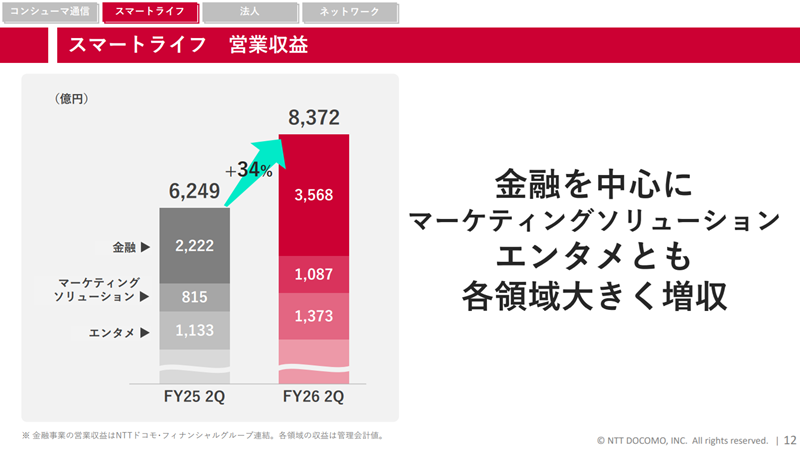
NTT DOCOMO’s second-quarter operating revenue totaled 3,282.1 billion yen (up 8.2% year-over-year), operating profit was 482.1 billion yen (up 1.5% year-over-year), and quarterly net income was 329.5 billion yen (down 3.0% year-over-year).Operating revenue for the Smart Life business—which includes finance and payments (Fintech) and marketing—rose 34% year-over-year to 837.2 billion yen. In addition to the expansion of the financial sector, which includes the consolidated effects of the bank, marketing solutions and entertainment also grew, driving Docomo’s overall growth.
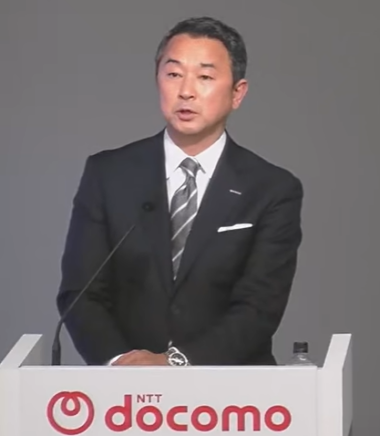
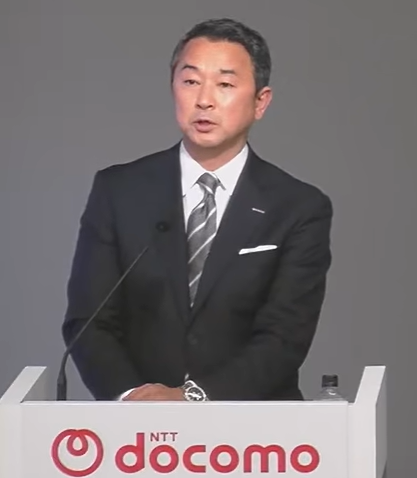
The Total Payment Volume for financial and payment services increased by more than 1 trillion yen year-on-year, reaching 9.31 trillion yen. Usage of both “d Pay” and “d Card” expanded.Yoshiaki Maeda, President and CEO of NTT DOCOMO, explained, “The number of subscriptions for the ‘d Card GOLD’ and ‘d Card PLATINUM’ credit cards increased by 860,000 to 14.7 million, further expanding our customer base, which is one of our key strengths.”
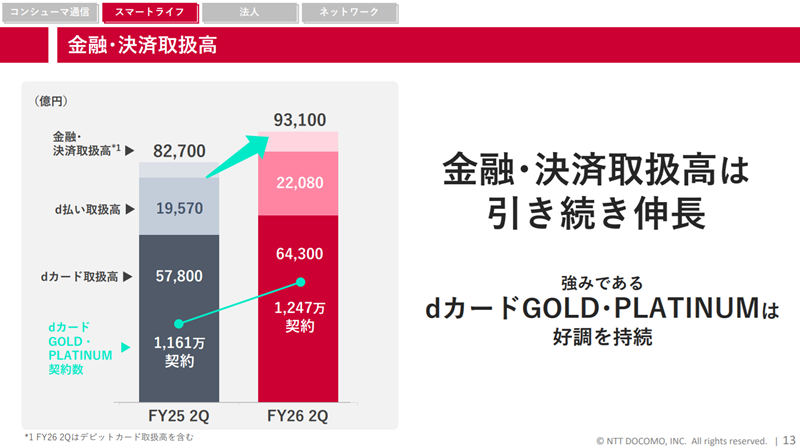
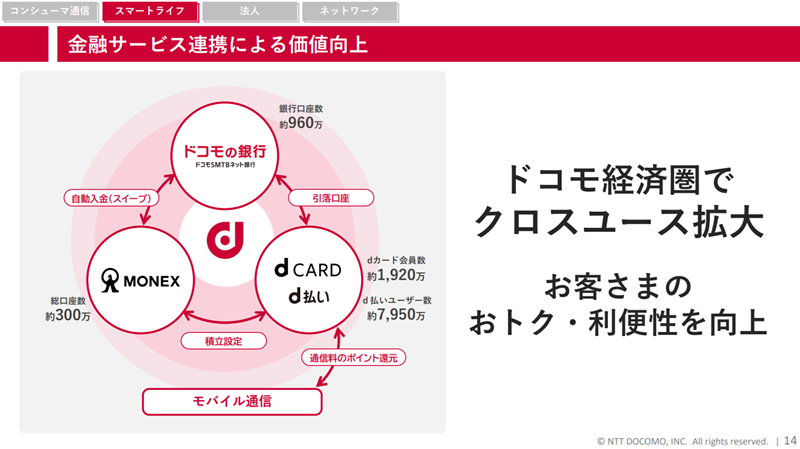
By combining this customer base with banking and securities services, the company aims to support customers in everything from daily payments to savings and wealth building. For example, the company is promoting integration across services—such as setting up bank accounts for card payments, configuring automatic savings plans, and establishing mechanisms to automatically transfer funds between bank and securities accounts. Through these efforts, the company aims to encourage customers to continue using multiple services.
Expanding
the Customer Base by Leveraging Physical Channels Increase in Loyal Users Utilizing Multiple Services
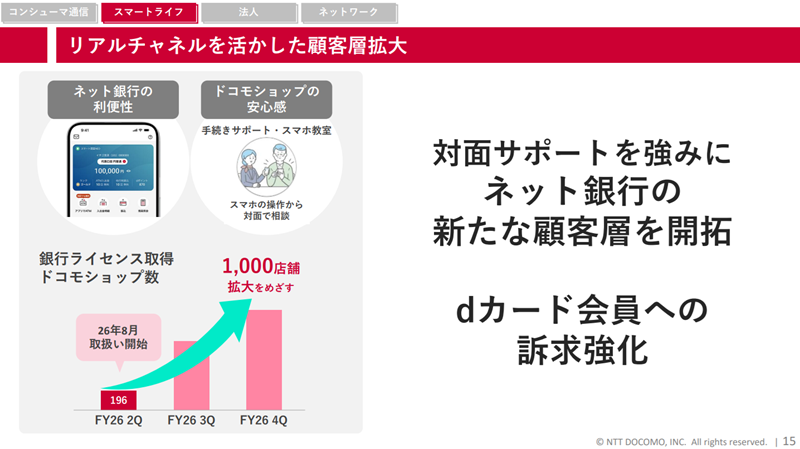
Docomo Shops nationwide are supporting this usage. They combine the convenience of online banking with the peace of mind that comes from in-person consultations.Leveraging the support capabilities cultivated through smartphone classes and other initiatives, staff assist customers with opening accounts, operating smartphones, and setting up accounts for card payments. The company plans to expand the number of stores offering banking services to 1,000 within the fiscal year to increase usage among those unfamiliar with online banking.
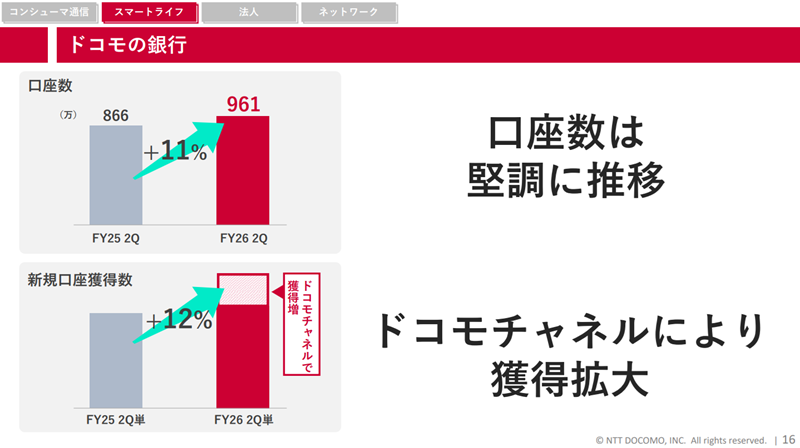
The number of accounts at Docomo Bank remains strong, with the total number of accounts up 11% year-over-year to 9.61 million, and new account acquisitions up 12%, with the Docomo channel contributing to this growth.
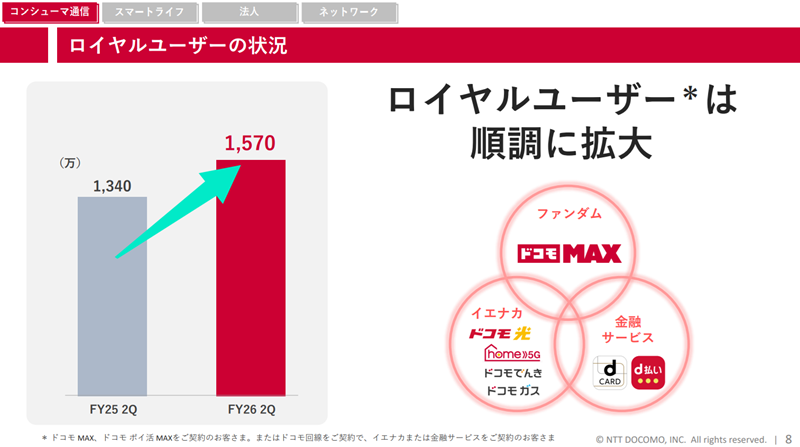
Furthermore, to encourage long-term usage, the company is working to expand its base of loyal users. It defines loyal users as those who use “Docomo MAX” or “Loyalty Point Rewards MAX,” as well as those who use either “Yenaka” services or financial services in conjunction with a Docomo mobile line.In addition to the growth in “Docomo MAX” subscriptions, usage of in-home and financial services has also increased, bringing the total number of members to 15.7 million—an increase of 2.3 million from the previous year. Since these members tend to have low churn rates, the company aims to encourage continued use by enhancing convenience, value, and enjoyment, thereby driving revenue growth.
As of October 27, Docomo MAX surpassed 5 million subscriptions. The number of applications for “Selectable Benefits” stands at 5.89 million. With the launch of WOWOW content on Lemio in October, the company has raised its subscription target for the fiscal year-end to 6 million.Docomo MAX subscriptions are also contributing to an increase in ARPU (average revenue per user), and the company has revised its forecast upward to 4,040 yen for the second half—an increase of 80 yen year-over-year—and to 4,040 yen for the full fiscal year, representing an increase of 30 yen.