November 26, 2026, 8:00 a.m. (JST)
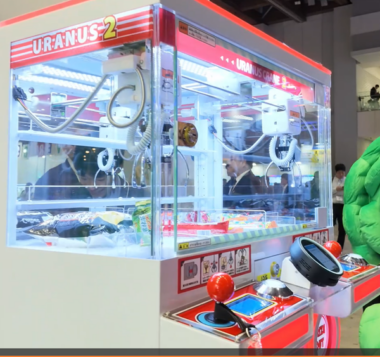
[Japan] At the “Amusement Expo” (organized by the Japan Amusement Industry Association [JAIA]) held in November 2026, Asahi Seiko, Kaga Electronics/Hiten Japan, DG Financial Technology (DGFT),the Toppan Group, Nayax, and Wako, among other domestic and international Payment Service Providers and equipment manufacturers, showcased their latest solutions. Key themes that emerged from our coverage included “cost reduction through multifaceted control,” “intensifying price competition from overseas players,” and “competition in CRM and sales promotion utilizing payment data.”
Cost Reduction
Through Multi-Faceted Control Some point to changing trends
The initial cost of installing a payment terminal on each individual game cabinet had been a major hurdle in adopting cashless payments at arcades. Currently, the main focus for companies is on systems that use a single terminal or relay unit to centrally control multiple booths (2–6 booths).
By moving away from the traditional “one payment terminal per game machine” model to “controlling multiple booths with a single terminal,” it is possible to shorten the payback period. In fact, at this trade show, Nayax showcased a system supporting six booths and TOPPAN one supporting four, demonstrating that this capability has become a key differentiator in the industry.
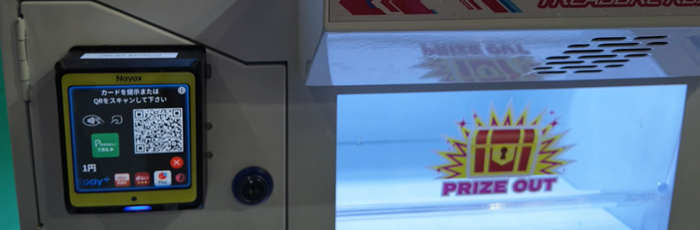
This trend is reportedly driven by circumstances unique to the amusement industry. Game machine usage fees are small, ranging from 100 yen to 500 yen. Meanwhile, large establishments typically operate anywhere from several dozen to over 100 machines.
“If we were to install an expensive payment terminal on every single machine, the initial investment would balloon to several million yen. What stores prioritize most is not the Payment Processing Fee, but how to keep installation costs down,” explains a representative from one of the exhibiting companies.
Furthermore, competition is intensifying in the field of control systems for managing multiple terminals, with companies like Wako introducing low-cost products.
Meanwhile, trends in payment methods are also shifting. In the past, some major chains attempted to introduce QR Code Payments via their own apps, but the hassle of downloading the app and registering for a membership proved to be a hurdle, and in some cases, led to customers abandoning the service.
Furthermore, with a recent spate of corporate personal data breaches, there is reportedly a growing sentiment among consumers that they “do not want to register their personal information in apps.” As a result, there is a noticeable shift back toward physical terminals—such as Contactless Payment, electronic money, and QR Code Payments—that allow users to simply tap their cards or smartphones without the need for registration.
What became clear through this year’s Amusement Expo is that the industry is evolving through four distinct phases. The first phase is “moving away from cash,” which involves transitioning from a cash-centric system to QR Code Payments and electronic money. The second phase is “reducing implementation costs” through multifaceted control.Phase 3 is “price competition,” driven by companies such as Nayax and Wako. And emerging as Phase 4 is “CRM and sales promotion strategies based on the utilization of payment data,” which companies such as DGFT, Hiten Japan, and TOPPAN are pursuing.
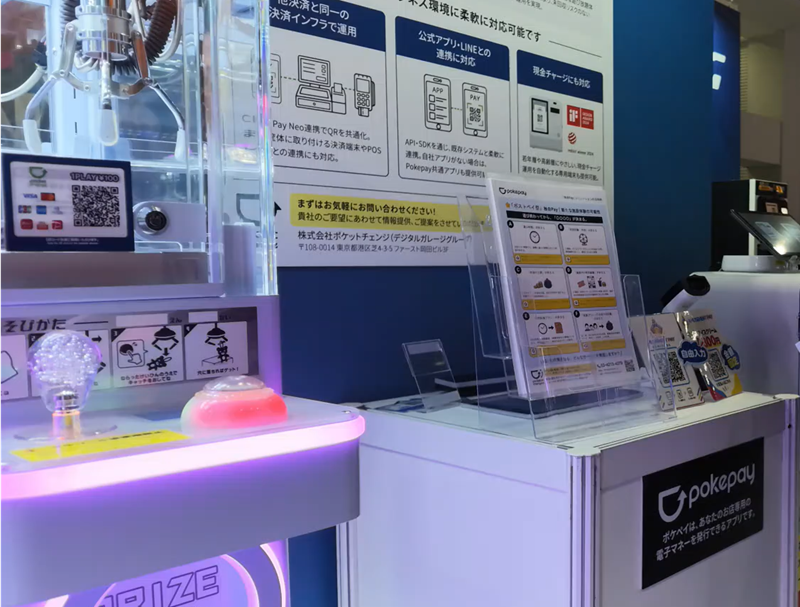
As cashless terminals become commoditized, the competitive landscape is expanding beyond simply “which terminal to install” to include integration with store loyalty apps, POS systems, and even fan marketing initiatives by IP (intellectual property) holders.
For example, Hiten Japan’s “Pay BOX (M80)” lineup integrates via API with store-specific QR Code Payments, in-house currency, and membership apps, enabling features such as applying coupons to specific users and controlling gate operations.
Price competition intensifies among Nayax and Wako; TOPPAN and
others counter with their experience Hiten Japan and DGFT also leverage their strong sales promotion capabilities
Now, let’s take a look at what each company is doing.
One company that stood out particularly at this trade show was Nayax, an Israeli fintech firm known for its yellow terminals. In addition to the company’s own booth, demonstrations of the terminals were also held at the DGFT booth.
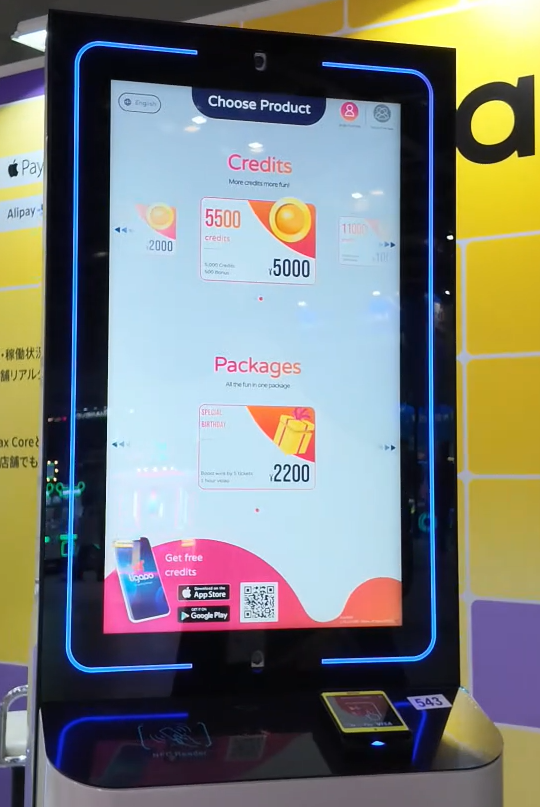
The company sold 40,000 units of its “VPOS Media 4 Series,” announced in May 2026, within six months. For the amusement industry, it is promoting the compact “mini” model as its flagship product.
Its greatest strength is its cost-performance ratio. Terminal prices start at approximately 32,000 yen. Even with accessories included, the total cost is said to be just under 40,000 yen, giving it a strong price advantage over domestic competitors.
Furthermore, since a single unit can control up to six booths, arcade operators can significantly reduce the installation cost per booth.
It supports transit e-money, major QR Code Payment methods, and KONAMI’s “PASELI,” and in addition to sales partners, there are reportedly moves by game machine manufacturers to make it a standard feature.
Meanwhile, a leading domestic player facing this offensive is TOPPAN Payments, part of the TOPPAN Group.The company aims to differentiate itself through quality—including the reassurance of domestic development and Japanese-language support, as well as excellent operational responsiveness. It has upgraded “ThincaGate,” which has approximately 5,000 units in operation, to support four booths, and its adoption is progressing at locations such as Taito and Bandai Namco. This product was also showcased at the Kaga Electronics booth.
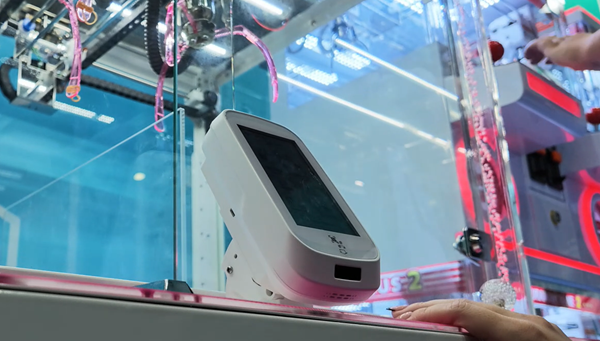
The company also unveiled “Thinca Nexia,” a new relay unit scheduled for release in the spring of 2027.In addition to allowing users to switch between POS mode and relay mode simply by toggling the DIP switches on the unit itself, it features a unique function that accommodates the varying voltages and specifications typical of foreign-made game consoles without the need for special cables. Leveraging synergies from group integration, the company is also strengthening proposals that combine movie ticket stub benefits with store-specific “house money” programs.
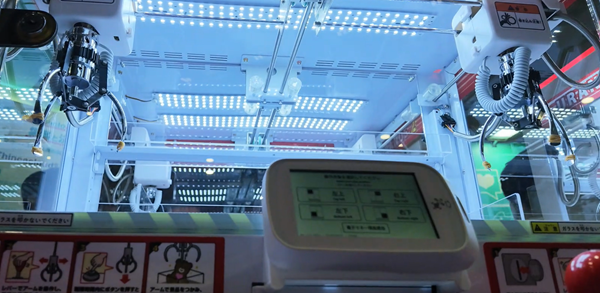
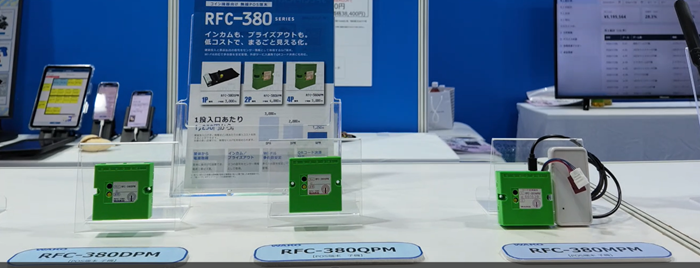
The trend toward lower prices continues to spread. Wako, a startup based in Nagano, exhibited its “RFC-380 Series” wireless POS terminals. By connecting to a server via a Wi-Fi router, the company has lowered the price range—which previously hovered around 17,000 yen—to between 3,000 and 5,000 yen.The company has its sights set not only on the arcade market but also on the coin-operated laundry market.
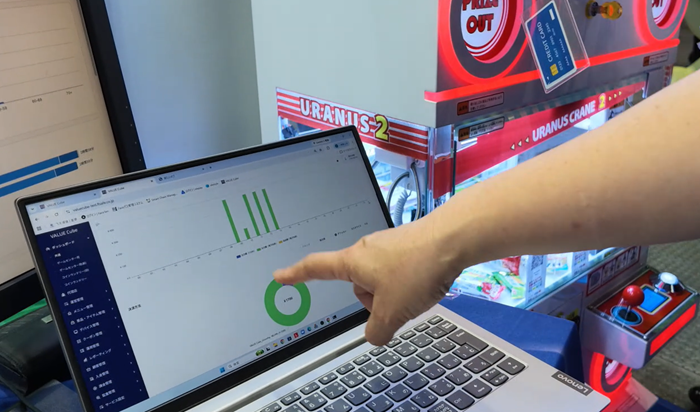
Hiten Japan, which co-exhibited with Kaga Electronics, also unveiled a new round-shaped terminal that was just released this month. This product has completed compatibility testing with SP-NET and specializes in Contactless Payment for credit cards and QR Code Payments.The company has also obtained patents for “Pay BOX”—a system deployed in collaboration with facilities such as Aeon Fantasy—and its management system, “Value Cube.” By integrating with LINE Mini Apps, the company has built a system that rewards customers with points and distributes prize coupons to encourage repeat visits. Data presented showed a 28% increase in sales at locations such as the Nishi-Funabashi store.
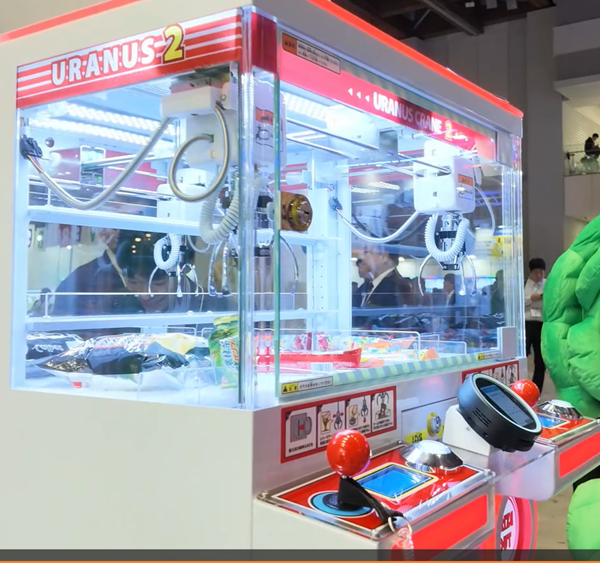
DGFT (Digital Garage Group) is expanding the adoption of Contactless Payment via credit cards, Apple Pay, and Google Pay, driven by the increase in inbound tourists, particularly from Europe and the United States. The company secured orders for approximately 10,000 units over the year-end and New Year period, primarily for large-scale facilities in Akihabara and Toyosu.In addition, leveraging the platform of “PokePay”—a group-affiliated prepaid service provider—the company promoted the rollout of proprietary in-house prepaid systems for amusement parks and entertainment facilities, as well as “Cloud Pay Register,” a reception and payment system integrated with cash dispensers.
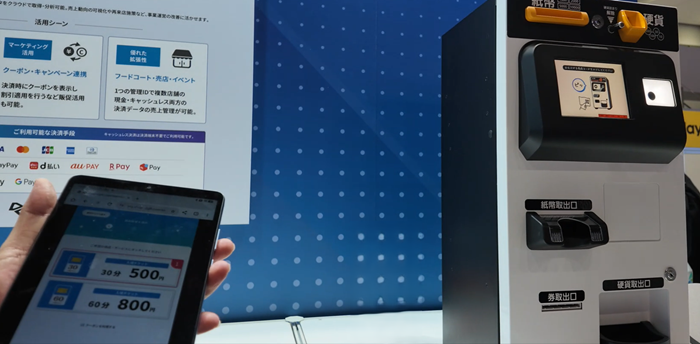
Asahi Seiko exhibited its proprietary, patented terminal that enables cashless payments using customers’ smartphone data connections, even if the store lacks an internet connection. In addition to proposing this solution for small stores and laundromats where installing a dedicated line is difficult, the company is adopting a strategy of offering multiple options—such as terminals manufactured by GMO Financial Gate (F3)—tailored to the size of the store.
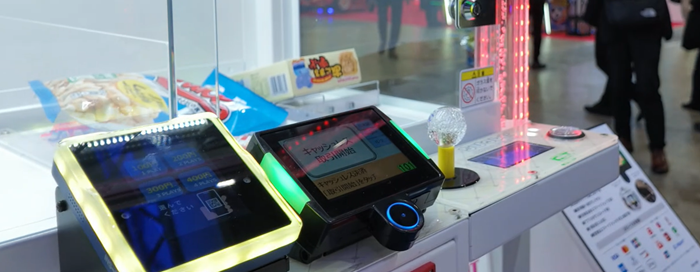
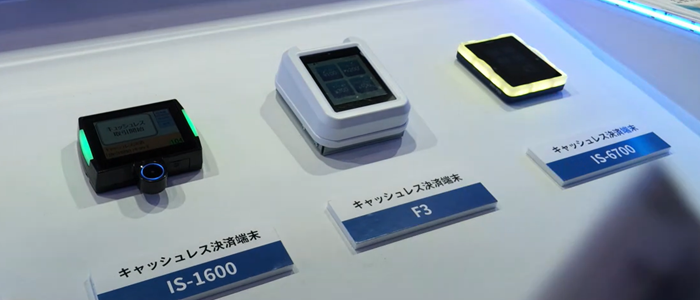
Thanks to the emergence of multi-faceted control technologies that reduce implementation costs and terminals specialized for Contactless Payment for credit cards, the barriers to adoption for operators are steadily decreasing.Going forward, competition in the operational sphere—specifically, “how to increase repeat visit rates and average transaction value through cashless payments”—is likely to draw even more attention, driven by the analysis of payment data and customer retention strategies via platforms like LINE and House Prepaid.
The shift toward cashless payments in the amusement industry has moved beyond the adoption phase; it is transitioning from an era of competing over the number of terminals installed to one of maximizing revenue by leveraging payment data. This trade show can be seen as a venue that symbolized that turning point.