August 4, 2026, 8:10 a.m.
Credit card companies are rolling out a series of service cutbacks, including reductions in point redemption rates, an expansion of activities excluded from point accrual, and shorter expiration periods.It appears these companies are embarking on a strategic review in light of environmental changes—such as the return of inflation and rising interest rates—with the aim of strengthening their corporate foundations. As PayPay and Rakuten, which have formed large-scale point ecosystems that include e-commerce, move to change their rules, this trend of service downgrades is spreading throughout the entire industry.
Tomoe Watanabe, Mail-Order Research Institute
Key Points of the Article!
① PayPay is trending
on social media as a “major downgrade” ② Mandatory identity verification (eKYC) is also affected
③ Service downgrades continue
for d-Pay and d-Points ④ Docomo is also set
to change the benefits of its tiered rewards system ⑤ Rakuten has decided to postpone
revisions ⑥ Rakuten’s changes will impact
traditional “point-earning activities” that leverage its ecosystem ⑦ Service providers aim
to cut service costs ⑧ Could members be feeling increasingly burned out?
PayPay Draws Criticism for “Major Deterioration” of Its Points Program
Shortly after the start of June 2026, PayPay’s points service—which underwent changes starting in June—became a hot topic on social media, with users calling it a “major downgrade.”
First, for users paying utility bills (electricity, gas, water) and taxes with the PayPay Card, the cashback rate—which was previously 1.0%—has been cut in half to 0.5%. While these fixed-cost payments had provided members with a steady stream of points, the large transaction volumes placed a heavy burden on the card issuer’s point reserves, prompting other companies to also review their policies.
Furthermore, the points that were previously awarded for payments made using PayPay Points have been eliminated, and such payments are no longer eligible for point rewards. While other companies sometimes do not award points for payments made with points, PayPay’s system—which did offer rewards—was popular, leading to complaints from members.
Similarly, other payment services such as FamiPay and WAON, as well as top-ups for transportation e-money like Mobile Suica and Mobile PASMO, have been newly excluded from the points reward program. Previously, users earned 1.0% in points when topping up these services with the PayPay Card.It is believed that electronic money top-ups were excluded because, like utility bills and taxes, they have low profit margins.
Furthermore, another change that could prevent users from earning points if they are unaware of it is the mandatory implementation of identity verification (eKYC) to link points to members.While eKYC using a My Number Card or similar was not always required in the past, starting in June, accounts that remain unverified will not only be excluded from PayPay Step (a benefit that increases the point redemption rate based on usage) but will also no longer earn points at all.
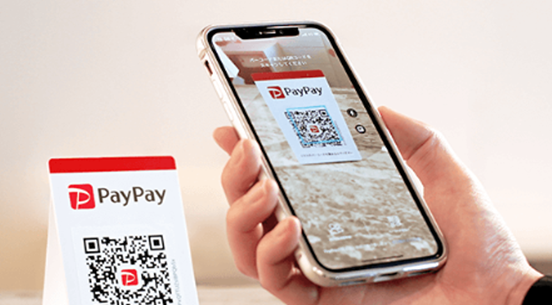
NTT Docomo Tightens Restrictions on “d Pay” and “d Points” Benefits
Since the start of 2026, NTT Docomo has continued to make changes that reduce the benefits of its “d Pay” and “d Points” services.Starting in February, the d Point cashback rate for taxes and utility bills paid with the d Card—which had previously been 1.0%—was reduced to 0.5%. On the other hand, the cashback rates for its own services, such as “Docomo Denki” and “Docomo Gas,” remain unchanged, clearly revealing the company’s aim to draw customers into its own economic ecosystem.
Furthermore, starting in September 2026, the company will change the details of two member rank benefits within the “d Points Club”: the “d Pay Benefit” and the “d Card Payment Benefit.”
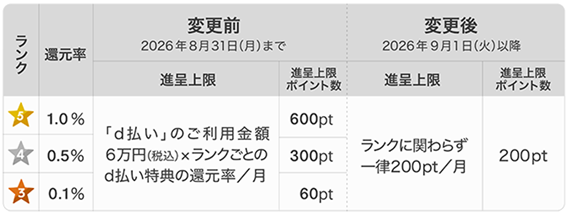
The “d Point Club” is divided into five tiers based on the number of d Points earned over the past three months, with the point multiplier increasing as members move up in rank.Previously, the monthly reward cap was calculated by multiplying the amount spent via d Pay (60,000 yen, including tax) by the reward rate for each rank; for example, Rank 5, with a 1% reward rate, would yield a maximum of 600 points.However, starting in September, as shown in the table below, the monthly reward cap will be a flat 200 points regardless of rank, resulting in a reduction in reward points for Rank 5 and Rank 4 members.
Since the previous monthly cap for Rank 3 was 60 points, the cap will increase after the change. However, because the reward rate remains unchanged at 0.1%, users will need to spend 200,000 yen per month to earn the full 200 points. Ranks 1 and 2 were originally excluded from the “d Pay Benefits” program, so there will be no changes for them.
Another change to the “d Card Payment Benefits” program is that the 0.5% cashback d Points awarded will become “time- and use-limited points” starting in September. The expiration period will be shortened from the current “12 months after the last use of points” to “94 days after the date the points are awarded.” Users will need to check their points regularly to ensure they do not expire.
The company established NTT Docomo Financial Group, a subsidiary that inherits financial and payment services such as d Pay, d Card, and insurance, following its acquisition of Sumishin SBI Net Bank as a subsidiary in October 2025. The new company began operations in July, and as the group strengthens its financial business, the points program may be revised frequently in the future.
Rakuten Announces Postponement of Revisions Due to User Dissatisfaction
In January 2026, Rakuten Payment announced that it would change the point rebate rates and conditions for its mobile payment service “Rakuten Pay” starting in March. This applies to code payments, QR payments, and self-checkout payments made with Rakuten Cash.
For Rakuten Cash payments via Rakuten Pay, the point rebate rate varies depending on the number of times a Rakuten Point Card is presented within a month.Following the revision, the threshold for the increased points rebate rate was changed from two or more times to five or more times. The base points rebate rate was to be lowered from 1.0% to 0.5%, and the maximum rebate rate after the increase was to be reduced from 1.5% to 1.0%.
However, perhaps due to an outpouring of complaints from users on social media and elsewhere calling the changes a “deterioration” following the announcement, the company reversed its decision just one week later, stating that it would “postpone the changes due to preparation issues.” As of this writing (August 2), there has been no official announcement regarding the matter, but attention remains focused on how the situation will develop.
In July 2026, the company announced that starting in August, the “monthly recharge limit” for transfers from Rakuten Edy to Rakuten Cash would be significantly reduced from the previous 100,000 yen to 10,000 yen.This is expected to impact traditional “point-earning activities” that leverage the Rakuten ecosystem, such as converting “Rakuten Gift Cards”—obtained through high-reward channels—into cash via Edy for use toward payments.
Furthermore, “Rakuten Pasha”—a service that allows users to earn Rakuten Points by photographing receipts and using coupons—also changed its eligibility requirements starting in July. The rules have become stricter, with requirements such as “earning at least 500 points from item coupons applied for in the current month” now mandatory.
Summary
In addition, there have been notable deteriorations in terms of use due to these revisions, such as the termination of regular campaigns and the introduction of service fees for credit cards with no annual fee. It appears the underlying motive is a desire to cut service costs now that the number of members has exceeded a certain target threshold, thanks to the success of marketing campaigns highlighting value and high rewards.
However, members are feeling considerable fatigue from dealing with the dizzying pace of repeated revisions and the increasing complexity of the services. While I believe a certain degree of revision is unavoidable, as a user, I hope the company will take steps that allow me to continue using the card with peace of mind, without having to constantly worry about every little change.