August 14, 2026, 8:36 a.m. (JST)
[Japan] Sumitomo Mitsui Card and TOKIUM (both based in Tokyo, Japan) have entered into a comprehensive business partnership agreement in the corporate payment sector.
As a first step, Sumitomo Mitsui Card and TOKIUM plan to offer the “TOKIUM Business Card.” By seamlessly integrating payment functions with business systems—such as expense reimbursement and invoice management—they aim to create a new corporate payment experience that optimizes back-office operations as a whole.
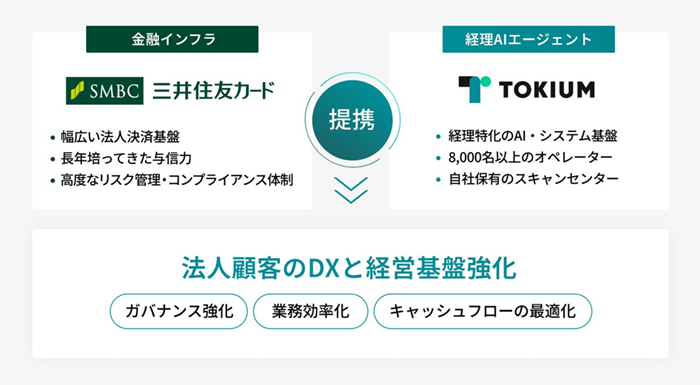
Furthermore, the card utilizes Infcurion’s card issuance platform, “Xard.” By operating it in tandem with TOKIUM’s expense reimbursement and invoice management services, the companies aim to achieve a high level of efficiency in accounting operations while simultaneously strengthening internal controls.
A key feature of the “TOKIUM Business Card” is that card statements are immediately reflected in the system after a payment is made. An AI agent automatically retrieves the statements, and account codes are automatically populated for the statements displayed on the TOKIUM management screen.Furthermore, if a transaction does not comply with established rules, the AI agent issues an alert and can reject the transaction.
Furthermore, users can check the usage status of all issued cards in real time via the TOKIUM management console without having to log in to a dedicated system. Spending limits and validity periods can be set for each card. This helps prevent off-budget expenditures and personal use while reducing the administrative burden on the accounting department.
Furthermore, virtual cards can be issued instantly with a single click from the management console. They can be organized by tags based on department or purpose, and the required number of cards can be issued online.
Furthermore, the service is available to companies of all sizes, supported by a platform where Sumitomo Mitsui Card handles credit screening, back-end financing, and the billing and collection of card charges. High-value payments—such as server usage fees and online advertising costs—that were previously paid via bank transfer due to corporate card spending limits can now be consolidated onto this card.
Going forward, the two companies plan to expand their collaboration into areas such as accounting-focused BPO services and business automation using AI agents. By leveraging corporate cards as a starting point to further enhance operational efficiency, they aim to provide comprehensive support for corporate back-office operations. (paymentnavi Editorial Team)