
August 10, 2026, 3:26 p.m. (JST)
[Japan] Digital Garage (DG, Tokyo, Japan) has launched the commercial rollout of its stablecoin payment platform, “DG Stablecoin Payment Service” (hereinafter “DG SPS”).
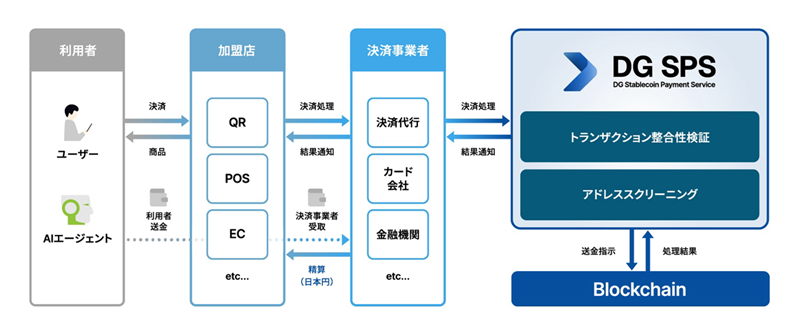
The company plans to first implement this platform at JCB and DG Financial Technology (DGFT), a DG payment subsidiary, and intends to expand it widely to various payment service providers and partner companies thereafter.
By collaborating with JCB—an international card brand operator with a network of 72 million merchant locations domestically and internationally and an annual payment volume of 53.3901 trillion yen—and DGFT, which supports over 1.3 million payment terminals with an annual transaction volume of 9.1 trillion yen,and over 1.3 million payment terminals, will accelerate efforts toward the social implementation of stablecoin payments in the Japanese market.
In January 2026, DG announced a collaboration with JCB and Resona Holdings aimed at the social implementation of stablecoin payments and has since been identifying technical and operational challenges through pilot tests at physical stores.
With the advancement of web3 technology and the widespread adoption of digital assets, there is a growing global demand for fast, low-cost payments using stablecoins.In Japan, while stablecoin payments offer various benefits—such as reducing the burden of currency exchange for inbound tourists (foreign visitors to Japan) and providing merchants with a new payment method—they also require blockchain-specific operations and system development, making it a practical challenge to integrate them into existing business practices and systems.
Furthermore, payment service providers face challenges such as the high technical complexity of handling stablecoins—which serve as a new payment channel—and the significant technical and operational burden of individually supporting different assets and blockchains.As a solution to address these issues comprehensively, we have commercialized “DG Stablecoin Payment Service (DG SPS),” a stablecoin payment platform tailored to the Japanese payment market.
By connecting “DG SPS” via API to the existing payment infrastructures of payment service providers—including JCB and DGFT—the company aims to build an environment that enables the rapid adoption and expansion of stablecoin payments across the extensive merchant networks maintained by these providers.
Specifically, merchants do not need to make special operational changes or capital investments to support blockchain; they can easily introduce stablecoin payments simply by connecting via API, just as they do with existing credit card or e-money payments.
The service will initially support payments using USDC on the Base chain. Going forward, the company plans to expand support to include JPYC—a Japanese yen-pegged stablecoin expected to see significant demand in Japan—as well as major chains such as Ethereum and Polygon in addition to Base, in order to meet the diverse needs of users.
Furthermore, the company aims to support the x402 protocol developed by the x402 Foundation and provide AI agent payments using the same infrastructure, thereby advancing functional expansions with an eye toward the agent-based commerce sector.
Going forward, DG will promote the creation of benefits for merchant partners in the inbound and cross-border e-commerce sectors by expanding the availability of “DG SPS” to payment service providers.
Currently, in the face-to-face payment sector, the rapid increase in foreign visitors to Japan has led to a diversification of payment method needs. To address these changes, merchants are required to establish a payment environment that is more user-friendly for foreign visitors to Japan.By encouraging payment service providers to adopt and utilize “DG SPS,” DG can offer merchants a new payment option—stablecoins based on a globally standardized blockchain infrastructure—enabling them to meet the payment needs of a broader range of foreign visitors to Japan.
Furthermore, in the realm of non-face-to-face payments (particularly cross-border e-commerce), there is a growing need to expand the variety of payment methods and establish an environment capable of seamlessly accepting payments from overseas users. The addition of stablecoins as a new payment option is expected to prevent merchants from missing out on business opportunities, leading to further sales growth and expansion into global markets.
Furthermore, in the medium to long term, payment service providers will expand the functionality of their next-generation payment infrastructure so that they can seamlessly integrate stablecoin payments into their own payment platforms and offer them as an option for all types of commercial transactions, whether in-person or contactless.When rolling out this system to merchants, the goal is to minimize the impact on existing business practices and operations and enable a smooth rollout without increasing operational burdens, thereby promoting the widespread adoption of this next-generation payment infrastructure throughout society.
Looking ahead, the company plans to build a foundation that supports merchants’ future business expansion, with an eye toward enabling automated payments by AI agents that conduct economic activities autonomously using the same infrastructure.