November 4, 2026, 8:20 a.m. (JST)
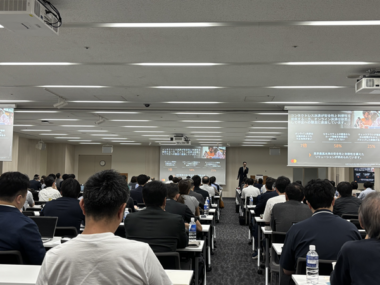
[Japan] On October 6, 2026, Acompany held a “Confidential AI Study Session.” The event featured an explanation of the report “Private Safety Processing Overview” published by OpenAI, as well as the latest trends in Apple’s“Private Intelligence” and “Private Inference,” as well as the underlying mechanisms of Confidential Computing.
OpenAI, Anthropic, and Others Conduct R&D
Based on Confidential Computing (CC) CAI Aims to Become the Standard Infrastructure for the AI Era
Acompany, with the mission “Trust. Data. AI. Trust in the use of all data and AI,” leverages Confidential Computing technology to support the use of data and AI. The company is also expanding into the fields of economic security, defense, finance, and healthcare.
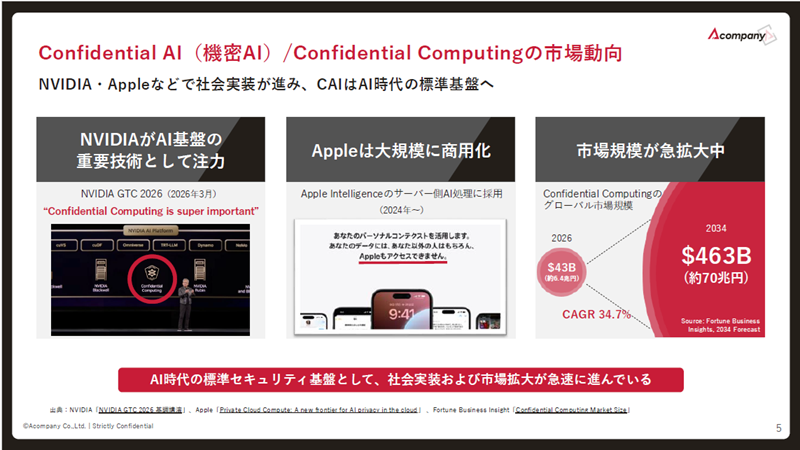
OpenAI, Anthropic, and others are already promoting research, development, and commercialization based on Confidential Computing (CC). OpenAI announced “OpenAI Private Intelligence” at one of its events. Furthermore, Anthropic has publicly stated that CC is not an option but a necessity.Confidential AI is being implemented in society by companies such as NVIDIA and Apple, and CAI is expected to become the standard infrastructure of the AI era. According to “Fortune Business Insights, 2034 Forecast,” the global market size for Confidential Computing is estimated to be approximately $24.2 billion as of 2025, and it is projected to continue growing rapidly at a compound annual growth rate(CAGR) of 34.7%, and is expected to reach $463.89 billion (approximately 70 trillion yen) by 2034.
CC
: Enabling “AI That Can Protect Secrets” Data and models are decrypted and processed only within a TEE
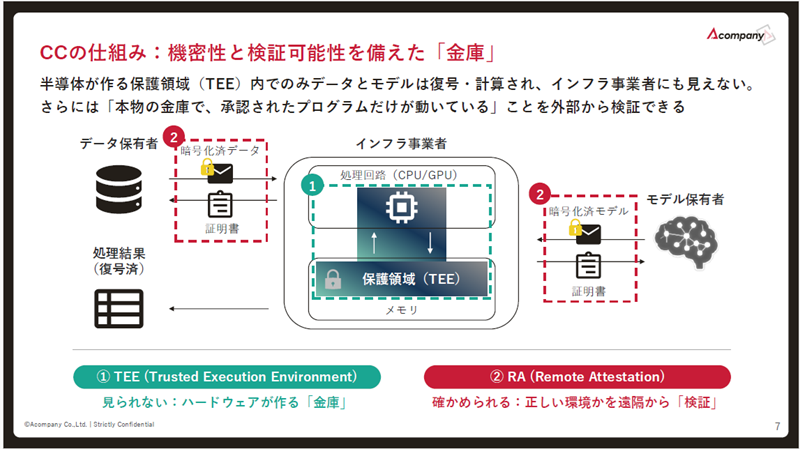
“AI that protects secrets” refers to AI that can be used with confidence while keeping data (prompts) and models (parameters/weights) confidential. Confidential Computing (CC) is the technology that makes this possible.
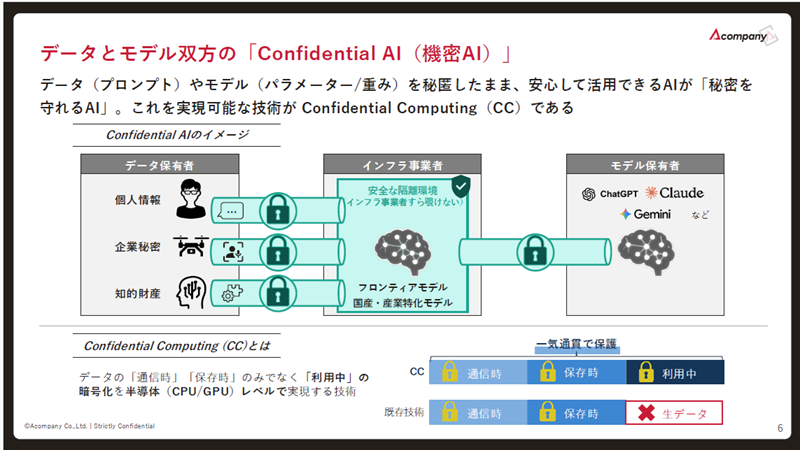
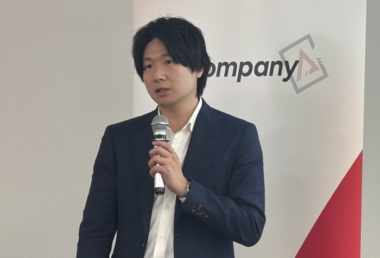
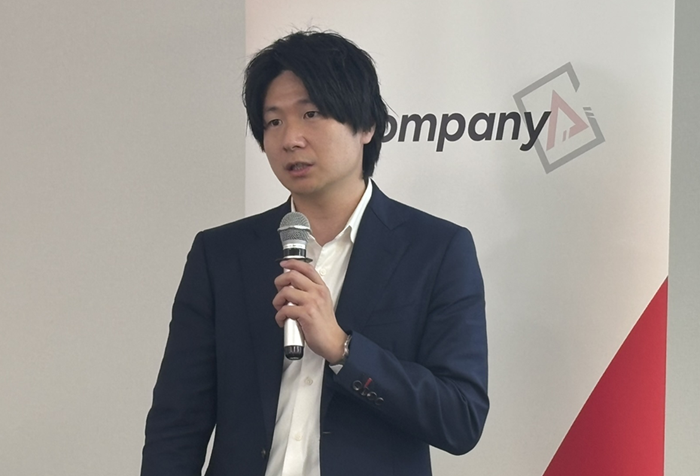
CEO Takahashi described the CC mechanism as a “safe” that combines confidentiality and verifiability.Data and models are decrypted and processed only within a protected area (TEE: Trusted Execution Environment) created by semiconductors, making them invisible even to infrastructure providers. Furthermore, it is possible to verify from the outside that “only authorized programs are running inside this ‘real safe.’”
Domestic and international providers are expanding
Japan’s AI computing infrastructure Options for AI computing environments tailored to specific requirements are increasing
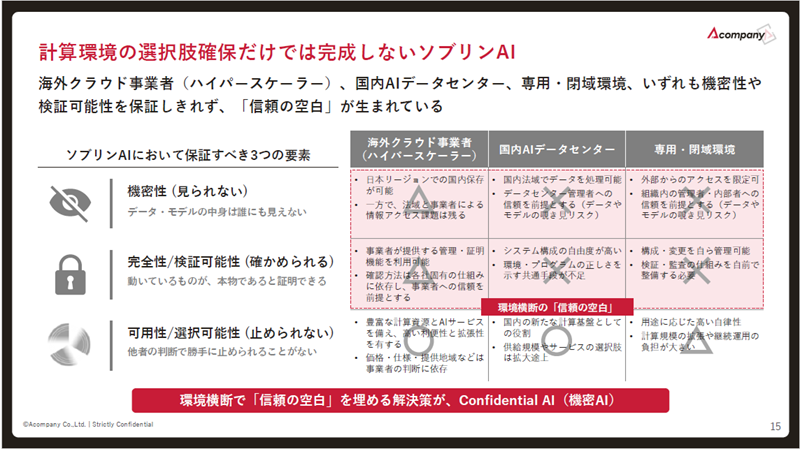
Regarding the dilemma between the value of AI utilization and confidentiality in enterprises, he noted that while AI becomes more valuable the more company-specific data and operational knowledge it is fed, the most valuable information is the hardest to utilize because companies must entrust the source of their competitiveness to external AI environments.Furthermore, corporate confidentiality challenges translate into AI sovereignty issues at the national level—specifically regarding jurisdiction, operations, and supply—when critical data, computing resources, and AI models are dependent on overseas operators.“Sovereign AI”—which manages three types of external dependencies—(1) dependence on jurisdiction and information access, (2) dependence on operational and execution control, and (3) dependence on supply and technology selection—to ensure AI autonomy—becomes crucial.
It is noted that the essence of Sovereign AI is not to retain all technology domestically. Rather, it involves securing options from both domestic and international computing infrastructure and AI models, protecting critical data, and independently controlling the use of each element.
Currently, major countries are expanding national investment in computing resources, AI data centers, and foundational models to avoid excessive dependence on overseas operators and to secure AI options, supply capacity, and continuity.In Japan, multiple policies and public support initiatives are advancing simultaneously across various domains—including semiconductors, computing infrastructure, AI models, physical AI, and government applications—to secure domestic AI supply capacity, development capabilities, and utilization capabilities.
Furthermore, backed by policy support and private investment, both domestic providers and overseas cloud providers are expanding Japan’s AI computing infrastructure, increasing the range of AI computing environments available to meet specific requirements.
Furthermore, it was noted that overseas cloud providers (hyperscalers), domestic AI data centers, and dedicated or private networks all fail to fully guarantee confidentiality and verifiability, creating a “trust gap”—a problem that Confidential AI is intended to resolve.
Building
a Trust Infrastructure to Realize “AI That Can Protect Secrets” Toward an Ecosystem Strategy Involving All Layers
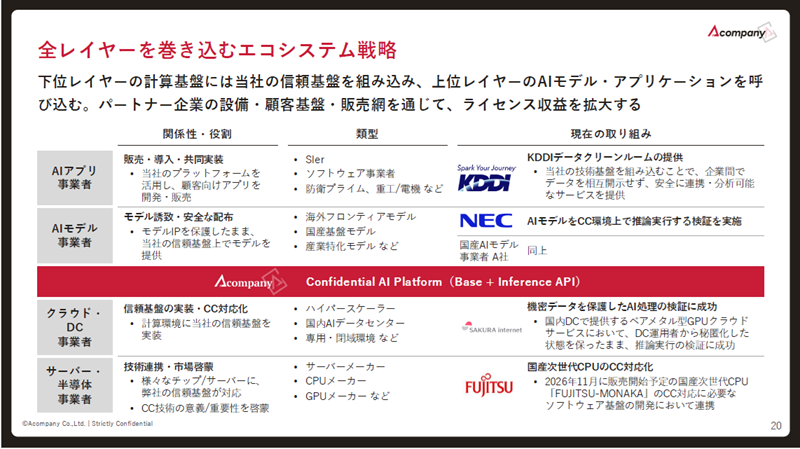
Acompany has built a “trust foundation” that integrates environment verification, key management, and confidential inference onto its computing infrastructure, and provides it as foundational software and APIs.Based on CC, which maintains encryption even during data processing, the company aims to solidify its unique positioning in the increasingly competitive global CAI market by standardizing its “Base and Inference APIs.”
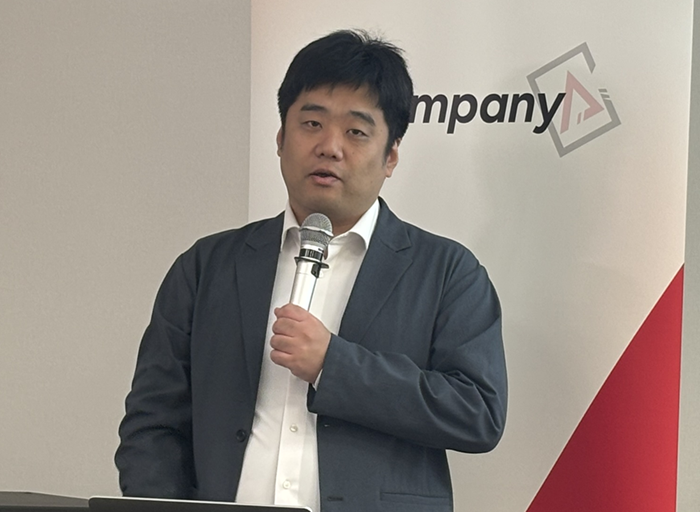
The company is pursuing an ecosystem strategy that involves all layers, including infrastructure partners with hardware and data centers, as well as AI vendors and application development vendors. Its policy is to expand licensing revenue through the facilities, customer bases, and sales networks of its partner companies. For example, it is one of NVIDIA’s partner companies in Japan.“We are the only startup focused on AI security,” said CEO Takahashi.
Furthermore, as Confidential AI is incorporated into standard requirements for government procurement, critical infrastructure, and corporate security, structural demand for a trust foundation will emerge. The company intends to take the lead in shaping market rules through policy advocacy and industry activities.
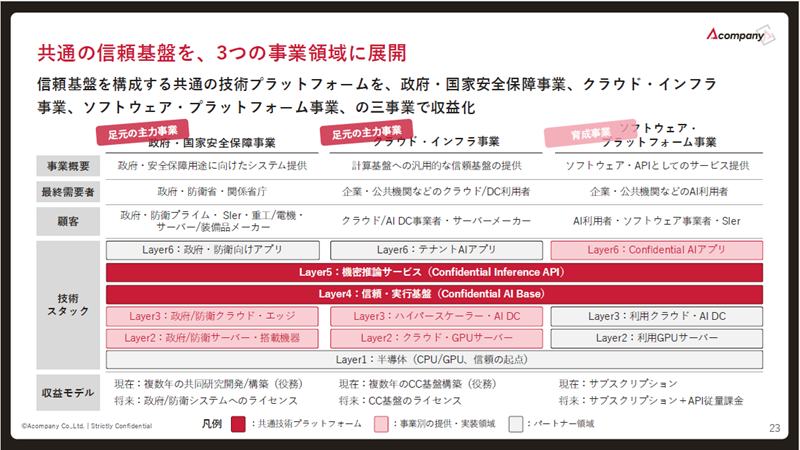
The company has developed a business model that monetizes the common technology platform comprising the trust foundation through three segments: government and national security, cloud and infrastructure, and software platforms.
The company was recognized for not limiting CC to the research stage but implementing it at a commercial level, thereby building a foundation that balances security with data utilization, and was awarded the Japan Startup Grand Prix 2026 Judging Committee Special Award. It also ranked in the top 10 out of 30,000 companies worldwide at the Startup World Cup 2025.
Currently, the company is collaborating with partner firms at various levels within Japan to establish a Confidential AI package that incorporates its trust framework. It aims to expand into sovereign AI markets in Europe, Asia, and elsewhere through its partners’ overseas sales channels and collaborations with local companies.
Furthermore, the company has begun research on the safety and reliability of AI agents in collaboration with Tohoku University’s Language AI Research Center. By combining the center’s expertise in natural language processing and machine learning with Acompany’s expertise in AI security and privacy, the companies aim to deepen their understanding of threats to AI agents and establish countermeasures.