October 5, 2026, 8:38 a.m. (JST)
[Japan] The Cabinet Office’s “Expert Panel on the Diversification of Payment Methods and Consumer Issues,” established to prevent consumer disputes arising from the diversification of payment methods, released its report in September 2026.The panel recommended imposing five core rules common to all payment sectors to protect consumers and is moving forward with measures and frameworks to implement them. Specific examples cited include “post-payment” and “Direct Carrier Billing,” and AI-powered automatic payments were also newly included.
Tomoe Watanabe, Mail-Order Research Institute

Key Points of the Article!
① Discussion
on the mechanisms of various payment methods and consumer harm ② Challenges
in establishing payment regulations and legal frameworks ③ Five core rules and a three-tiered
framework ④ Need
to examine “post-payment” and “Direct Carrier Billing” systems ⑤ Designing safeguards for AI is crucial
⑥ The industry as a whole is moving toward strengthening self-regulation
To be finalized following the interim report to be released in August 2025
The “Expert Panel on the Diversification of Payment Methods and Consumer Issues,” established by the Cabinet Office’s Consumer Commission, held its first meeting in March 2025 and published an interim report in August of the same year.It then began its second phase in November, and this report was finalized at the 20th meeting held in September 2026.
Amid the increasing diversity and complexity of cashless payments—such as QR Code Payments and electronic money—the panel discussed the mechanisms of each payment method and consumer harm through hearings with relevant Payment Service Providers and analysis of the current situation.In last year’s interim report, the committee proposed, among other things, the consideration of cross-cutting civil rules for payment methods not covered by the “Installment Sales Act of Japan,” such as deferred payment, Direct Carrier Billing, and credit card “monthly clear” plans.
Establishing Five Core Rules Applicable Across All Payment Methods
The report released this time points out that regulatory frameworks and legal systems—which were traditionally organized primarily by payment sector—have become increasingly difficult to manage due to the diversification and increasing complexity of payment methods. Since sector-specific regulations alone cannot fully address consumer disputes, the report argues that a shift is needed toward cross-cutting regulations that focus on “function” rather than “sector.”
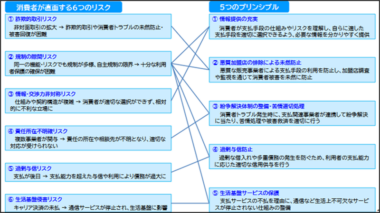
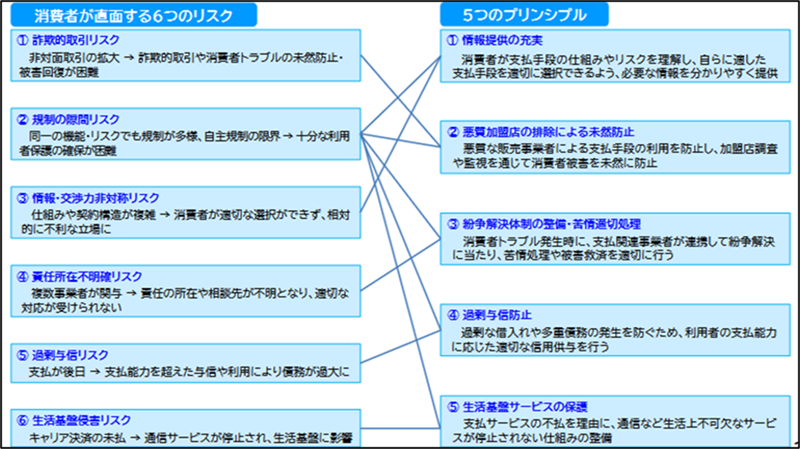
Consequently, to address the various risks faced by consumers, the report established five “core rules (principles)” that should be ensured across all payment methods.① Enhancing the provision of information; ② Preventing problems before they arise by eliminating unscrupulous Merchants; ③ Establishing dispute resolution systems and ensuring appropriate handling of complaints; ④ Preventing excessive credit; ⑤ Protecting essential living services—based on these principles, specific measures and frameworks will be developed to ensure their implementation.
The institutional framework required of relevant government agencies and Payment Service Providers consists of the following three layers: ① Recognizing that the existing framework is insufficient to address consumer disputes, the committee has established principles common to all Payment Service Providers (first tier); ② it requires that current laws, supervisory guidelines, industry guidelines, and self-regulatory measures be reviewed in light of these principles (second tier).Furthermore, ③ in cases where these efforts alone are insufficient to resolve the issue, relevant administrative agencies are asked to consider effective and appropriate measures (third tier).
<Diagram showing the five principles established to address six anticipated risks>
“Deferred Payment” and “Direct Carrier Billing” Identified as Key Issues
Specific matters requiring institutional review include “supervision by administrative agencies through registration and notification” and “civil remedies and relief mechanisms in the event of consumer harm.” Furthermore, the report calls for a review of “post-payment settlement” and “Direct Carrier Billing” as specific payment business models.
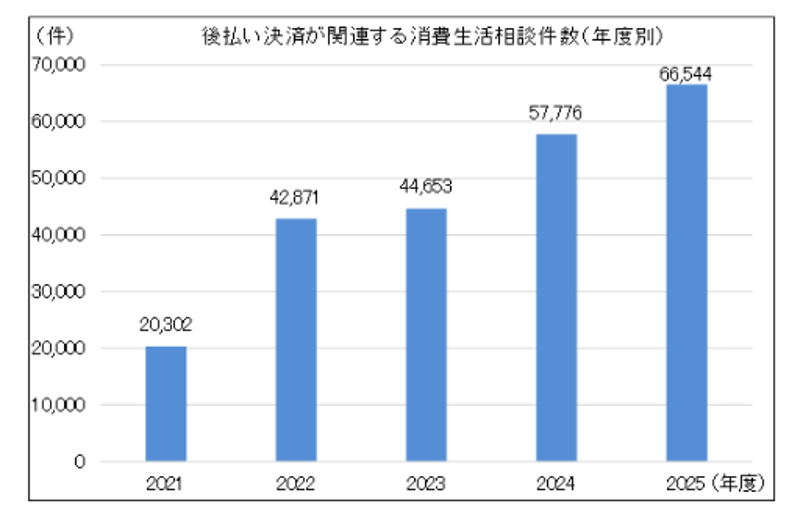
Regarding “post-payment services,” the number of consultations reported to PIO-NET (National Consumer Information Network System) is projected to increase to approximately 67,000 in fiscal year 2025—roughly three times the figure for fiscal year 2021.Disputes regarding recurring purchases and cancellation requests were particularly prominent, and challenges were identified in information sharing with sellers and in handling consumer inquiries when disputes arose under sales contracts.
Furthermore, while “post-payment” is not currently subject to legal regulations, the report points out that it effectively functions as a form of credit. It recommends examining the actual nature of these transactions and the characteristics of consumer disputes, and considering appropriate consumer protection measures by drawing on the principles governing “individual credit purchase arrangements” under the Installment Sales Act of Japan.
Regarding “Direct Carrier Billing,” while the number of consultations in recent years has been approximately 6,000 per year—lower than that for “post-payment settlements”—the report emphasized the structure whereby payment delinquency directly leads to the suspension of telecommunications services. It raised concerns about the system in which mobile phone bills and payments for other goods are billed together as a single invoice.There is concern that if payments for goods accumulate, this will result in delinquency that includes telecommunications fees, leading to the loss of access to telecommunications services—a vital part of daily life—and causing disruptions to daily life. Based on these risks, the report recommended examining appropriate consumer protection measures.
As a countermeasure, the committee recommended that telecommunications services be restored once payment of the mobile phone bill is confirmed following a payment reminder.While the implementation of this requires a system of “separate billing” for communication fees and other charges, the background to this recommendation is that many members of the study group advocated for separate billing as a safeguard to prevent the suspension of communication services. Furthermore, to prevent excessive credit extension, the committee recommended introducing a system to verify users’ ability to pay when setting credit limits or increasing them.
New Focus on AI-Driven Purchasing and Payments
This report also delves into consumer protection in light of rapidly evolving AI-driven purchasing and payment behaviors. It envisions scenarios of “agent-based commerce,” where consumers directly purchase goods and services through conversational AI and complete the payment process. Since there is a possibility of transactions occurring that do not respect the consumer’s best interests, the report noted that security measures are already being developed overseas.
In particular, security measures are essential for purchases involving credit. The report highlights the importance of, for example, promoting “card control features”—which limit usage to specific stores—and ensuring that payment service providers themselves design appropriate safeguards for AI systems. At the same time, given the convenience offered by AI, the report emphasizes the need to establish regulatory frameworks that strike a balance between risks and benefits.
Furthermore, the report adds that attention must be paid to areas not covered in this report. It cites “damage related to small-amount transactions,” where detailed investigations on a case-by-case basis are difficult, and “transactions with overseas-based sellers,” where investigation and corrective action are challenging.
Summary
With the completion of the report—the result of a year and a half of discussions—the Consumer Commission has issued a “recommendation” to the ministers of relevant ministries and agencies, such as the Financial Services Agency and the Ministry of Internal Affairs and Communications, requesting that they consider specific measures based on the report. The Commission is requesting a report on the status of implementation based on this “recommendation” by June 2027.
Going forward, each ministry will proceed with deliberations on the necessity and formulation of guidelines and legal regulations in accordance with the report. It is highly likely that some form of guidelines or legal regulations will be introduced for payment methods not covered by the Installment Sales Act of Japan, such as “post-payment” services, and the industry as a whole will need to strengthen its self-regulation.