November 9, 2026, 8:00 a.m. (JST)
[Japan] “Money20/20,” one of the world’s leading FinTech events, and FXC Intelligence, a provider of cross-border payment data and intelligence, released their latest joint report in October 2026 titled “North America’s Cross-Border Payments Rewiring: The Current State and Future Potential of the Industry in 2026.”During a press session held while Money20/20 was in session, Lucy Ingham, Vice President of Research at FXC Intelligence, and Daria Hammer, Head of Global Investors and Startups at Money20/20, took the stage to present the report’s findings.

“Rewiring Cross-Border Payments in North America: The State of the Industry and Future Outlook for 2026” was released as part of a 2026 global research partnership between the two companies. The report provides a comprehensive analysis of industry trends over the past 12 months across the three North American countries: the United States, Canada, and Mexico.

First, regarding the overall size of the cross-border e-commerce market, the value of cross-border transactions in the Americas reached $9.4 trillion last year alone. This figure is projected to reach $14 trillion by 2033.
The team at FXC Intelligence and Money20/20 are focusing on the fact that Southeast Asia has enormous room for growth and is expanding rapidly. While the North American market is somewhat mature and is not growing at the same pace as other regions, they noted that Latin America and Mexico, among others, are showing steady growth.
Remittances remain a very large market and are particularly significant between Mexico and the United States. Discussions surrounding regional payments are remarkably diverse, covering a wide range of topics from the technical mechanisms of payment infrastructure to policy issues. In addition to technology and infrastructure, factors such as tariffs, taxation, and regulations also come into play.
This discussion also took place at “Money20/20 Amsterdam,” held in Amsterdam, the Netherlands, in June; it appears that in Europe, a common framework and regulatory bodies are driving the market forward.
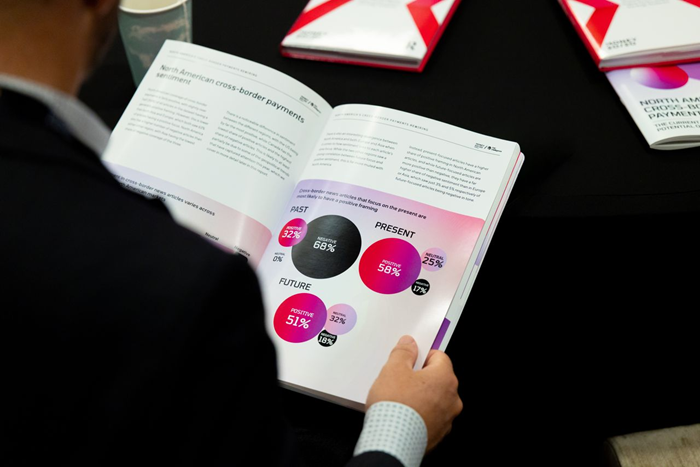
The report analyzes 650 industry articles published in the United States, Canada, and Mexico over the past 12 months. According to news reports and articles related to the payments and fintech industries, nearly three-quarters (73%) of payments-related news in North America does not focus solely on domestic matters but invariably references other countries or international connections.
While coverage in Europe tends to address multiple countries and regulatory systems, the focus on countries within and outside the region varied significantly by country in North America. Approximately 90% of related reports in the U.S. focused on countries outside the U.S. In contrast, the U.S. was the central focus of discussions in Mexico and Canada.
Across the region as a whole, interest in “interoperability”—which connects domestic and international payments—is reportedly growing the most. Interoperability has long been a topic of discussion in the payments industry, but it remains one of the most important issues in the United States, appearing in 57% of related discussions.
In fact, the past few years have been a crucial period. While there was previously little development of domestic real-time payment systems, the construction of domestic regional networks is now well underway. As these networks become interconnected, there is potential for regional companies to improve payment efficiency.
While Stablecoin Payments cannot be ignored in the 2026 discussions at Money20/20 USA, the global retail international payments market is projected to be 44.3 trillion as of 2025, yet Stablecoin Payments are expected to account for only $135 billion (0.31%) of that total.Although this percentage is increasing, it is not growing fast enough for stablecoins to become a mainstream payment method anytime soon. Currently, challenges remain, such as time zone differences between the sending and receiving countries, as well as dependence on the business hours of intermediary banks.
That said, the regulatory environment has changed significantly over the past year or two. The extent of corporate adoption and involvement has also shifted considerably, and interest in using Stablecoin Payments for actual fund transfers is growing. In addition to the rapid growth of international remittances via Stablecoin Payments, major payment players are moving forward with implementations in production environments.
In fact, while the modernization of payments in North America is progressing, he noted that the key issue is the extent to which each country’s payment systems will be integrated compared to the past.
Discussions were held with approximately 25 executives from North American banks and credit unions, and topics included concerns about deposit outflows and how to utilize Stablecoin Payments. However, the number of companies that have actually implemented them remains relatively small. In Europe, shared infrastructure and policy play a major role, and in the U.S. as well, the question of who will develop the payment infrastructure is crucial.